

Importing from a CSV
Whether you're bringing contacts or notes from Notion, Airtable, or another CRM, you can also import contacts as a .CSV file.
Importing Contacts through CSV
Things to Know
- Dex tries to match generously based on header names of the file, so 'first_name,' 'First name,' and 'Name' should all be matched correctly.
- Any column you don't map is ignored, so you don't need to strip extra columns out of the file first.
- The 'Group' and 'Tag' fields take more than one value per cell. Separate them with a comma, a semicolon or the ':::' string.
- If you're importing from a LinkedIn, Outlook, or Google Contacts CSV export, no changes are needed.
- Save the file as UTF-8. See below if your names come through as garbled characters.
- CSV import is in the Dex web app only. The mobile app doesn't have it, so use Dex in a browser on your computer.
Converting a spreadsheet to CSV
Renaming an .xlsx file to .csv does not convert it, and neither does a plain "CSV (Comma delimited)" save in Excel, which writes the file in a regional encoding. Either way, accented letters and non-Latin names arrive in Dex as strings of unrelated characters.
In Excel, use File → Save As and pick CSV UTF-8 (Comma delimited) from the format list. In Numbers and Google Sheets, exporting to CSV already gives you UTF-8.
If contacts are already in with garbled names, delete them, re-save the file as CSV UTF-8, and import again.
Getting Started
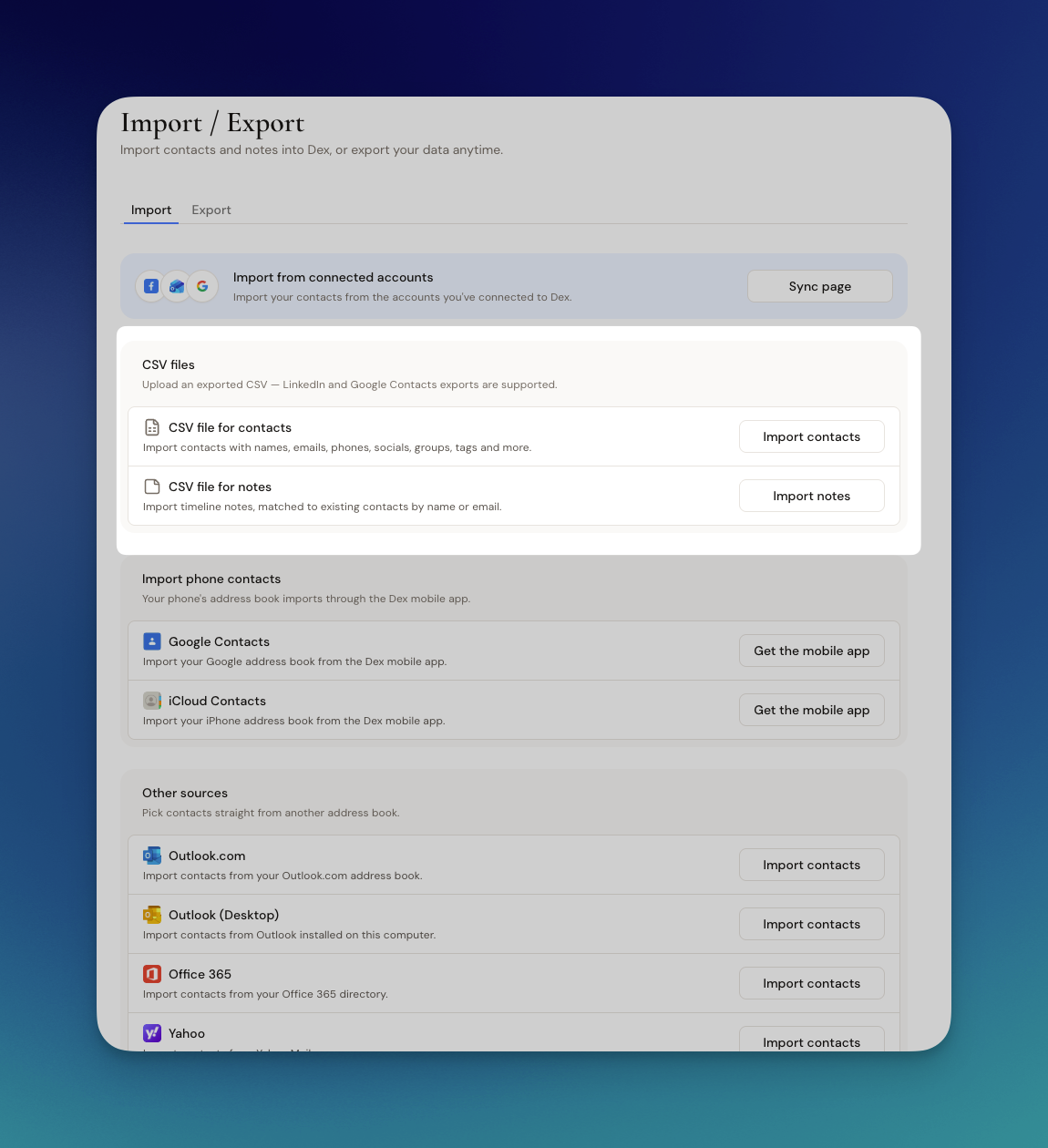
Go to the Import page
In Dex on the web, go to Settings → Workflow → Sync & Import/Export and open the Import tab. Find the 'CSV files' section and click 'Import contacts' next to 'CSV file for contacts'.
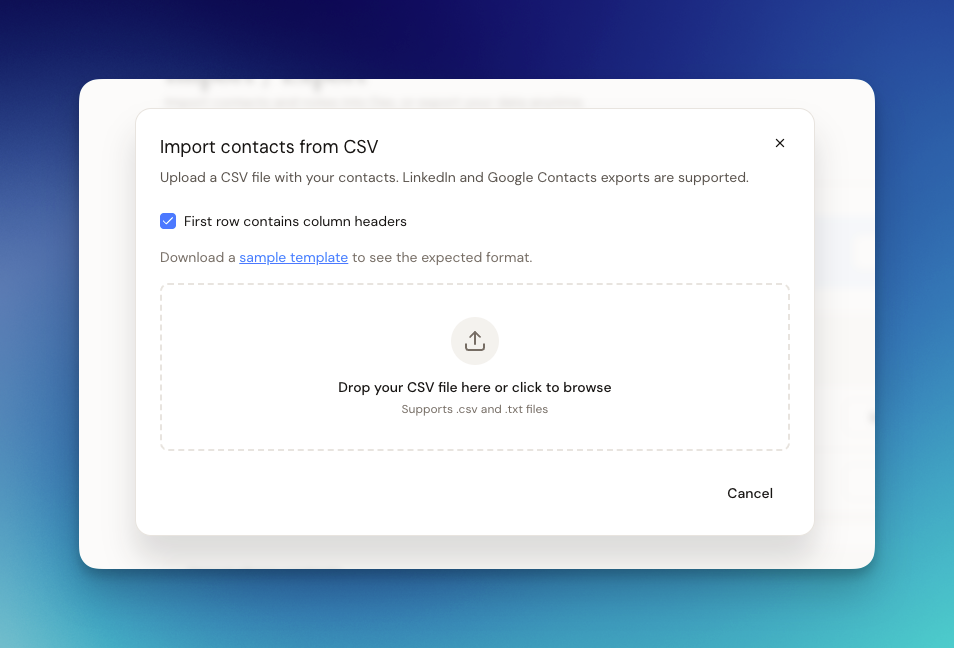
Upload the file
Drop your CSV onto the upload area, or click it to browse for the file. Leave 'First row contains column headers' checked if your file has a header row.
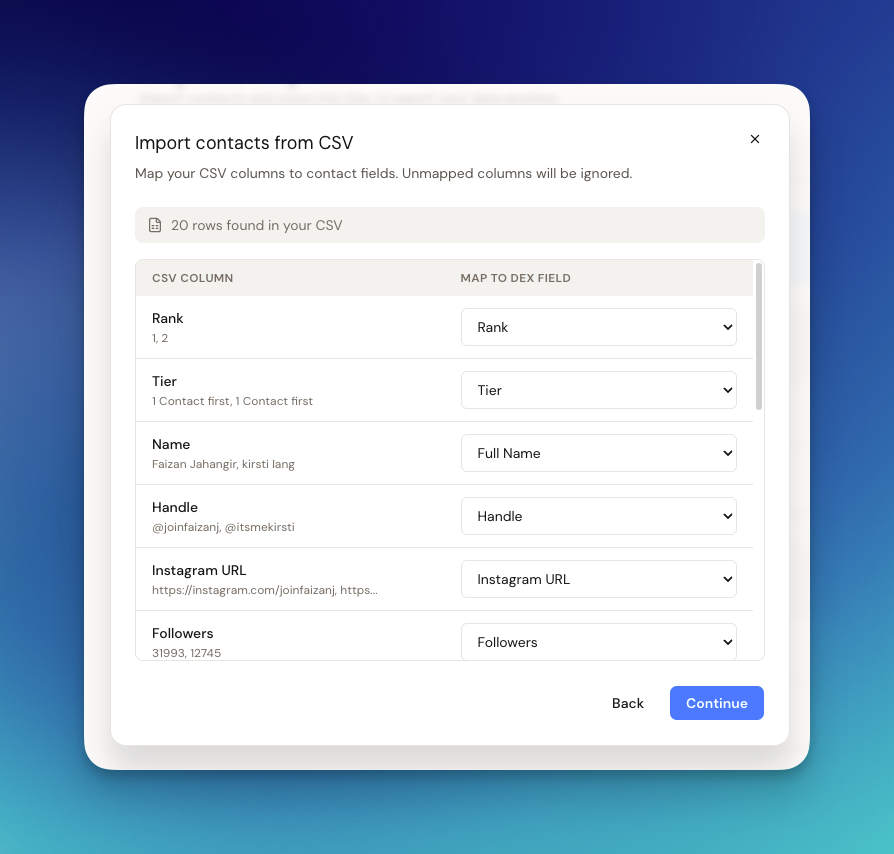
Assign the headers
Dex lists every column it found in your file and pre-selects the Dex field it thinks each one belongs to. Check the matches, correct any that are wrong from the dropdowns, and leave a column unmapped if you don't want it imported. Click 'Continue' when the mapping looks right.
Columns that don't match a Dex field become new custom fields. Dex lists them on the next screen so you can rename them, change their type, or skip the ones you don't want.
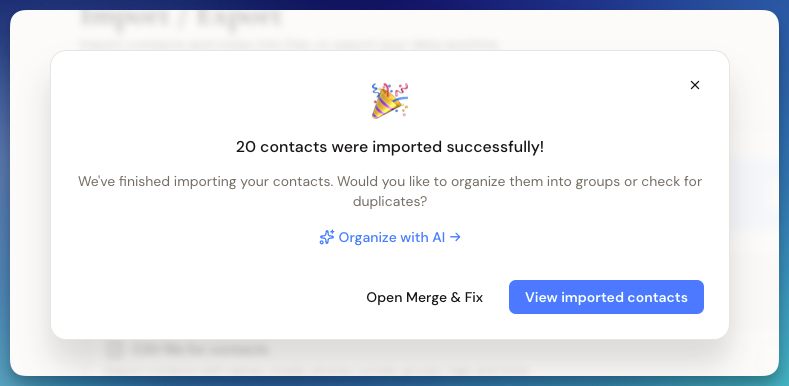
Complete the process
Dex confirms how many contacts were imported. From there you can view the imported contacts, use Organize with AI to sort them into groups, or click 'Open Merge & Fix' to clean up duplicates.
CSV Schema/Format
If you're downloading from another tool, we recommend the following basic header format for CSV files:
- Name
- Title
- Description
- Phone
- Company
- Education
- Tags
- Group
- You can add multiple groups by separating them with a comma or ':::' string.
- Birthday
- Use common formats, like 2/20/2000 or Feb 20
- Location
- Use a plain string value, like 'New York City' or 'SF'
- Last Interaction
- Use common formats, like 2/20/2000 or Feb 20
- LinkedIn URL
- Twitter URL
- Facebook URL
- Instagram URL
- Custom Fields
- Profile Photo
Importing Notes through CSV
Things to Know
- Notes are matched to existing contacts by name or email. If no contact matches, Dex creates one.
- The note body can be written in HTML.
Getting Started
Go to the Import page
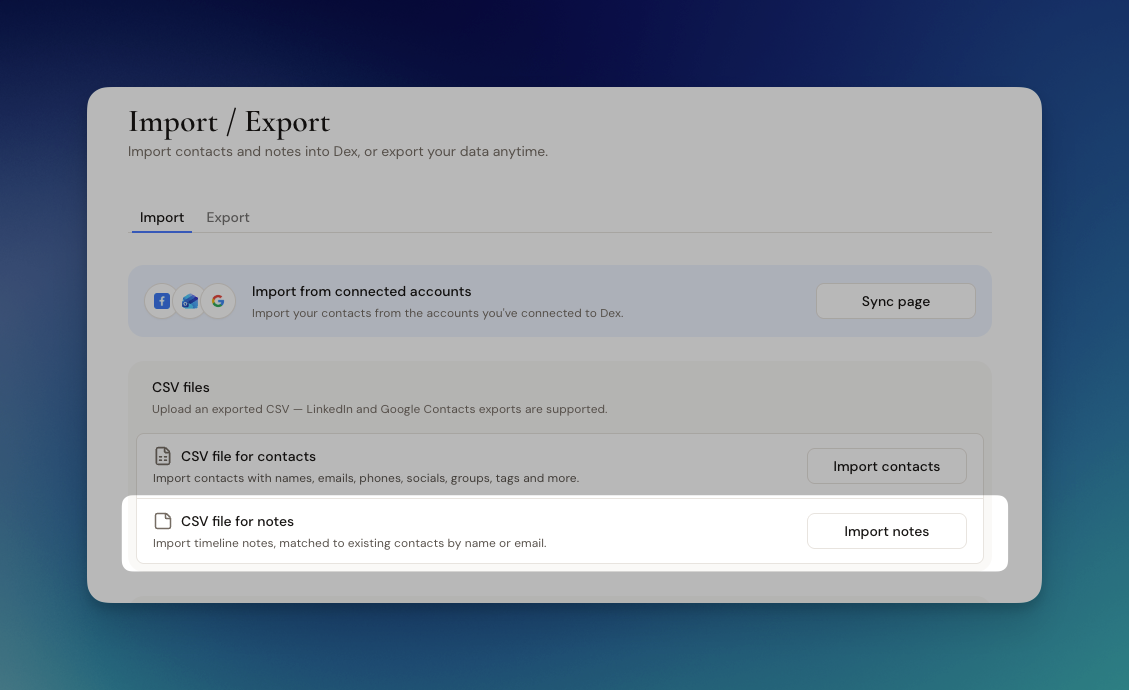
In Dex on the web, go to Settings → Workflow → Sync & Import/Export and open the Import tab. Click 'Import notes' next to 'CSV file for notes'.
Upload the file
Drop your CSV onto the upload area, or click it to browse for the file.
Assign the headers
Match each Dex field to the matching column in your file, then click 'Continue'.
Expected columns
- Full Name — the contact's full name, used to look up the contact (required)
- Email — optional, also used for contact lookup. If no contact matches, Dex creates one.
- Note — the note content (required)
- Date — when the note was created (optional)
Review and import
Dex shows how many notes it's ready to import and which contact each one will be attached to. Check the list, then click 'Import Notes' to finish.
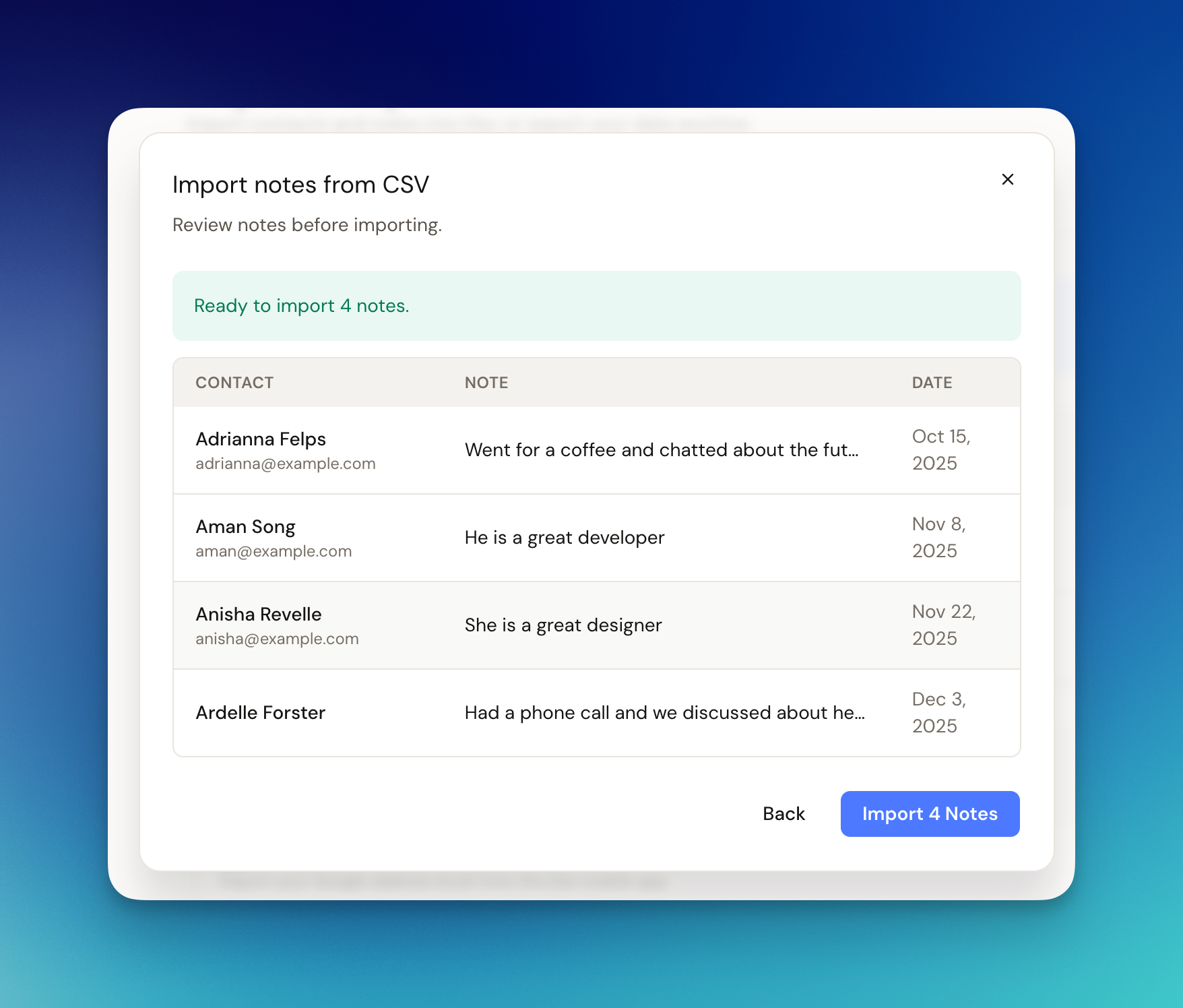
Once the import finishes, the notes appear on each contact's timeline, dated to the 'Date' column where you provided one. If any notes landed on a newly created contact, you can tidy those up on the Merge and Fix page, under Contacts in the sidebar.