The Real Estate Agent's Guide
Your CRM is for leads. This guide is for people: how to build a sphere-of-influence database, keep past clients warm for a decade, work referral partners and agent-to-agent referrals, and run it all in 20 minutes a week.

Introduction
Your CRM is for leads. This guide is for people.
Most agents already pay for a CRM: Follow Up Boss, kvCORE/BoldTrail, Lofty, Wise Agent. Those tools are very good at one job, converting new leads. Portal integrations, round-robin routing, speed-to-lead texting, drip campaigns for strangers who filled in a form at 11 p.m.
But that is not where most listings come from. In NAR's 2025 Profile of Home Buyers and Sellers, 66% of sellers found their agent through a referral or went back to an agent they had worked with before (NAR, 2025 Profile of Home Buyers and Sellers). Two out of every three listings start with someone who already knows you, or someone who knows someone who does.
Those people are your sphere of influence (SOI), your past clients, and your referral partners. And inside a lead CRM they get buried under pipeline stages and drip campaigns. Past clients get a generic newsletter and a holiday card, and then the agent loses them to whoever texted last.
This guide is the playbook for that other half of the business: how to build the database, what to send and when, how to work lenders, inspectors, attorneys and other agents, and a weekly routine that keeps it all running in about 20 minutes.
Why This Guide?
A Note from the Team at Dex
We're a small team on a mission to help people build and manage meaningful relationships. Over the past seven years we've built Dex, a personal CRM that organizes how individuals maintain their networks, without the overhead of a sales CRM or the chaos of contacts scattered across a phone, three email accounts, and a drawer of business cards.
Real estate agents turned up in our user base earlier than we expected, and for a consistent reason. Their brokerage already gave them something to catch leads. Nothing they had was built to hold a relationship for the decade between one closing and the next. The frustration was always the same: the guilt of knowing they should have called, no system that made calling easy, and a slow drift where a client who loved them at closing forgets their name by year four.
This guide is the practical version of what we've learned from those agents. Whether you're two years in with forty past clients or fifteen years in with six hundred, you should be able to set it up this weekend.
Tip: Nothing here asks you to cancel your lead CRM. Keep it for leads. This is the layer it doesn't cover: the people who already know you.
Why Your Lead CRM Isn't a Relationship CRM
'Your network is your net worth.'
- Porter Gale
A lead CRM is organized around where a lead sits in a funnel: new, contacted, showing, under contract, closed. Once a deal closes there is no stage left, so the contact drops into a nurture campaign and becomes one of hundreds of people getting the same monthly email.
A relationship CRM is organized around a person and how long it has been since you talked. That shape does four jobs a funnel can't:
A cadence per person. Top referral partners monthly, past clients quarterly, the wider sphere twice a year. The software tracks who is due.
Dates that matter to them. Closing anniversaries, birthdays, a kid leaving for college. Each one is a reason to reach out that isn't a pitch.
Context at the moment you reach out. When the reminder fires, the note that they wanted a bigger yard is on the same screen.
Capture without typing. Conversations from email, calendar, LinkedIn and messaging land on the person's timeline on their own, so the history doesn't depend on what you remembered to log at 9 p.m.
Why it matters more since the NAR settlement
Since August 17, 2024, agents working with buyers must sign a written agreement before touring a home, and offers of compensation can no longer appear on the MLS (NAR). Compensation is now a conversation you have up front, which means you have to show your value before the first showing, not after closing.
The easiest way to win that conversation is to not be a stranger. A buyer who was sent by a past client, or who remembers you from their parents' sale, has already seen your work. A warm sphere is the cheapest source of business an agent has, and after the settlement it is also the easiest one to close.
Use both, with one handoff rule
Keep your lead CRM for new inquiries and active deals. Let a relationship CRM own the person after closing. The rule that makes this work: closing hands the contact over. If the same client lives in both systems with no owner, both copies go stale.
Lead CRM (Follow Up Boss, BoldTrail, Lofty, Wise Agent): portal leads, routing, speed-to-lead, action plans, deal stages, transaction checklists.
Relationship CRM (Dex): past clients, sphere, referral partners and other agents: cadences, anniversaries, notes, and who knows whom.
Automate the handoff. If your lead CRM or transaction software can start a Zap when a deal closes, Dex's Zapier integration (Professional plan) can handle the handoff: create or update the client in Dex, add them to Past Clients, and fill in their Close Date. Dex matches contacts on email, so map the client's email into the step and you won't end up with duplicates.
Your sphere also belongs to you, not your brokerage. If it lives only in a company system, changing firms can cost you the relationships you spent years building. Keep your own copy from day one.
Building Your SOI Database
Right now your sphere is fragmented. The brokerage CRM has leads. Your phone has clients. Gmail has the lender and the inspector. LinkedIn has the people from your last career. There's a spreadsheet of buyers from the team you left and a stack of open-house sign-in sheets. Step one is getting all of it in one place.
Step 1: Import everything
Phone contacts. This is where most past clients actually live.
Email and calendar. Current and old accounts. Syncing them also backfills the history of who you've been talking to.
Texts and calls. Most client conversations happen by text, not email. WhatsApp sync and iMessage sync (beta, which also covers SMS) update each person's last-contact date, so a text to a past client counts as a touch. On a Mac, Phone Call Sync does the same for your call history.
LinkedIn. Former colleagues, classmates and everyone from your previous industry. Dex imports connections and flags job changes, which are often the first sign someone is about to move.
Past transactions. Export a CSV of closed deals from your transaction software or old brokerage (names, address, close date, price) and bring it in with CSV import.
Business cards and sign-in sheets. The card scanner in the Dex mobile app reads a card, fills in the contact and keeps a photo of the card on file. You can scan a whole stack back to back after a broker open or a networking night. Type up the sign-in sheets worth keeping, or put them in a spreadsheet and import that.
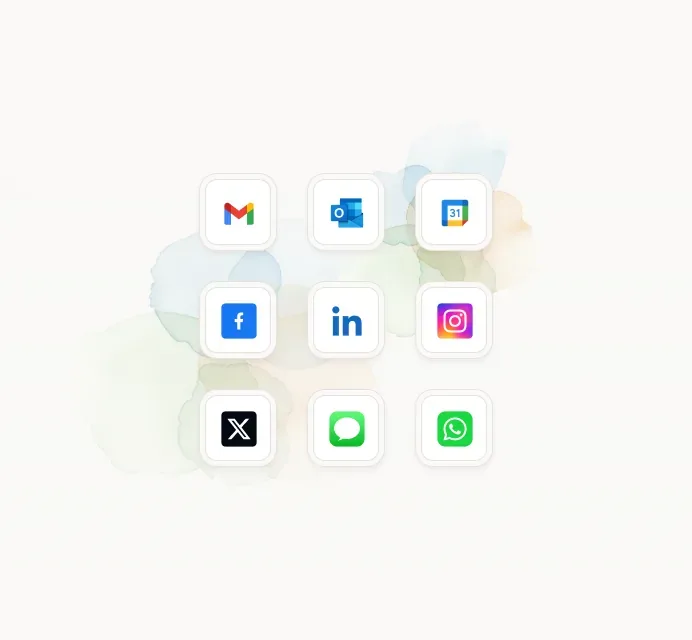
Image: Dex syncs Gmail, Outlook, Google Calendar, LinkedIn, Facebook, Instagram, X, iMessage and WhatsApp into one contact list
Then merge duplicates, fix what you can, and stop when it's good enough to work with. Budget three to five hours. It's the least glamorous weekend of your year and the one that pays for a decade.
Step 2: Tag and group
Use groups for who someone is to you, and tags for everything you'll want to filter by later. A structure that works for most agents:
Groups: Past Clients, Sphere, Referral Partners, Agent Network, Farm: [neighborhood].
Tags: buyer / seller, close year, referral source, 'likely mover', and a market tag for out-of-area agents (e.g. 'market: Denver').
Do this once and every list in this guide becomes a filter you already have. The just-listed email goes to "Farm: Hillcrest." The Denver referral goes to whoever is tagged "market: Denver." The spring check-in goes to past clients tagged with a close year of 2021 or earlier.
Step 3: Add the context (the note is the asset)
A name and a number is not a relationship. What makes year eleven work is the detail you wrote down in year one. For past clients, create a Close Date custom field (Dex supports date fields) so every house-iversary can be found and reminded, and add a short note:
Example: 'Closed 4/12/26, 118 Marlow. Wanted a yard, gave it up for the Hillcrest schools. Said they'd move again once the youngest is out. Lender was Dana at Pinebank. Golden retriever, Auggie. Referred by the Parks.'
Thirty seconds after closing. Six years later that note is the difference between 'Hi, just checking in!' and 'How's Auggie, and is the youngest nearly done at Hillcrest?'
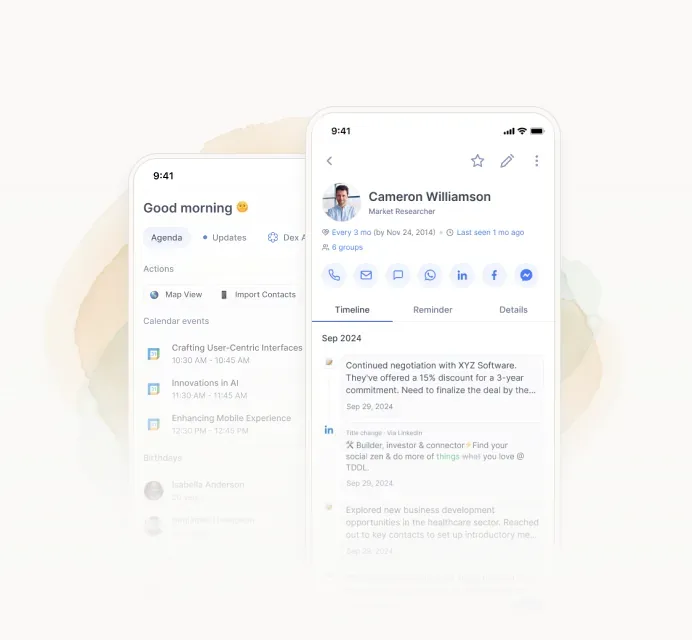
Image: The Dex mobile app with the home agenda and a contact's timeline of notes, LinkedIn job changes and last-seen date
On your phone, the note and the timeline are a tap away in the driveway before a showing, which is when you actually need them.
Second-career agents: your old industry is your sphere. The nurses, engineers or teachers you worked with for fifteen years are people who already trust you. Our guides on Networking After 40 and Career Pivots cover how to reconnect with that network without it feeling like a sales call.
The Past-Client Touch Plan
Sellers in NAR's 2025 Profile had owned their homes for a median of 11 years before selling (NAR). The job isn't staying top of mind for a month. It's still being their agent a decade from now.
Many agents learned the '33 touch' system from Gary Keller's The Millionaire Real Estate Agent: 33 contacts a year with everyone in your database. The weakness is that most of those touches end up being mailers and newsletters that look like every other agent's. The personal version keeps whatever automated marketing you already send and adds six to eight touches a year that only you could have sent.

Image: Staying the neighborhood agent long after closing
Year one after closing
Week 1: thank-you note, handwritten if you can.
Day 30: 'How's the house?' check-in. Offer a contractor, a handyman, the good pizza place.
Day 90: check-in. This is when clients are most likely to refer, because the move is still a story they tell.
Month 6: something useful and local: a tax-assessment or homestead deadline, a seasonal maintenance reminder.
Month 12: the first house-iversary.
Every year after
House-iversary: the cleanest excuse an agent has to get in touch without asking for anything, and the one most often missed. Offer a free value update.
Birthday: a text, not an e-card.
Two personal check-ins: each referencing something from your notes.
One value drop: a comp on their street, a recommended roofer, an article about their school district.
One in-person or event touch: a client appreciation event, a coffee, a pie drop at Thanksgiving.
Setting it up in Dex
Put the Past Clients group on a 90-day Keep-in-Touch cadence and move people between cadences on a drag-and-drop board (Keep-in-Touch). A synced email or message resets the clock, so you aren't logging touches by hand. Then add a yearly repeating reminder on each client's close date for the house-iversary (reminders). Birthdays surface on their own.
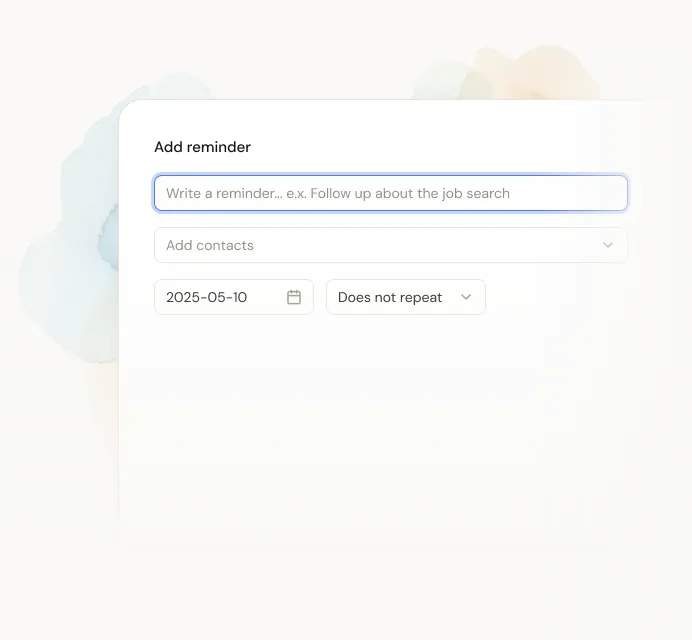
Image: Adding a reminder in Dex. Set it to repeat yearly on the close date and the house-iversary takes care of itself.
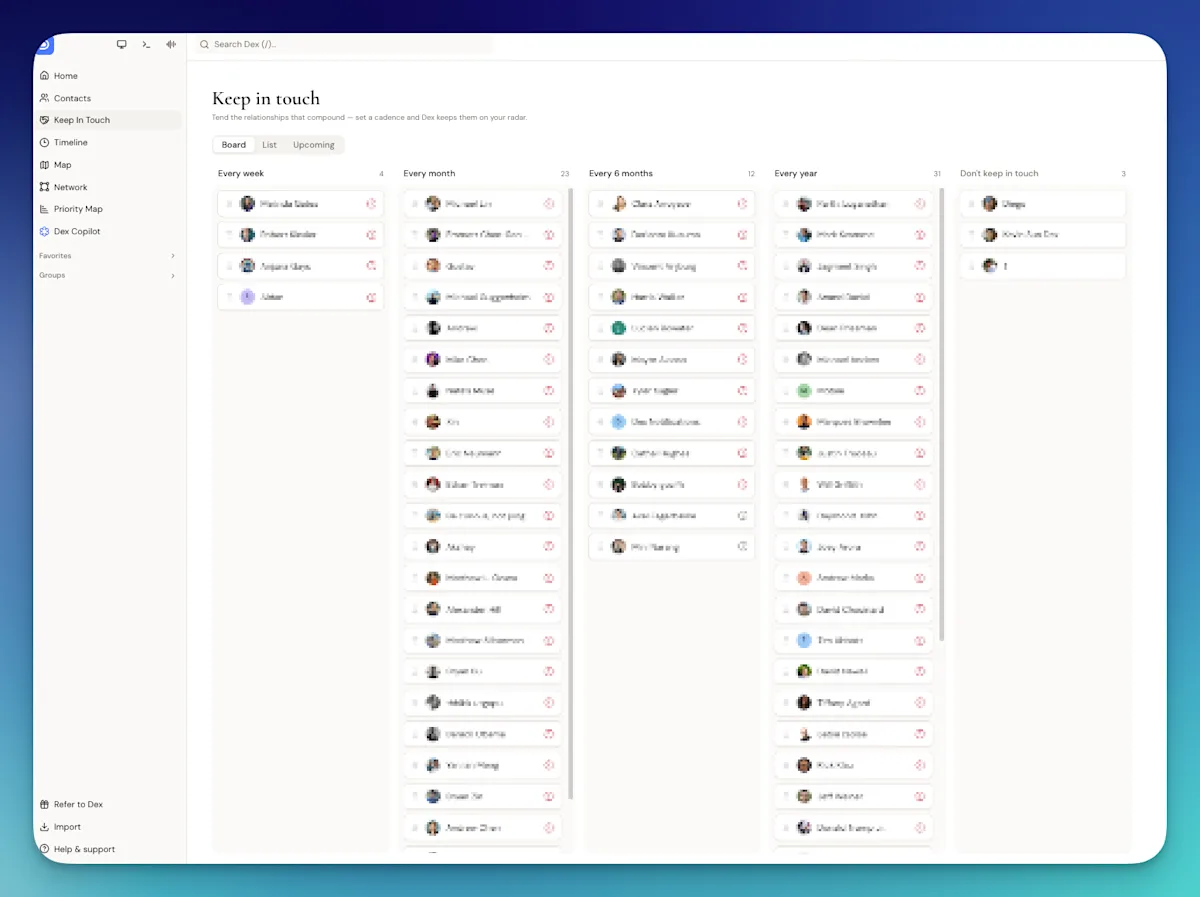
Image: Setting keep-in-touch frequencies on a kanban-style board in Dex
Referral Partners
Lenders, inspectors, real estate attorneys, title and escrow officers, stagers, contractors, transaction coordinators. These twenty to forty people touch more of your future clients than any ad you'll buy, and most of them work with dozens of agents. The ones who think of you first are the ones you actually stay in touch with.
Put them in their own group on a 30-day cadence for your top ten, 90 days for the rest.
Link partners to the clients they worked with. Related Contacts in Dex connects Dana the lender to every buyer she closed with you, so you can see who knows whom.
Log referrals in both directions. A one-line note each time ('Sent the Garcias for pre-approval, 3/2' or 'Referred the Parks, closed 5/18') tells you who actually sends business and who your clients had a good experience with.
Close the loop. When a partner sends you someone, tell them how it went. It's the most underrated touch in the business.
Keep it clean: recommend partners because your clients are well served by them, not as part of a trade. RESPA prohibits giving or taking anything of value in exchange for referring settlement-service business, and an explicit 'you send me, I send you' arrangement can cross that line. Your broker can tell you where it sits in your market.
Agent-to-Agent Referrals
Your past clients' parents retire to Florida. A buyer's sister takes a job in Denver. A seller is relocating across the country. Each of those is a referral fee if you know a good agent in that market, and a lost relationship if you don't.
Build the out-of-market network before you need it. Agents you met at conferences, coaching groups, designation courses and online communities. Put them in an Agent Network group and tag each by market.
Note what you know about how they work. Luxury or first-time buyers, responsiveness, whether you'd trust them with your best client.
Put the fee in writing. Referral fees are commonly 25% to 35% of the receiving agent's side, set in a signed referral agreement and paid broker to broker. Log the agreed fee and the outcome on the contact.
Hand the contact over properly. Once your client agrees to the intro, Share Contacts sends the receiving agent their name, email and social profiles straight from Dex, whether or not that agent uses Dex. Phone numbers, addresses and birthdays aren't shared, so put the number in your intro email.
Stay in touch with the client anyway. They're still your past client, and they'll move again. Keep them on the cadence.
Touch your agent network twice a year so a referral isn't the first time you've spoken since the conference.
Farm-Area Prospects
A farm is a neighborhood you want to be known in. Postcards get you recognized; relationships get you listings. The people you meet at open houses, neighborhood events and your own listings are the start of a sphere in that area.
Group by area. One group per farm ('Farm: Hillcrest'), including past clients who live there.
Follow up on open houses within 48 hours with a note that shows you listened: the neighbor curious about their own value, the renter who wants to buy next year. Follow your state's and the national do-not-call rules.
Use the map. Dex's map view plots contacts by address, so when you take a listing you can see which past clients and farm contacts live within a few streets before you send the just-listed note.
Send the just-listed note in one pass. On the Professional plan, Mail Merge sends a personalized email to up to 200 contacts from your own Gmail or Outlook. Select the farm group, write the note once, let Dex add an AI-written line for each person, and read every email before it goes. The same works for client-appreciation invites and a year-end market note. It's email only; texts still go one at a time.
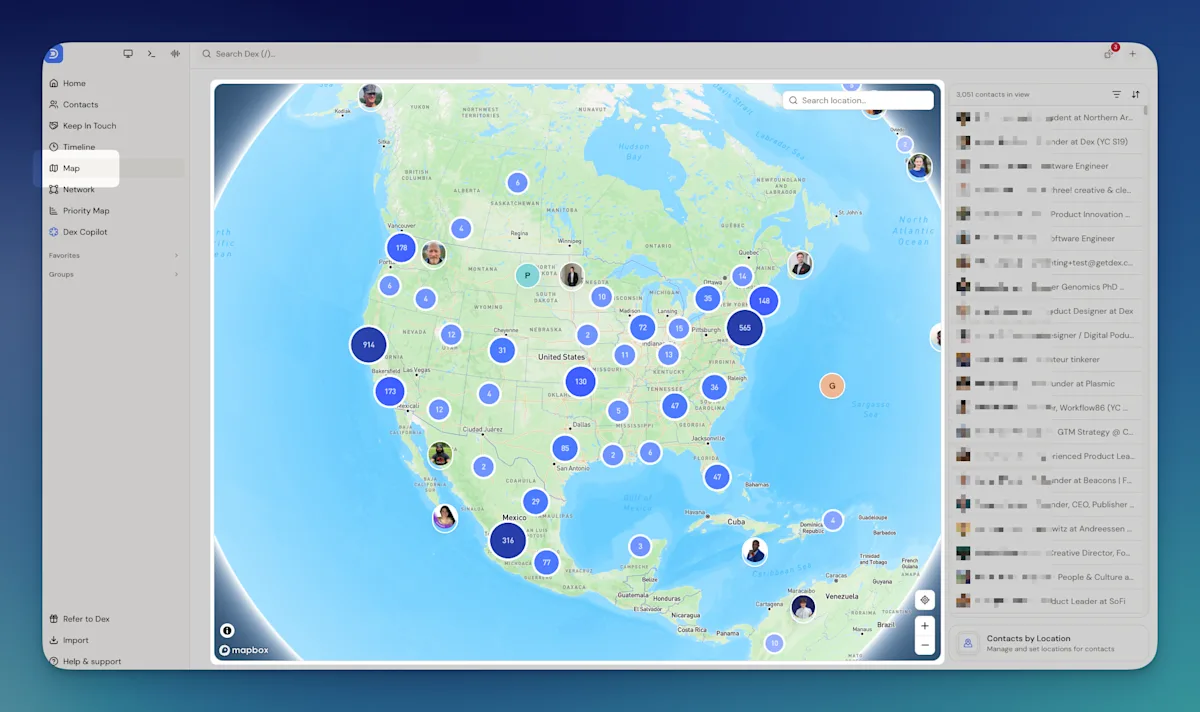
Image: Map view in Dex
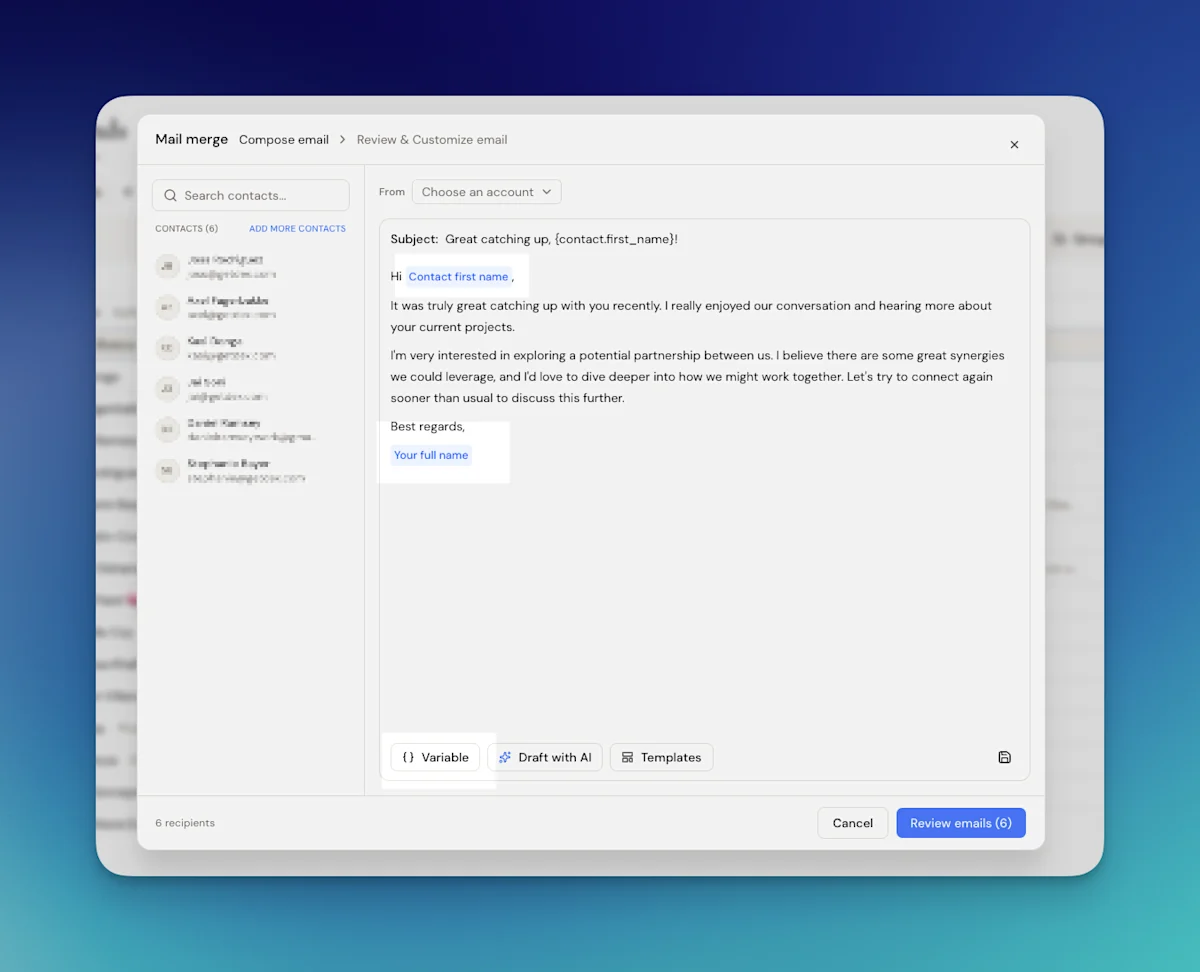
Image: Mail Merge in Dex: one email with first-name variables, sent from your own account to a whole group
The Weekly 20-Minute Routine
Good intentions don't survive a closing week, and memory doesn't scale past about a hundred and fifty people. The sphere has to run on a routine, and the routine has to be short enough that you actually do it. Block 20 minutes at the same time every week, Monday morning for most agents, and treat it like a listing appointment.
See who's due (3 minutes). Open the week's Keep-in-Touch list plus any house-iversaries and birthdays coming up.
Send the past-client touches (10 minutes). Start from a template, then change one line using the note on their profile. Most take under a minute.
One referral partner (3 minutes). A thank-you, a closed-loop update, or a coffee invite.
Log the week (2 minutes). Anything you learned at showings or closings goes into notes. Tag anyone who mentioned a move as a likely mover and pull them onto a shorter cadence.
One earned referral ask (2 minutes). Only to someone who just thanked you, just had a good experience, or just told you about a friend who's thinking of moving.
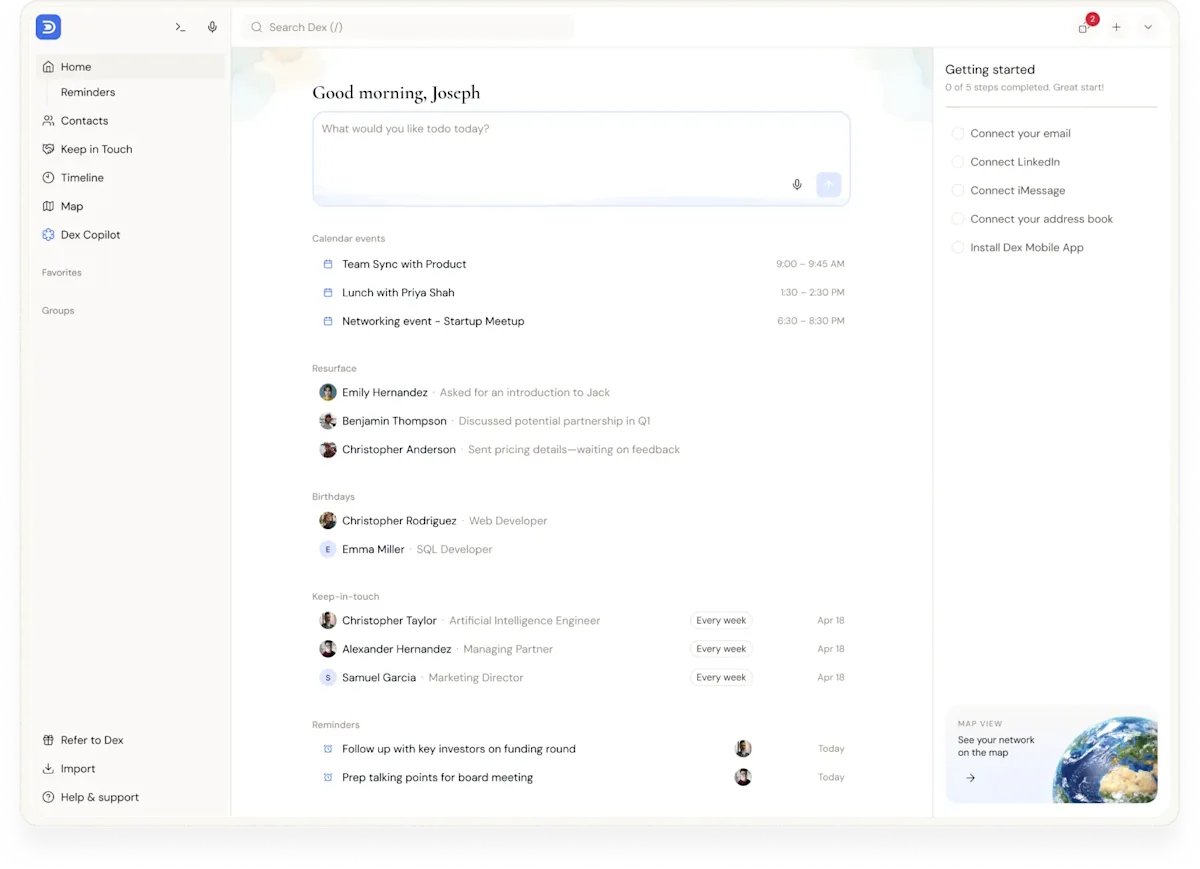
Image: The Dex home screen lists today's calendar events, birthdays, Keep-in-Touch contacts and reminders in one place
Between sessions, Dex's daily digest (by text or WhatsApp) tells you who's due that day, and you can text Dex a note from the car after a showing instead of typing it later. On Professional, voice mode lets you just say it: "Add a note to Maya Chen: her sister is relocating to Denver in the spring."
Two AI features make the routine faster. Dex Copilot answers questions about your database in plain English, such as "who do I know in Hillcrest that I haven't talked to in six months?" And when you're stuck on the first line of a check-in, AI Assist suggests openers based on your notes, past meetings and recent emails with that person.
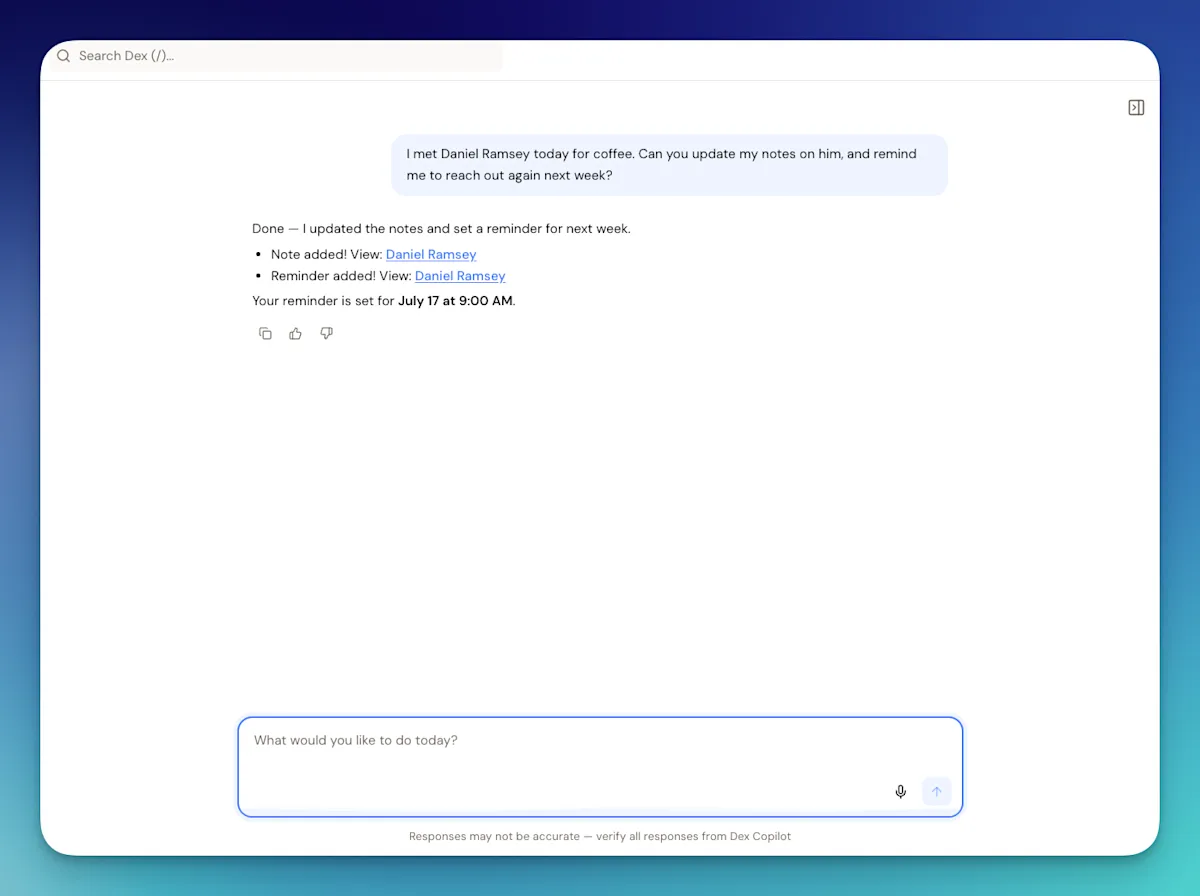
Image: Dex Copilot logs a note and sets a follow-up reminder from one plain-English request
If you have more than about 200 past clients, 20 minutes won't cover every quarterly touch: split it into two sessions, or move the wider sphere to twice a year.
What that adds up to: across the eleven years the median seller stays put, a quarterly cadence is about 44 real conversations with each past client before they list. The agent who had those conversations is the one who gets the call.
Before Every Listing Appointment
A seller who came to you through a past client expects you to remember that connection, and a lender you're meeting for coffee will notice if you've forgotten the last deal you did together. Three Dex features cover the five minutes before you walk in:
Pre-meeting brief. With Google Calendar connected, Dex emails you about 10 minutes before a small meeting (up to four people, including you) with each attendee's recent emails, past meetings and your notes on them. It's in beta, and it only works when the attendee's email address is on their Dex contact (Pre-Meeting Brief).
Dex Research. Run it on a new seller or a referral partner you've just been introduced to and you get a short briefing: background, current role, and what's changed since you last spoke. Premium includes 10 research credits a month and Professional 20 (pricing).
Related Contacts. Check who referred them and which of your partners they already know, so you know who to thank when you win the listing.
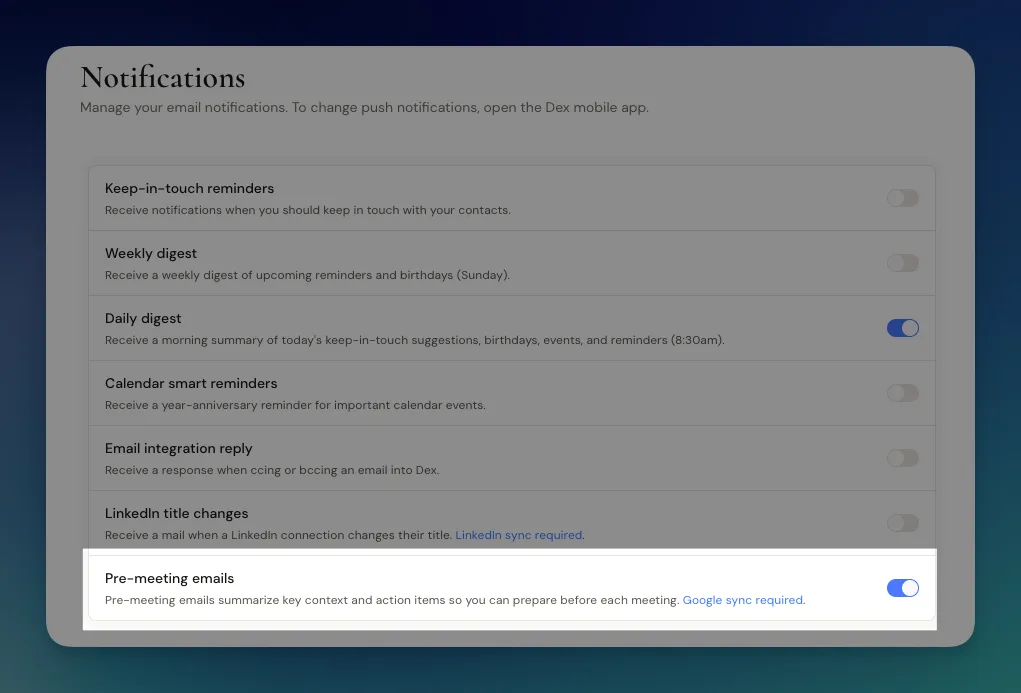
Image: Pre-meeting emails and the 8:30 a.m. daily digest are switched on under Notifications in Dex settings
Templates: Check-In, House-iversary and Referral-Ask Scripts
Use these as starting points. The line that makes each one work is the one you change using your notes.
Check-in
Text: Hi Maya, it's Jordan. Drove past Marlow Street today and thought of you two. Did the new fence ever get finished? Hope Auggie's enjoying it.
Email: Subject: Quick hello from Jordan. Hi Maya and Sam, it's been a few months and I wanted to say hi. Last time we talked you were thinking about finishing the basement. Did that happen? If you need a contractor, I've got two I'd send my own family to. Nothing else, just hope the house is treating you well.
House-iversary
Text: Happy house-iversary, Sam and Priya! Two years ago today you got the keys to 118 Marlow. Hope it feels like home. If you're ever curious what it's worth now, I'm happy to pull the numbers, no strings.
Email: Subject: Two years at 118 Marlow. Hi Sam and Priya, it's two years to the day since closing, and I still remember you two measuring the backyard with your phones. Three homes on your street sold this year; if you'd like a quick value update, reply and I'll send one over. Happy house-iversary!
Referral ask
Text: Thanks so much for the kind words, Maya. It honestly made my week. Most of my business comes from clients like you, so if anyone you know starts talking about buying or selling, I'd be grateful for an intro. I'll take good care of them.
Email: Subject: A small favor. Hi Maya, working with you and Sam was one of the highlights of my year. I build my business almost entirely on referrals, so here's my one ask: if a friend, coworker or family member mentions moving, would you pass along my name? I'll give them the same attention you got, and I'll let you know how it goes.
Referral partner and agent-to-agent
Partner thank-you (text): Dana, the Parks closed yesterday and they couldn't stop talking about how easy you made the loan. Thank you for taking such good care of them.
Outgoing agent referral (email): Subject: Referral: relocating buyers to Denver. Hi Chris, my past clients the Garcias are moving to Denver in March. First-time buyers, looking in Wash Park or Platt Park, around $750K. I've told them you're the person I trust there. I'll send over our standard referral agreement; can you reach out to them this week?
One Past Client, Eleven Years in Dex
Here's how the system plays out for one client. Maya and Sam closed on 118 Marlow through you, with Dana at Pinebank as their lender.
Closing day. The deal closes in your lead CRM, and a Zap adds Maya and Sam to Past Clients in Dex with the Close Date filled in. You spend thirty seconds on the note: the yard they gave up, the Hillcrest schools, Auggie, Dana, the Parks who referred them. Then you set a yearly reminder on the close date.
The first 90 days. A one-off reminder brings up the day-30 check-in. After that, the 90-day Keep-in-Touch cadence takes over. When Maya texts you back asking for a fence contractor, iMessage sync resets the clock, so you never log the touch yourself.
Every April 12. The house-iversary turns up in your morning digest. Their profile shows the note, so the text mentions Auggie and the fence, not just "Happy anniversary!"
Year three. Sam's LinkedIn title changes and Dex flags it. That's a reason to send congratulations, and a promotion is sometimes the first sign of a move-up buyer. Tag them "likely mover" and shorten the cadence.
Year five. Over coffee, Maya mentions her sister is moving to Denver. You tell Dex from the car. Back at your desk you search for "market: Denver," find Chris, and send the intro and the referral agreement that afternoon.
Year eight. Maya's neighbor calls about listing. You linked the two in Related Contacts when Maya made the intro, so you remember to thank her before the appointment. The appointment is on your Google Calendar, so the pre-meeting brief with your notes on the neighbor lands in your inbox about ten minutes before you knock.
Year eleven. The youngest finishes at Hillcrest, which is exactly when your note from closing day said they'd move. You've had about 44 conversations with them by now. They don't interview three agents.
At no point did you keep a spreadsheet or spend a Sunday night on data entry. Synced email, calendar, texts and calls kept each last-contact date current. The home screen and daily digest told you who was due and whose house-iversary was coming up, and the closing-day note gave you the one line that made each message theirs. If you switch brokerages in year six, nothing gets left behind, because the contacts live in your own Dex account rather than the company's system.
Where Dex Fits
Dex is a personal CRM built around the relationship rather than the deal. It pulls contacts and conversations from Gmail, Outlook, Google Calendar, LinkedIn, iMessage, WhatsApp and more (integrations), merges them into one timeline per person, and puts a Keep-in-Touch cadence on the people who matter. Everything in this guide maps to a feature: import, the card scanner, and text and call sync for building the SOI database; custom date fields and yearly reminders for house-iversaries; Related Contacts and Share Contacts for partners and referrals; map view and Mail Merge for your farm; pre-meeting briefs and Dex Research for listing appointments; the daily digest, Copilot and voice mode for the weekly routine. See how Dex works as a real estate CRM for your sphere.
Where Dex stops: no lead routing, IDX website, drip campaigns, transaction management or dialer. That's what your lead CRM is for, and you should keep it.
Running a team? Dex is built for one agent's own network. Rolodex, from the same team, puts everyone's contacts in a shared workspace and shows when a teammate has already reached out, so two agents don't call the same past client in the same week.
Pricing: Premium is listed at $12/month. Professional is $20/month and adds Mail Merge, voice mode, Zapier and Outlook sync. Both have discounts for quarterly and annual billing and a 7-day free trial (a card is required to start it, and you aren't charged until it ends). Comparing tools more broadly? See Finding the Right Personal CRM.
Conclusion
Two out of three sellers pick an agent they were referred to or have worked with before. Those relationships pay out slowly, often a decade after the first closing, and nothing about a lead-conversion CRM is designed to keep them warm that long.
You don't need to become a better marketer. You need one place that holds every past client, partner and agent friend with real context attached, a cadence that tells you who is due, and 20 minutes a week you actually protect. Small, regular contact compounds. Occasional bursts don't.
The listings that will define the next decade of your business are sitting in houses you already sold. Import your sphere this weekend, set this year's house-iversaries, and send four short notes on Monday. Start your free 7-day Dex trial.
Frequently Asked Questions
How do real estate agents build a sphere of influence database?
Import every source into one place: phone contacts, email and calendar, LinkedIn, past-transaction exports and open-house sign-ins. Merge duplicates, sort people into groups (past clients, sphere, referral partners, agent network, farm) and add a short note plus a close date for each past client. Most agents can do this in a weekend.
How often should real estate agents contact past clients?
A personal touch every quarter, plus the house-iversary and birthday, works for most agents, with extra check-ins in the first year after closing. With sellers staying in a home a median of 11 years, consistency over a long stretch matters more than intensity right after closing.
What is a house-iversary?
The anniversary of a client's closing date. It's a natural, no-ask reason to get in touch every year, and a good moment to offer a free home value update. Store the close date on each contact and set a yearly repeating reminder.
How do I ask past clients for referrals without being pushy?
Ask when it's earned: right after a client thanks you, praises your work, or mentions a friend who's thinking of moving. Keep it to one sentence, make it about taking care of the person they refer, and don't ask the same person more than once or twice a year.
Can I use a relationship CRM alongside Follow Up Boss or my brokerage CRM?
Yes, and most agents should. Let the lead CRM handle new inquiries and active deals, and let the relationship CRM own the person after closing. Decide that closing hands the contact over so you don't end up with two stale copies.
Can Dex track my texts and calls with clients automatically?
Partly. WhatsApp sync and iMessage sync (beta, which includes SMS) update each contact's last-contact date, so a text counts toward their Keep-in-Touch cadence without you logging it. Phone Call Sync does the same for calls, but only through the Dex desktop app on a Mac. Dex keeps the latest message on each contact, not the full conversation, so important details still belong in a note.
How do agent-to-agent referral fees work?
The referring agent receives a share of the receiving agent's commission, commonly 25% to 35%, agreed in a signed referral agreement and paid broker to broker. Check your brokerage's policy and your state's rules before sending or accepting one.
Further Reading
The Millionaire Real Estate Agent by Gary Keller (2004). The source of the 33-touch system and the standard text on treating your database as the engine of the business.
Never Eat Alone by Keith Ferrazzi (2014). Generosity and consistent follow-up as the mechanics of a durable network.
Give and Take by Adam Grant (2013). Why givers build the strongest networks over a long career.
Related reading: Networking After 40 · Career Pivots · Finding the Right Personal CRM · Dex vs Cloze