Dex vs Orvo: best AI personal CRM in 2026?
We compared Dex and Orvo across integrations, AI tools, pricing, and mobile access. Here's which personal CRM fits your workflow.


Dex and Orvo both show up when you search for personal CRMs, but they're not quite the same category of tool. Orvo describes itself as relationship management software for individual professionals, not exactly a personal CRM, and not a sales tool. Orvo describes itself as a personal CRM that goes further: stakeholder intelligence, meeting prep, and relationship tracking built for navigating professional relationships at work.
Dex is more squarely a personal CRM. It pulls your contacts and interactions from multiple platforms like LinkedIn, Gmail, and your calendar automatically, so your personal CRM fills itself. Orvo wants you to record voice notes after meetings and build up relationship context over time, with AI that turns that context into meeting briefs and follow-up prompts.
If your network lives on LinkedIn and email, Dex is the better fit. If you're managing stakeholders at work and want a system built around that, Orvo has a real argument. Here's the full breakdown.
Category | Dex | Orvo | Who wins |
|---|---|---|---|
Starting price | $12/mo (Premium) | $19/mo (Pro) | Dex |
LinkedIn sync | Yes (up to 9,000 connections) | No | Dex |
Gmail/Outlook sync | Yes (auto-logs interactions) | Yes (email sync on paid plans) | Dex (auto-log vs sync) |
Calendar sync | Google Calendar + Apple Calendar | Yes (on paid plans) | Tie |
AI voice capture | No | Yes (40h/mo on Pro, unlimited on Business) | Orvo |
AI meeting prep | Yes (pre-meeting briefs) | Yes (relationship context briefs) | Tie |
AI email drafting | Yes (AI Assist) | Yes | Tie |
Network visualization | No | Yes (hierarchy/org map) | Orvo |
Mobile app | iOS + Android (native) | Web-based, no native app | Dex |
Free tier | Yes | 14-day trial only | Dex |
Social imports | Facebook, Instagram, X, iCloud | Dex (more platforms) |
Why does LinkedIn sync matter so much in a personal CRM?
For most professionals, LinkedIn is where the network lives.
Orvo has no LinkedIn integration. No contact import, no connection sync, and no job change alerts. If you manage 500+ connections on LinkedIn, that's a non-starter.
Dex syncs with LinkedIn and pulls in up to 9,000 connections on the Professional plan ($20/mo). It tracks job changes too, so when a contact switches companies, that update shows up without anyone checking LinkedIn manually. For founders managing investor relationships, recruiters tracking candidates, or consultants maintaining referral networks, this one feature justifies the entire subscription.
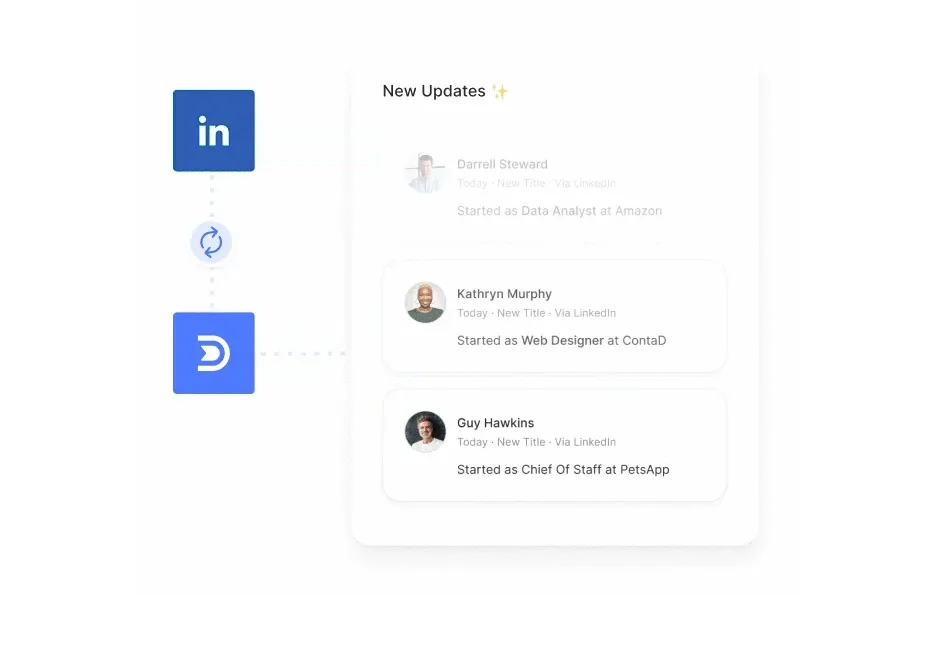
The practical math: 2,400 LinkedIn connections connected to Dex appeared in the personal CRM within a few hours, with job titles, companies, and profile photos. Doing that in Orvo would mean adding each contact by hand or through voice notes. At 30 seconds per contact, that's 20 hours of manual work to replicate what Dex did automatically.
Where Orvo actually wins: the network map
Orvo has a visual network map that shows reporting lines, team structures, and relationship connections across an organization. If you're an account executive tracking 15 stakeholders at one company, that hierarchy view helps you see that your champion reports to a VP you haven't met yet and that VP reports to the CRO who signs off on deals.
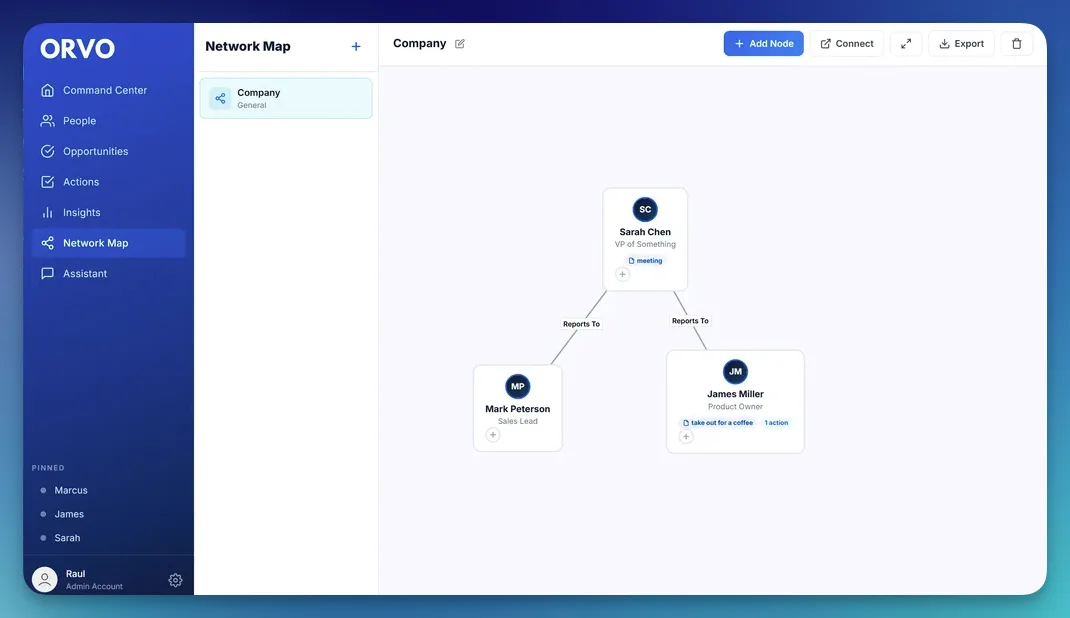
Dex has a map view too, but the two serve different purposes. Dex's map visualizes your broader personal network, who you know, how you're connected, where relationships are going cold. Orvo's is more org-chart oriented, built for understanding the internal structure of a specific company or team.
Which one matters more depends on whether you're managing a large professional network across many companies (Dex) or navigating stakeholder relationships inside a specific organization (Orvo).
How do the AI features actually compare?
The philosophy is different, and that matters more than the feature list.
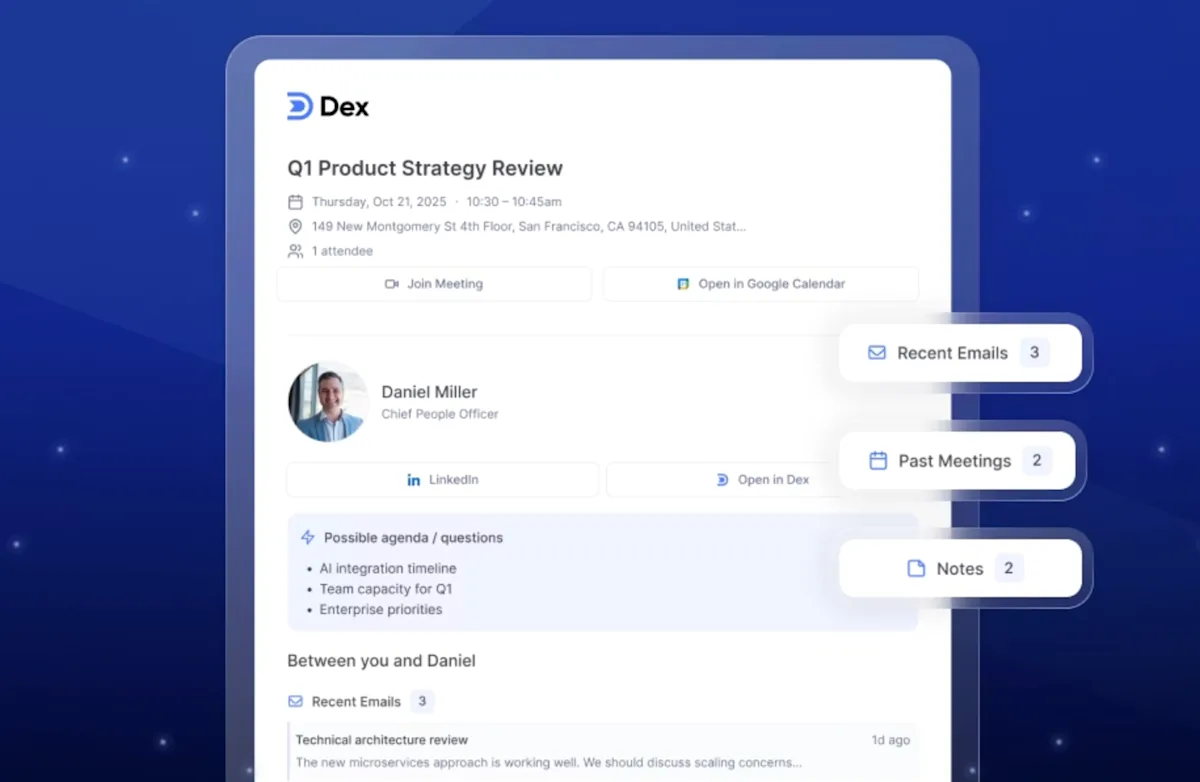
Dex's AI works in the background. It watches your email, calendar, and LinkedIn activity, then surfaces what you should know. Before a meeting, Dex compiles a brief with your shared history, last conversation, and any notes you've taken. None of this needs to be triggered. It happens because Dex already has the data from your synced accounts.
Orvo's AI responds to what you give it. Record a voice note and the AI transcribes it, extracts contact details, and drafts a follow-up. Ask for meeting prep before a call and Orvo pulls together relationship context, past notes, and open action items, what was discussed last time, and what you committed to, what to follow up on. Intelligence is good, but it only knows what you've told it. Skip logging a meeting and that interaction simply doesn't exist in Orvo.
Both tools generate pre-meeting briefs, but they're powered differently. Dex's briefs are built from data it collected automatically (emails, calendar events, LinkedIn activity) so they're populated even for contacts you've never manually touched. Orvo's briefs are built from what you've logged: voice notes, manual entries, tracked actions. Richer when you use it consistently, empty when you don't.
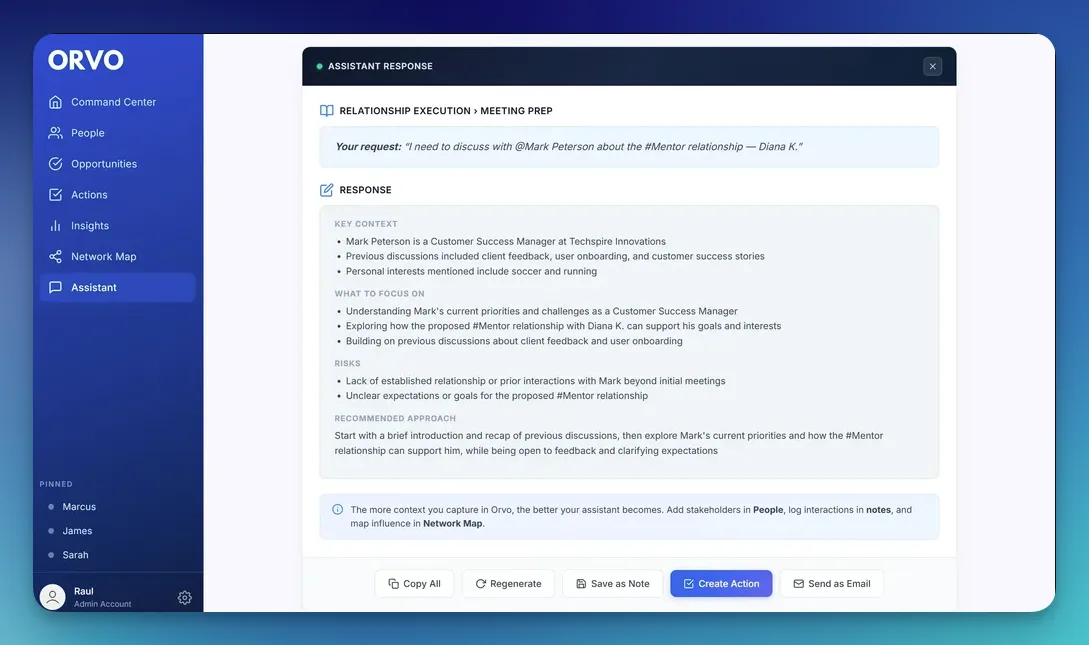
The tradeoff: Dex gives you automatic intelligence from your digital interactions. Orvo gives you richer context when you use it, because a voice note captures nuance that no email subject line can. But Orvo requires discipline, and that discipline is harder to maintain than it sounds.
How much does each tool cost per year?
Plan | Dex | Orvo |
|---|---|---|
Entry tier | $12/mo (Premium) | $19/mo (Pro) |
Full-feature tier | $20/mo (Professional) | $39/mo (Business) |
Annual cost (entry) | $144/year | $228/year |
Annual cost (full) | $240/year | $468/year |
Free option | 7-day trial only | 14-day trial only |
When should you skip Dex?
Dex is the wrong pick if your networking happens offline and you need to capture context in the moment. If you attend 3–4 conferences a month and your best contacts come from hallway conversations that never touch email or LinkedIn, Dex will miss those interactions. It only knows what it can sync.
Dex also falls short if you need to map complex organizational structures at a single account. Enterprise sales teams tracking 15 stakeholders with reporting lines will find Dex's list-and-tag approach limited compared to Orvo's hierarchy view.
And if connecting LinkedIn, Gmail, and calendar to a third-party app is a concern, Dex's entire value requires those connections. Without them, it's an empty personal CRM.
For what it's worth, Dex is SOC 2 compliant and never sells your data.
When should you skip Orvo?
Orvo is the wrong pick if you already have a large LinkedIn (and other social platforms) network and expect automatic import. You'll spend hours, possibly days, manually adding contacts that Dex would sync in minutes.
Orvo doesn't have native mobile apps (web-only as of April 2026). Recording voice notes through a mobile browser works, but it's clunkier than Dex's dedicated iOS and Android apps.
If you're not disciplined about recording voice notes, Orvo's main advantage disappears. After the novelty wears off, recording consistently is harder than it sounds. If that habit won't stick, you're paying $19–39/month for a tool you'll underuse.
Orvo is also newer with a smaller user base. Dex has 30,000+ users. Orvo's community on Reddit and independent review sites is thin. If long-term product stability matters, that's worth considering.
The bottom line
For most professionals managing a network across LinkedIn, email, calendar, and more, Dex is the better personal CRM. It costs less for what it does, syncs automatically, has native mobile apps, and connects to more platforms. The AI works in the background on data you generate by doing your normal work.
Orvo is the better pick for a specific use case: people who meet contacts face-to-face, want to capture rich context through voice, and need to map organizational hierarchies. Conference-heavy consultants, enterprise account executives, and people who genuinely enjoy recording voice notes after every interaction. If folk is also on your shortlist, see our Dex vs folk comparison.
Frequently asked questions
Does Orvo sync with LinkedIn?
No. Orvo has no LinkedIn integration as of April 2026. You can't import connections, sync job changes, or pull profile data. If your professional network lives on LinkedIn, you'll need to add contacts to Orvo manually or through voice notes. Dex syncs LinkedIn connections automatically,, including job title updates and company changes.
Is Dex or Orvo cheaper?
Dex starts at $12/month (Premium plan) and includes LinkedIn sync, Gmail sync, calendar sync, and AI features. Orvo starts at $19/month (Pro plan) with voice transcription capped at 40 hours per month. Annually, Dex costs $144 vs Orvo's $228, a difference of $84 per year.
Which personal CRM has better AI features?
Different strengths. Dex's AI is passive: it generates pre-meeting briefs, suggests follow-ups, and drafts messages based on data it auto-collects from your email, calendar, and LinkedIn. Orvo's AI is active: it transcribes voice notes, extracts contact details from recordings, generates icebreakers, and drafts personalized emails. Dex gives you intelligence without effort. Orvo gives you richer context if you put in the work.
Can I use Orvo on my phone?
Orvo works in a mobile browser but has no native iOS or Android app as of April 2026. Voice notes can be recorded through the browser. Dex has dedicated native apps for both iOS and Android.
What integrations does Dex have that Orvo doesn't?
Dex connects to LinkedIn, Gmail, Outlook, Google Calendar, Apple Calendar, Facebook, Instagram, X, iCloud, iMessage, WhatsApp, Superhuman, and Zapier. Orvo connects to email, calendar, and WhatsApp. The biggest gaps for Orvo are LinkedIn (no sync at all), social platforms, and Zapier (no workflow automation). See the full integration list here. Full integration list here.
Related guides