
Networking as an Introvert
A relationship-first framework for introverts who want to build a powerful network without draining themselves or pretending to be someone they're not.
If you're reading this, you already know that networking isn't just about collecting business cards or attending every mixer on the calendar. You understand that real professional success comes from meaningful connections, but the traditional networking playbook doesn't work for everyone.
Here's the truth that most networking advice misses: introverts actually have a networking advantage. Research shows that 85% of job vacancies are filled through networking and referrals, yet the conventional approach. Crowded rooms, constant small talk, surface-level interactions might feel draining and inauthentic for introverts. But science reveals a different story.

Studies demonstrate that introverts possess a 37% advantage in accurately understanding others' positions and needs during conversations. You naturally excel at the deep, one-on-one connections that lead to lasting professional relationships. While extroverts often spread themselves thin across surface-level interactions, introverts build networks that consistently outperform in quality and long-term value.
When it comes to professional opportunities and meaningful collaboration, depth consistently outperforms breadth.
Networking advice assumes everyone recharges through social interaction and values meeting as many people as possible. But introverts gain energy through solitude and build stronger networks through consistent cultivation of select relationships. This fundamental difference in approach often yields superior results because quality relationships compound over time.
This guide will show you how to build a sustainable networking practice that works with your energy patterns, not against them. The key is having the right systems in place to support your approach, because when you're not naturally energized by constant social contact, you need structure to ensure important relationships don't go cold.
Why This Guide?
A Note from the Team at Dex
We're a small but dedicated team on a mission to help people build and manage meaningful relationships. Over the past seven years, we've developed Dex, a personal CRM that streamlines how individuals organize and strengthen their networks.
For years, we’ve worked closely with customers, teammates, and partners who don’t naturally gravitate toward traditional networking. Many of them are more introverted or simply more thoughtful in how they build relationships. They consistently tell us that typical networking advice feels draining, inauthentic, and hard to sustain. It’s not that they don’t value relationships; they just prefer depth over breadth, context over cold outreach, and consistency over constant visibility, so what they need isn’t more pressure to “network,” but a framework that supports how they naturally stay connected. We took note of this and improved our product with care around these preferences, creating a system that works the way they naturally do.
Through their insights. and through our own work supporting introverted professionals with Dex, this guide outlines research-backed best practices to help you enhance your network authentically. Whether you're looking for mentors, career opportunities, or a robust professional community, this reference will help you turn intent into action.
Tip: We don't claim to replace career coaches or the invaluable mentorship of senior colleagues. Think of this guide as a complement to those resources. A pragmatic, research-based toolkit you can return to throughout your career.
Why Networking is Important
'Dig your well before you're thirsty.'
- Harvey Mackay
The professional landscape has shifted dramatically. Competition for opportunities has intensified across industries, and the traditional path of 'do great work and you'll be recognized' no longer guarantees success. In today's interconnected world, relationships have immense power to open doors.
The reality is stark: people make decisions based on who they know and trust. In a world where credentials alone don't guarantee success, your ability to stand out often depends on who you know and trusts you.
For introverts, this reality might seem daunting. The stereotype suggests that networking requires constant socializing, working rooms, and maintaining hundreds of shallow connections. But research tells a different story. Studies reveal that introverts are naturally suited for the type of networking that actually drives career success: deep, trust-based relationships that compound over time.
Like Warren Buffett's rule of compound interest yielding massive returns from early, incremental investments, every small, positive engagement grows your 'social capital' over time. A thoughtful note to a mentor, a coffee chat with a colleague, or a simple introduction at a conference might later lead to career-defining opportunities.
Your social capital is now worth more than at any other time in history. Networking isn't hard, but it does require intention, effort, and a dedicated routine that respects your energy patterns.
Bottom Line: Whether the market is booming or contracting, a strong network can cushion the fall or amplify your success. If you invest early and often in building genuine connections in a way that honors your introverted nature, you won't just survive in a competitive environment. You'll thrive.
Step 1: Get Everyone in One Place
One of the toughest parts of organizing connections in the digital age is that your interactions happen across LinkedIn, email, texts, social media, and in-person events. For introverts who invest significant energy into each interaction, losing track of these connections is especially painful.
You might meet someone at a professional event, connect on LinkedIn, exchange thoughtful emails about a shared interest, and then run into them again at a conference. Without a system, these valuable touchpoints get scattered across apps.
Here's how to consolidate your network:
Choose a Contact Management Tool: Look for a personal CRM (e.g., Dex) or even an advanced spreadsheet system (like Airtable) that supports importing from multiple data sources.
Import or Sync Contacts: Pull in your LinkedIn, email, and phone contacts so you can see everyone in one place. Tools like Dex also let you integrate social platforms like X or Instagram.
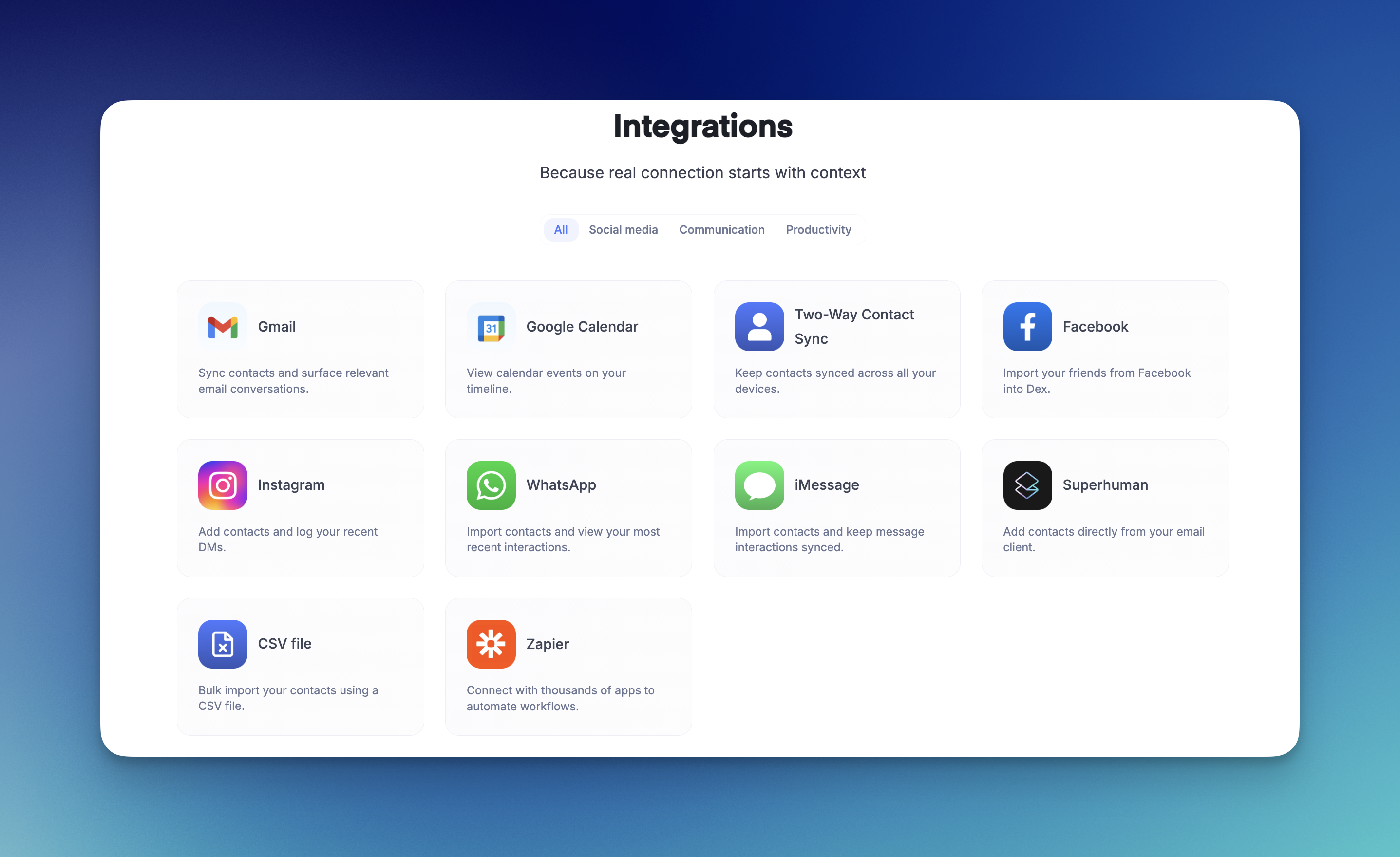
Image from getdex.com
Merge Duplicates: After importing, you might see duplicates of the same person from different sources. Use a built-in 'merge' feature (if provided) or manually consolidate those entries.
Let Automation Help: Many systems like Dex will track the frequency of your interactions, so you can see at a glance when you last chatted with someone.
TIP: By consolidating and syncing your contacts, you'll avoid the silo problem where 'professional contacts' get stuck and 'personal connections' stay scattered. You can then stay on top of each relationship without shuffling through multiple apps, crucial for introverts who can only maintain a limited number of active relationships at once.
Step 2: Leave Notes and Use Your System
Once you have your contact list under control, you can level up your networking with features that support your introverted approach. Your system should help you leverage this strength.
If you're using a Personal CRM or a well-structured spreadsheet, look for these core functions:
Notes: A place to record important details about a contact or interaction. If you had a thoughtful coffee meeting and discussed career transitions, note down the highlights so you can reference them months later. This is where your natural listening ability becomes a superpower.
Keep-in-Touch or Recurring Alerts: Set a reminder to reconnect with someone every few weeks, months, or once a year. Value-focused outreach generates more positive responses than generic check-ins. Whenever you log a new conversation, it resets the clock.
One-Off Reminders: Not everything is routine. You might want to follow up after someone's product launch or check in around a career milestone. One-off reminders handle the special occasions that don't fit a recurring schedule.
Groups and Filters: Manual lists of contacts you can define for any purpose. Maybe you have a 'Mentors' group or a 'Industry Contacts' group. Automated searches can pull together people based on shared attributes. Dex, Notion, Excel, and other systems support creating and saving filters.
TIP: Using both Groups and filters in Dex can streamline how you find and organize people, making it far less daunting to stay connected over time, even as an introvert with limited social energy.
Step 3: Make Yourself Presentable (Online)
As an introvert, you might prefer quality conversations over constant social media presence. But your online presence serves as a landing page for everyone who meets you. Think of it as doing the introductory work once, so you can focus your energy on deeper conversations later.
Focus on three key areas:
LinkedIn
If nothing else, focus on this. LinkedIn is where professional connections happen. Even after a great in-person conversation, it's likely that LinkedIn is where you'll connect. Spend time polishing your profile:
Use a high-resolution headshot as your profile picture coupled with a complementary background
Nail your headline. Aim for clarity and confidence.
Craft a short, punchy bio that details your unique interests, skills, and standout achievements
2. Email Signature
A clean, professional signature with your name, role, and contact info is often enough. If you want more, you can add a simple logo or link to your website, just avoid clutter. For introverts, a well-crafted email signature does networking work for you in every message you send.
3. Personal Website or Blog
This is especially valuable for introverts. The ROI on writing online is hard to understate. It attracts people with similar intellectual interests in an infinitely scalable manner, you build your network while you sleep. Once you start to publish your writing, you'll never guess who'll end up reading and resonating with it.
Platforms like Substack, Squarespace, or Wix make launching a personal site quick. Showcase relevant projects, blog posts, or research interests. This signals thought leadership and attracts people who share your passions: the kind of networking introverts excel at.
The lowest lift, highest ROI solution is launching a newsletter on Substack, which takes minutes. Your newsletter doesn't need to be groundbreaking; saying something thoughtful online is already doing more than the vast majority of people.
Putting It Together
By centralizing your contacts, setting up reminders, and polishing your online profiles, you're ready for networking to become a continuously compounding asset. Instead of scrambling to recall names and prior conversations, or worse, avoiding follow-up because you can't remember the details, you'll now have a foundational system.
Each new person will have a home, where you can track interactions, group contacts, and set reminders that get you to a second meeting and beyond. And once you keep track of everything, you'll enable the deeper, more meaningful relationships where introverts truly excel.
Let the networking begin.
How to Network Effectively
'You can have everything in life you want, if you will just help other people get what they want.'
- Zig Ziglar
Professional life offers constant opportunities to meet new people: conferences, workshops, online communities, and industry events. As an introvert, there's a fine line between building authentic, thoughtful relationships and coming across as purely transactional (or worse, forcing yourself into situations that drain you completely).
If you can strike the right balance and leverage your natural strengths while protecting your energy, networking can become one of the most transformative investments in your career.
Below are practical strategies for different networking contexts, each adapted for introverts who want to build genuine connections without burning out.
Professional Events and Conferences
The Introvert Challenge: Large networking events can feel overwhelming with crowded rooms, constant small talk, and pressure to meet as many people as possible.
The Introvert Advantage: Research shows that identifying 3-5 specific people to connect with at larger functions results in 31% higher conversation quality ratings. Your natural inclination to prepare and research transforms networking from random encounters into strategic relationship-building.
Arrive Early: Arrive when crowds are smaller and your energy levels are at their peak. This timing allows you to establish comfortable connections before the environment becomes overstimulating. Position yourself near registration tables or information booths where natural conversation starters emerge organically.
Set Realistic Goals Per Event: Aim for two to three quality conversations rather than collecting dozens of business cards. Research attendees beforehand using the event app or website to identify people whose interests align with yours. This preparation transforms random encounters into intentional connections.
TIP: If you've met someone before, a quick look at their Dex profile before the event can surface past conversation notes, reminding you exactly where you left off.
Use Structured Formats: Seek out roundtable discussions, workshop sessions, or panel Q&As where conversation topics are predetermined. Research from the Kellogg School shows that introverts perform better in structured, purpose-driven networking situations. These formats reduce the pressure of initiating small talk while providing natural talking points.
Schedule Downtime: Build in recovery moments between conversations by stepping outside, visiting the restroom, or finding a quiet corner to recharge. This prevents the energy drain that often derails introverts at networking events. Remember: you're not trying to maximize quantity of connections, you're optimizing for quality.
Online Communities and Digital Networking
This is where introverts often shine. Online communities allow you to build relationships at your own pace, on your own schedule, without the energy drain of in-person events.
Choose Your Communities Wisely: Instead of joining dozens of groups, focus on 2-3 communities where you can genuinely contribute. Look for professional forums, Slack communities, or LinkedIn groups aligned with your expertise and interests.
Lead with Value: Don't jump into group discussions asking for favors. Instead, begin by thoughtfully responding to others' questions with detailed, helpful answers. Over time, you'll build recognition as a knowledgeable resource, leading to direct messages from members seeking your expertise.
Track Promising Connections: As you interact with community members, add them to Dex with notes about shared interests and past conversations. This ensures every follow-up feels personal rather than transactional.
One-on-One Coffee Chats and Meetings
This is your domain. Your natural inclination toward deep listening creates immediate trust and rapport. When others feel truly heard, they remember the interaction positively. This natural inclination to process before responding allows you to ask more insightful follow-up questions and identify genuine connection points that surface-level networkers miss entirely.
Prepare Thoughtfully: Before meetings, research the person's background and recent work. Prepare 2-3 genuine questions about their challenges, interests, or recent projects. This preparation creates more substantive interactions than spontaneous small talk.
Take Notes Afterward: Immediately after a conversation, jot down notes in Dex capturing what you learned. These details become gold when you reconnect weeks or months later, and they're the foundation for value-focused follow-up that generates 26% more positive responses
After the meeting, you can jot a quick note in Dex so you can be reminded and updated when it’s time to reach out.
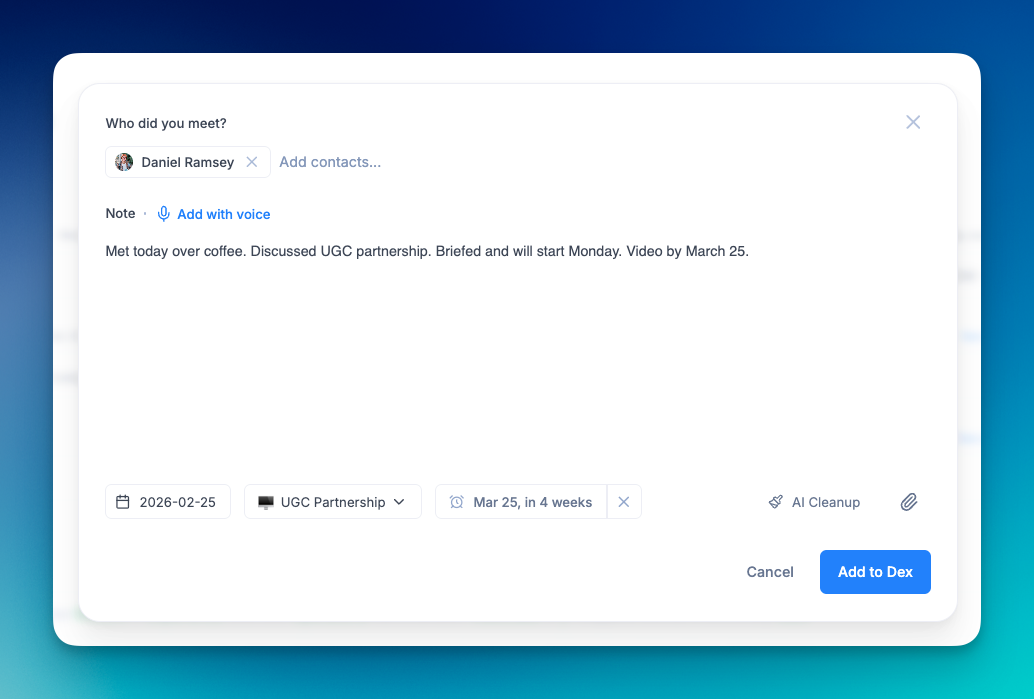
Image: Note creation in Dex. Also available on mobile.
Industry Mentors and Senior Professionals
Senior professionals and potential mentors are often more receptive to introverts than you might think. They appreciate thoughtful questions, genuine curiosity, and people who listen more than they talk.
When you have no warm connection, a succinct email often works better than a random LinkedIn message. Cold outreach has a 1% success rate, but warm intros succeed over 70% of the time, so always check for mutual connections first.
If sending cold emails, follow this structure:
Personalize: Refer to a recent article, talk, or interview where they were mentioned
Context: Briefly introduce yourself and your background
Specific Ask: Clearly state why you want to connect—seeking insights on a specific challenge or career question
Short & Respectful: Keep it concise; busy professionals respond to emails that are easy to skim
Don't fear failure; fear inaction. Most non-responses aren't rejections, they're simply missed emails. Follow up after a week or two. Your persistence combined with genuine interest will eventually break through.
Small Group Dinners and Intimate Gatherings
These intimate settings allow for the deep, meaningful conversations where you excel.
Seek Out Closer Settings: Look for dinner clubs, small workshops, or roundtable discussions (ideally 4-8 people) where everyone can contribute meaningfully to the conversation.
Consider Hosting: When you host, you control the vibe, guest list, and format. People naturally gravitate to the host, creating opportunities for deeper conversations. You can use Dex to organize people you want to invite based on shared interests or complementary backgrounds.
TIP: After the event, note in Dex who clicked with whom. This makes you a valuable connector, which is one of the most powerful networking positions you can occupy.
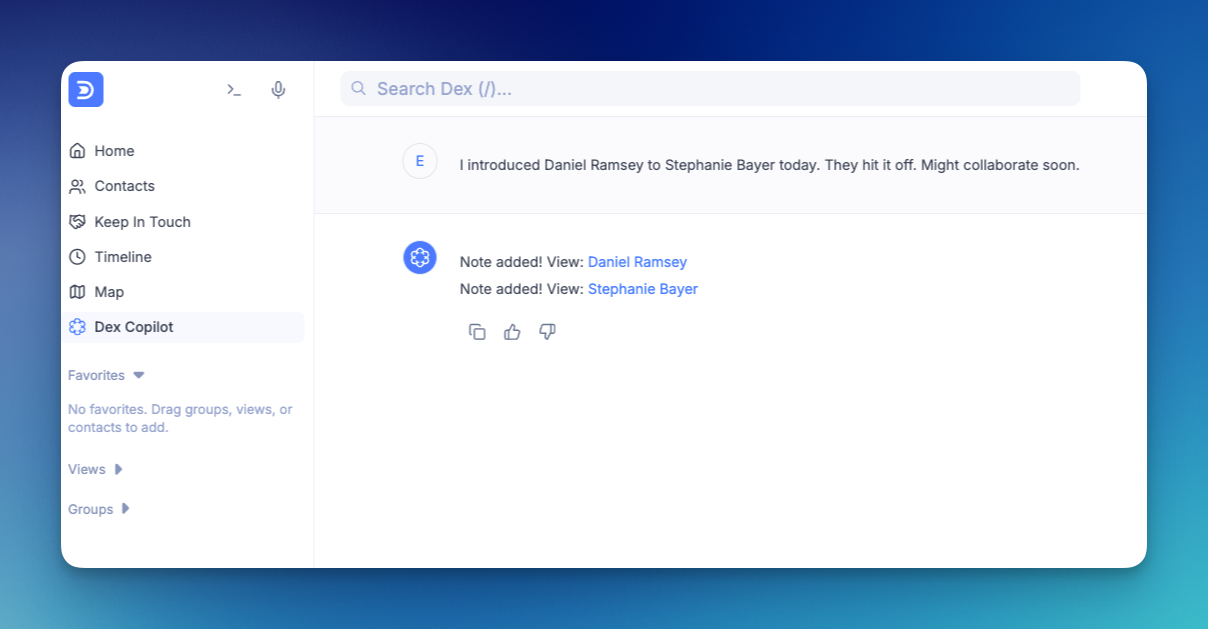
Image: Saving a note through Dex Copilot. Also available on mobile.
The Art and Science of Introvert Networking
Effective networking as an introvert is part strategy, part genuine human connection. You'll be amazed at how quickly meaningful relationships can form over thoughtful coffee chats, substantive email exchanges, or focused small-group discussions, and how these relationships might come back around as career-defining opportunities.
Give Before You Take: Zig Ziglar's quote aligns perfectly with introverts' natural inclination toward authentic relationships. Help others without expecting immediate returns.
Build and Maintain: A personal CRM like Dex, or even a well-organized spreadsheet, helps you store contact info, reminders, and conversation details. But real connection requires regular, authentic interactions. Just fewer of them, done more deeply.
Stay Curious: Whether you're chatting with a mentor about research or a peer about their career challenges, genuine curiosity signals respect and often leads to deeper rapport. Your advantage in understanding others' positions comes from this natural curiosity.
Maintaining Your Network Over Time
For introverts, maintaining relationships is both the hardest part and the most crucial. You can't rely on the constant socializing that keeps extroverts' networks warm. Instead, you need systems that ensure your carefully cultivated connections don't go cold during periods when you need to recharge.
The good news? Your preference for fewer, deeper relationships means you have a manageable network to maintain. And with the right systems, staying in touch becomes nearly effortless.
Tools and Tactics
Set 'Keep-in-Touch' Alerts: In Dex, you can assign a 'Keep-in-Touch' frequency for your most valued relationships. Whether it's monthly, quarterly, or annually, these gentle nudges ensure your key contacts don't slip off your radar, especially important when you're going through introverted recharge periods.
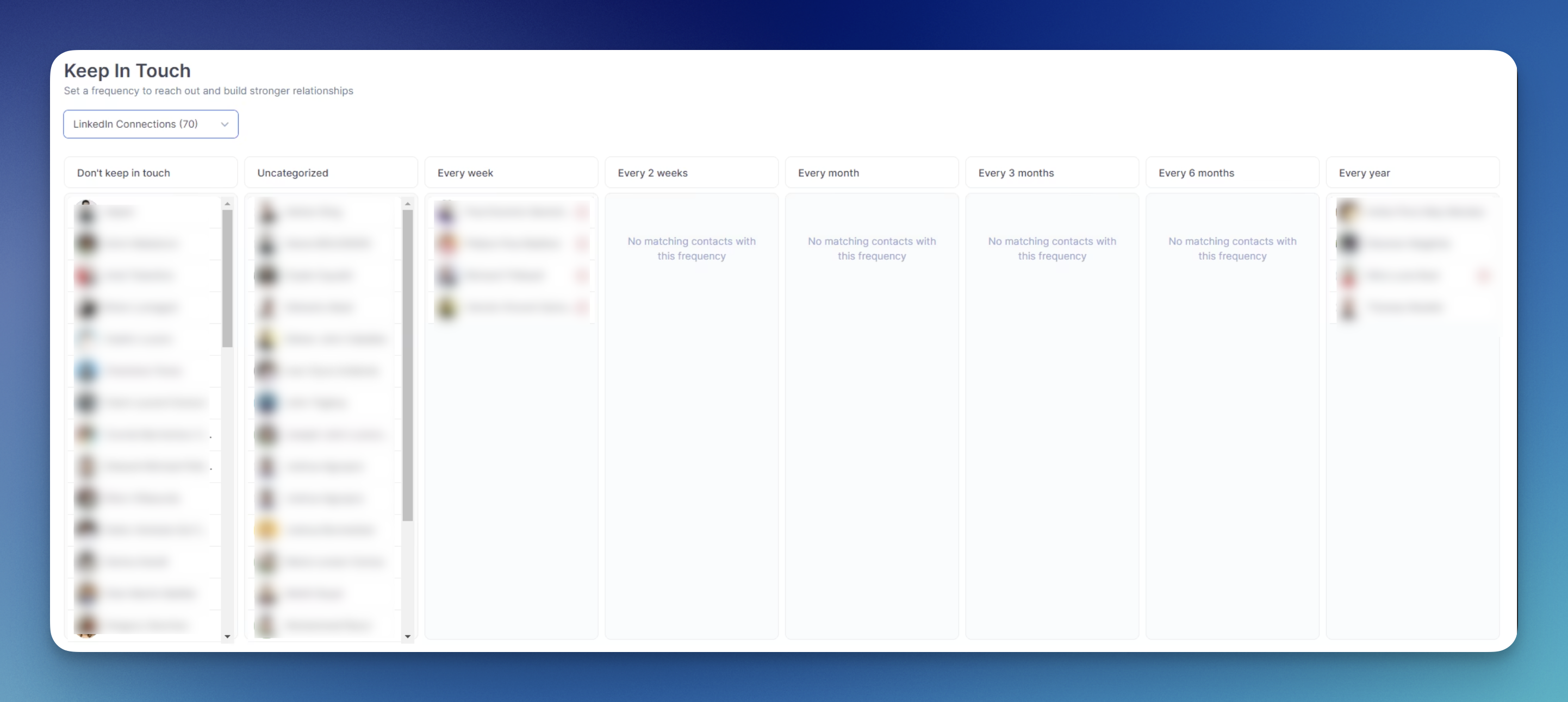
Image: Setting KIT frequencies using a kanban-style board on Dex
Leverage Network Updates: The Network Updates feature in Dex helps you spot LinkedIn headline changes, job moves, or other major life events at a glance. This creates natural opportunities to send congratulations or offer help, making your outreach feel organic rather than forced.
Contextual Outreach: When you get a reminder to follow up, go beyond 'How are you?' by sharing an insightful article, relevant opportunity, or thoughtful comment that relates to their interests. Remember: value-focused outreach generates 26% more positive responses. Dex makes this easy by displaying your previous notes and conversation history.
The 3-Touch Rule: Establish a systematic follow-up process that feels natural and manageable. Plan three meaningful touchpoints with each new connection:
An immediate thank-you within 24 hours
A value-add communication within two weeks
A check-in within three months
TIP: Dex is purpose-built for this cadence. Its reminder system lets you set exactly these touchpoints for each contact, so the right prompt appears at the right time without overwhelming you.
Energy Management Framework
Research shows that introverts process social information differently, requiring deliberate recovery time. Build this reality into your networking maintenance plan:
Map Your Energy Cycles: Identify your peak energy periods throughout the week. Schedule important networking touchpoints during these windows, and protect your low-energy periods for solo work and recovery.
Batch Your Outreach: Rather than scattering relationship maintenance throughout the week, dedicate specific blocks of time to catch-up messages. This prevents networking from becoming a constant energy drain and allows you to enter a 'relationship mode' mindset.
Quality Over Frequency: It's better to send one thoughtful, personalized message every quarter than force yourself to check in monthly with generic pleasantries. Research confirms that fewer, higher-quality interactions yield better relationship outcomes for introverts.
How Much Networking is Too Much?
'Networking is overrated. Go do something great and your network will emerge.'
- Naval Ravikant
Networking is often frowned upon, and sometimes justifiably so. Many see it as shallow, thoughtless, and only for those incapable of earning opportunities by merit. This perception hits especially hard for introverts, who naturally resist superficial interactions.
It's blatantly obvious when someone is being transactional. And ironically, the less you try to 'network' and the more you try to make genuine connections and pursue your intellectual curiosity, the better your results.
The best networking doesn't look like networking at all. For introverts, this is liberating news. You're not trying to attend every event, meet every person, or maintain hundreds of shallow connections. You're building authentic relationships around shared interests and values, which is exactly what Naval's quote implies.
So how much is too much? If networking starts feeling like a chore, if you're forcing conversations that don't interest you, or if you're attending events purely out of FOMO, then you've crossed the line. Pull back, recharge, and refocus on the relationships that genuinely matter.
Conclusion
'Everyone has a plan until they get punched in the face.'
- Mike Tyson
Networking as an introvert will present unique challenges. There will be awkward silences, moments of burnout, people who don't reciprocate, and situations where you feel completely drained. This is normal. The difference is that now you have a framework and systems to handle these challenges without abandoning your authentic self.
When those difficult moments happen, remember why you started:
Long-View Mindset: Relationships often pay dividends at unexpected times. People might recommend you for a role years after a single thoughtful conversation. The depth you cultivate today compounds over decades.
Genuine Intent: If you approach networking as a way to support others as much as yourself, it won't feel transactional. Your natural empathy and authentic interest are advantages, not liabilities.
Resilience: Even if you face setbacks, keep showing up in the ways that work for you. Consistency over time builds trust, which creates opportunities. You don't need to attend every event or meet every person. You need to show up authentically for the right people.
When you approach networking as relationship building rather than self-promotion, you create sustainable professional connections that enhance both your career trajectory and personal satisfaction.
Begin with intention and stay consistent. That steady, grounded approach will set you apart from those who treat networking as mere checkbox-chasing or who burn out trying to be someone they're not.
Start with one relationship this week. Your future self will thank you for taking that first authentic step.
Further Reading
Below are resources that complement the strategies covered in this guide:
Books
Quiet: The Power of Introverts in a World That Can't Stop Talking by Susan Cain (2012). The definitive book on introversion that validates your natural tendencies and shows how they can be professional strengths.
Networking for People Who Hate Networking by Devora Zack (2010). A refreshing, low-pressure approach to building authentic connections for those who find networking daunting.
Never Eat Alone by Keith Ferrazzi (2014). While written from an extrovert's perspective, the principles of generous networking and consistent follow-up apply universally.
Give and Take by Adam Grant (2013). Explores how helping others can fuel professional success, perfectly aligned with introverts' preference for authentic relationships.
How to Win Friends and Influence People by Dale Carnegie (1936). A timeless classic emphasizing listening and empathy.
Tools & Personal CRM Systems
Dex: A personal CRM designed for managing meaningful relationships through seamless integration across multiple platforms without the overhead of traditional networking tools.
Airtable or Notion: For those who prefer building custom workflows, these platforms can be adapted to manage contacts and reminders.
folk: For those who value team-based networking, folk lets multiple users manage contacts, track interactions, and organize workflows efficiently with collaborative features.
Monica: For those who value a fully customizable, open-source personal CRM, Monica gives individuals control over their data while helping manage and nurture personal relationships.
Remember, networking is a journey of continuous learning. Keep seeking knowledge, keep practicing authentically, and most importantly, keep reaching out in good faith to others.
Try Dex free for 7 days and start leveraging your introverted superpowers to network with ease.