Dex for Venture Firms
How a venture firm can share founder, co-investor and LP relationships in Dex, find warm intros through partners and keep the history when an associate moves on.

A fund runs on relationships: founders, co-investors, LPs and the operators who send the best companies your way. Most of that history sits in individual inboxes and calendars, one partner at a time. The pipeline tool knows about the deal, but it often doesn't know that your partner had coffee with the founder last quarter.
Dex for Teams gives the firm one shared place for those relationships. This guide covers how to set it up for a venture firm, how to organize founders, co-investors and LPs, and how to keep the history when someone leaves. If you invest on your own, read Dex for investors instead. An individual plan covers a solo GP, an angel or a scout.
Where Dex fits next to your pipeline
Keep Affinity, Attio or the spreadsheet for the pipeline: the deal, the stage, the round and the notes someone took the time to log. Dex doesn't track deals, stages or rounds, and it has no pipeline to keep up to date.
Dex holds the relationship side. That means who at the firm knows whom, the email and calendar history each person chooses to share, and who's due a check-in. Some firms run Dex on its own because their pipeline was only ever there to remember who knew whom. If that's you, import a CSV of your contacts to get started.
Set up a workspace for the firm
Everyone at the firm keeps their own private Dex. The workspace is a separate space you add to it.
Start a 14-day free trial of Dex for Teams. You don't need a card.
Go to Settings → Team and create a workspace for the firm.
Choose which of your accounts the workspace sees, and at what level.
Invite colleagues by email. Each of them makes the same choices for their own accounts.
Start with one deal team, not the whole firm. Pick a partner and the associates who cover the same companies, and add the founders and co-investors they work with. Before the next first meeting, open the founder's timeline and see whether a colleague's history changes how you prepare. If it does, invite the rest of the firm.
Workspaces have four roles: owner, admin, member and viewer. Partners, principals, associates and the platform team usually join as members. The viewer role gives read-only access. Viewers see everything the team has shared, so review the workspace before you invite venture partners, scouts or advisors.
Organize founders, co-investors and LPs
Founders, co-investors, LPs, bankers and the operators who send you companies all fit in the same workspace, with the same timeline, search and reminders. Sort them into groups:
Portfolio founders
Founders you're tracking
Founders you passed on
Co-investors and other funds
LPs and prospective LPs
Operators, advisors and scouts
Give LPs a group of their own, so the firm keeps in touch with them on their own cadence and the next raise doesn't start with a cold email.
Add custom fields for fund, sector or geography, so people are organized the way the firm already thinks about them. You can filter on any field, and a saved view such as "Fund III, fintech, founders we're tracking" keeps the right list one click away.
History in Dex is organized by person, not by company. Each shared contact has a timeline. There's no separate company directory, so to see who the firm knows at a company, search its name.
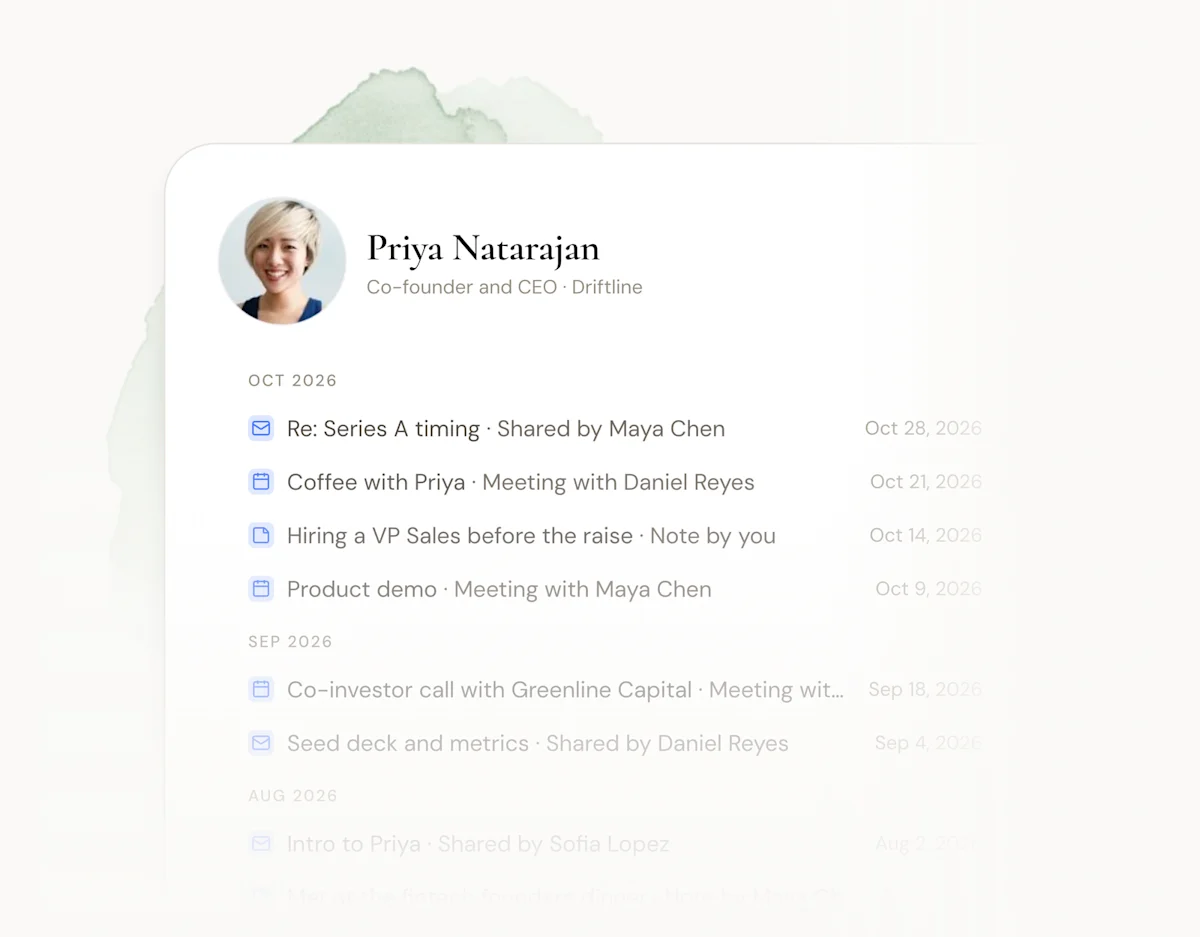
Walk into the founder meeting already caught up
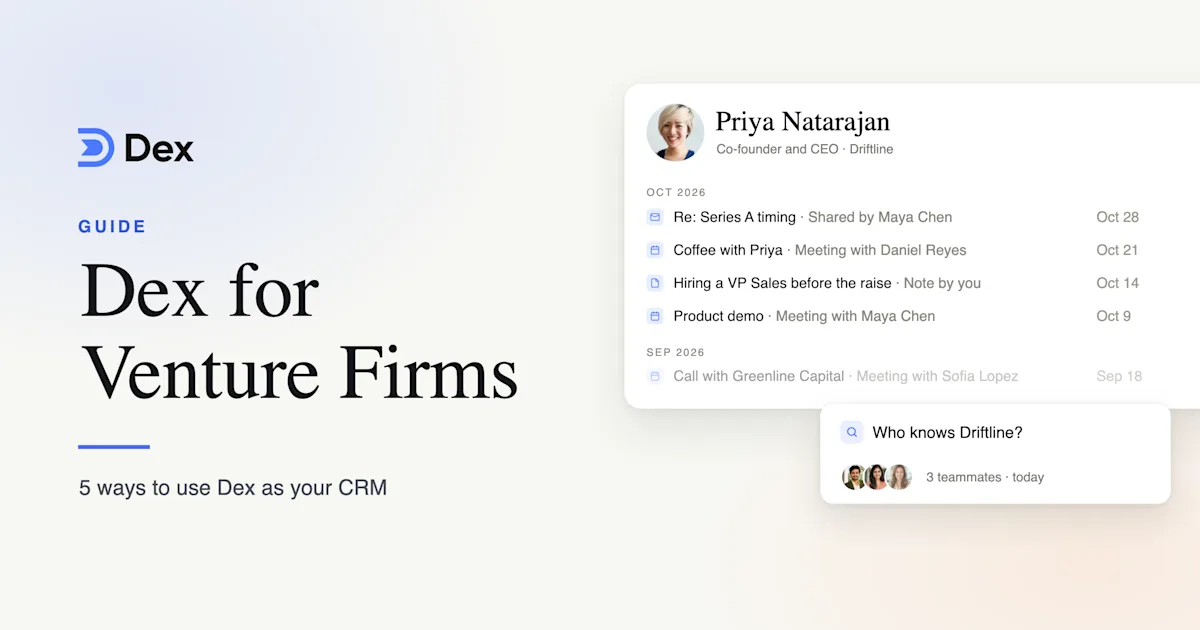
Before a first meeting, open the founder's contact. The timeline brings together the email and calendar history colleagues have shared and the notes they wrote after a pitch or a coffee. You pick up where your partner left off, instead of asking a founder to repeat what they told your colleague last quarter.
After the meeting, add a note while it's fresh: what they're building, what they asked for and what the firm promised. Each note can be shared with the firm or kept private. Notes from pitches and coffees are often the most useful part of the record, since none of it reaches an inbox.
Find warm intros through your partners
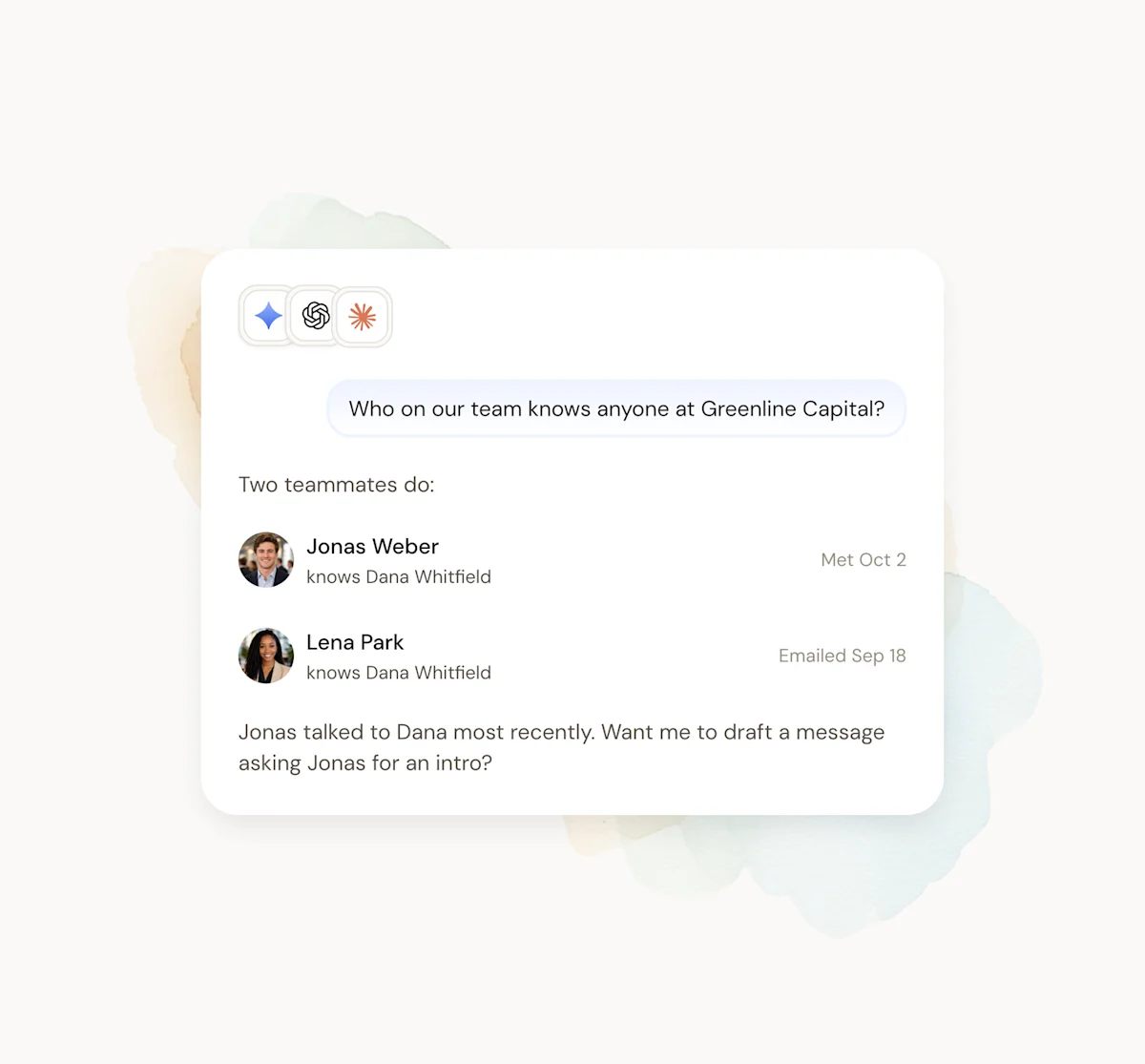
Before you reach out cold, search the person or the company. Dex shows which colleagues know them and when they last talked. Read the context they've shared, then ask for the intro. That way you don't find out after the call that your partner had the relationship all along.
You can also connect the workspace to Claude, ChatGPT or another AI assistant through the Dex MCP server. From there you can ask "who on our team knows anyone at Greenline Capital?" or what's been shared about a founder, without opening Dex.
Keep in touch with founders, co-investors and LPs
A keep-in-touch frequency gives each relationship a rhythm. Set one per contact or per group, for the firm or just for yourself:
Portfolio founders: every month
Co-investors: every 3 months
LPs: every 6 months
Founders you passed on: every 6 months
Operators and scouts: every 3 months
The keep-in-touch list shows who's due, so an LP hears from you between the annual meeting and the next raise, and a founder you passed on hears from you between rounds. Dex works out the next date from the last interaction, so an email or a meeting resets the clock by itself. Use reminders for anything with a date attached, like "check in after their seed closes in March".
Keep the history when an associate moves on
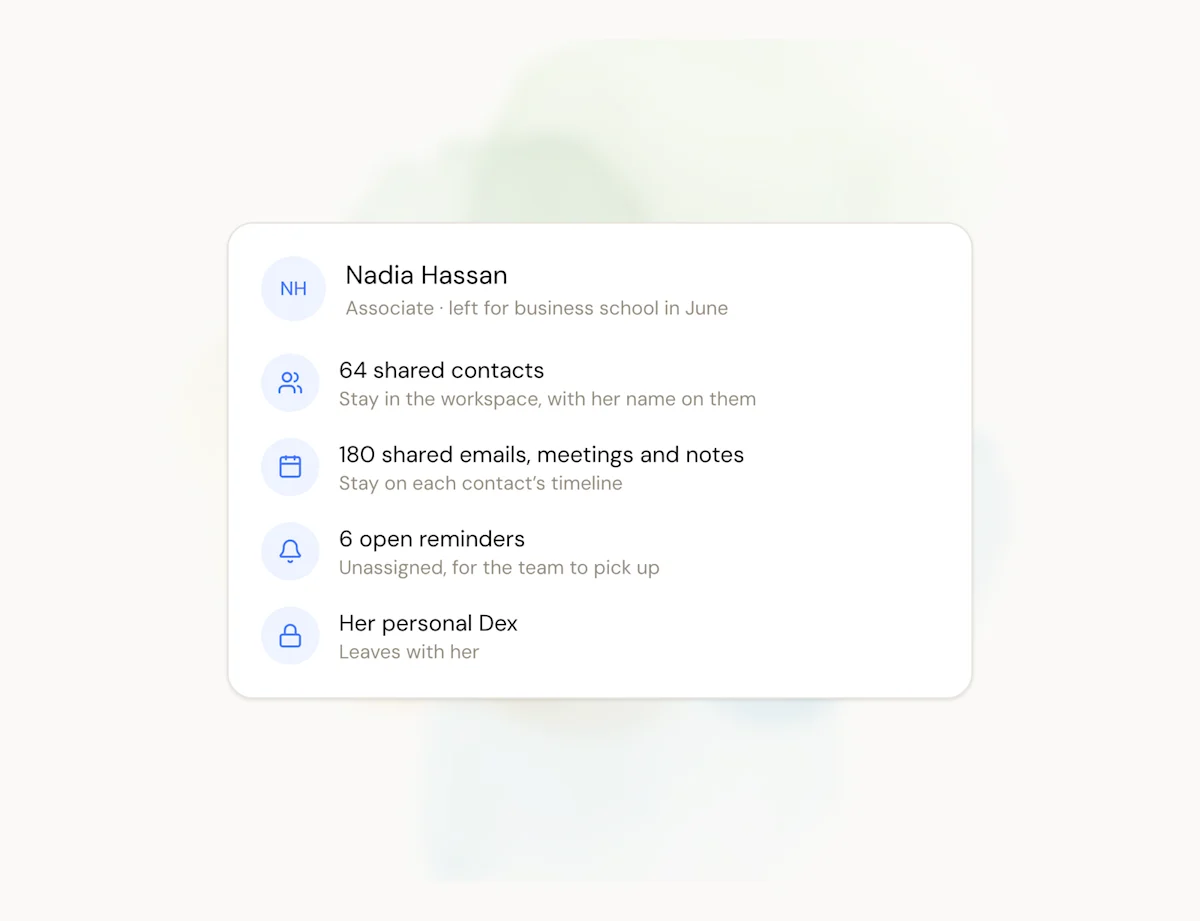
Associates rotate out every couple of years and partners move on. When an owner or admin removes someone from the workspace, what they shared stays, with their name on it. That includes the contacts, the timeline items and the shared notes. Their connected accounts stop feeding the workspace, and their open reminders are unassigned for the team to pick up. Anything they never shared, and their personal Dex, leaves with them.
Whoever picks up their founders starts from the record instead of an empty inbox.
Decide what to share before you connect
Some conversations shouldn't leave the person who had them, like an LP's commitment or a term sheet in negotiation. For each connected account, you choose whether the workspace sees nothing, only subjects, participants and dates, or full content. If even the subject line would be sensitive, leave that account out. Each note can be shared or kept private, and you can change any of this later.
Nobody has to connect an inbox. Someone can take part with only the contacts and notes they add by hand. A good default for most firms is subject and metadata for email, plus shared notes after founder meetings. The security page covers how data is stored and encrypted.
A weekly routine for a deal team
Clear the founders, co-investors and LPs due on the keep-in-touch list.
Read the timeline before each first meeting this week.
Add a shared note after every pitch and coffee.
Search any new founder or fund before reaching out, and ask whoever knows them for the intro.
Frequently asked questions
Does Dex replace Affinity or our deal pipeline?
No. Dex doesn't track deals, stages or rounds. Keep Affinity, Attio or the spreadsheet for the pipeline, and use Dex for who knows whom, the shared conversation history and the follow-up. Some firms run Dex on its own if the pipeline was only ever there to remember who knew whom.
What happens when an associate or a partner leaves?
An owner or admin removes them from the workspace. Their connected accounts stop feeding it, and their open reminders are unassigned for the team. What they shared stays, with their name on it. Anything they never shared, and their personal Dex, leaves with them.
Does it work for LPs as well as founders?
Yes. LPs, co-investors and founders sit in the same workspace, with the same timeline, search and reminders. Put LPs in their own group with their own cadence.
How much does Dex for Teams cost?
The Team plan is $40 per user per month, billed monthly. A four-partner firm with two associates is $240 a month, and twelve people are $480. There's a 14-day free trial, and no card is needed.
Get started
Start with one deal team. Choose what each person shares, put founders, co-investors and LPs on a cadence, and read the timeline before the next first meeting.
Start a 14-day free trial of Dex for Teams, with no card needed, or book a demo. There's more on the Dex for venture firms page.
Related guides