What Is Relationship Intelligence? A Plain-English Guide for Small Teams
Relationship intelligence is the practice of using your team's email, calendar, and contact data to see who knows whom, how strong each connection is, and the best path to a warm introduction. Software now does most of the work automatically.


Every team has more connections than it can see. Your co-founder went to school with a partner at the fund you're pitching. Your newest hire spent three years working with the buyer you've been cold-emailing. Nobody knows, because that knowledge lives in eleven different inboxes and LinkedIn accounts.
There's a name for fixing that blind spot. This guide explains what relationship intelligence means, how the software behind it works, and how a small team can start using it, with or without a paid tool.
Fast facts:
It turns scattered data (email, calendar, LinkedIn, notes) into a shared answer to "who knows whom, and how well?"
Most of it is automatic. The software reads metadata like who emailed whom and when, so nobody has to log calls by hand.
Its main payoff is warm introductions. A 2022 study of 20 million LinkedIn users found that moderately weak ties drove the most job mobility.
Privacy is the trade-off. Good tools let each person control what the team sees.
Relationship intelligence, defined
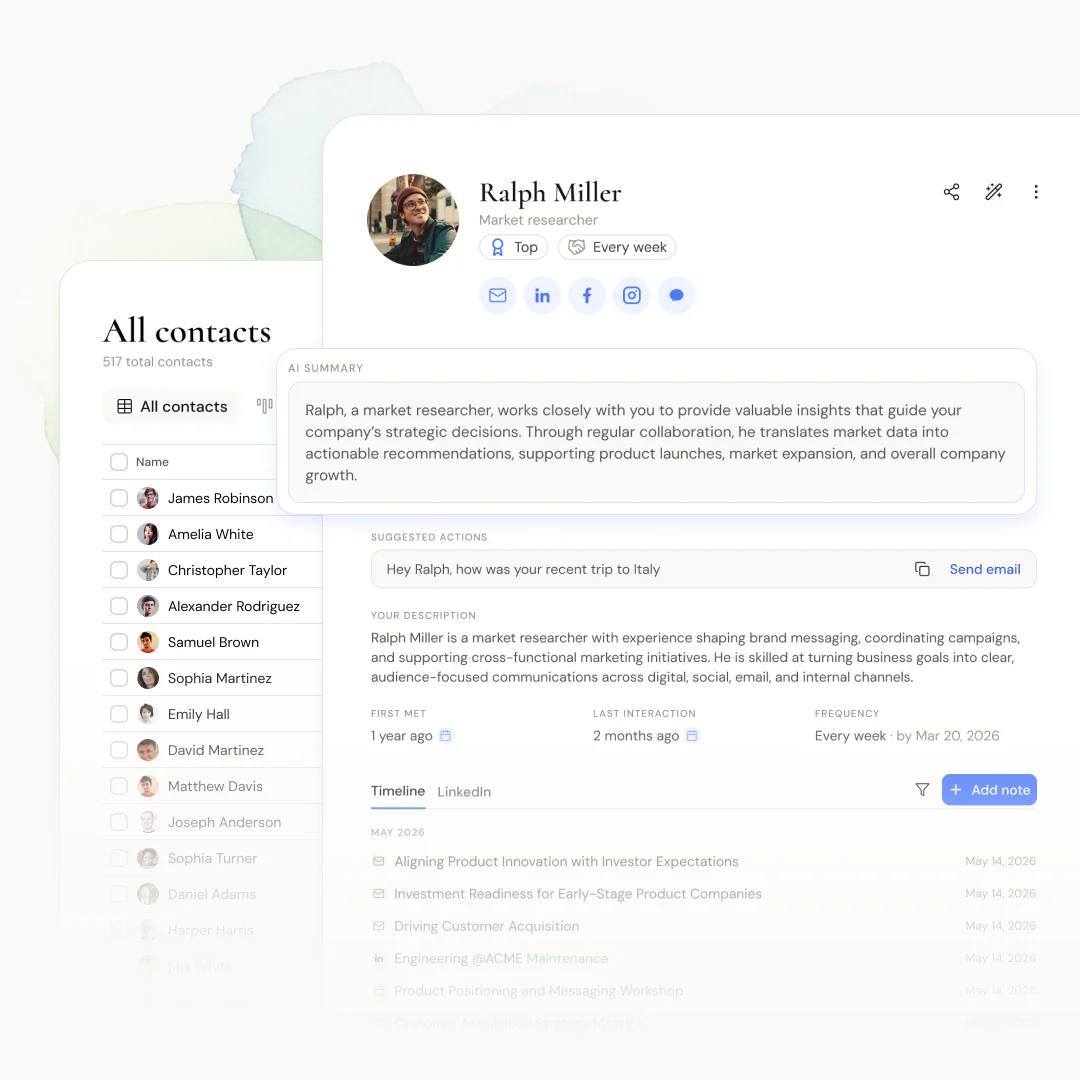
Relationship intelligence is knowing, at any moment, who in your network (or your team's network) knows a given person, how strong that connection is, and what has been said between them. The term usually refers to software that builds this picture automatically, but the idea is older than the software.
A good executive assistant has always done this in their head. They know the CEO met the investor at a dinner in March, that the investor's partner is a former colleague of the CFO, and that the last email went unanswered. A relationship intelligence platform tries to give the whole team that same memory.
It helps to separate the term from two neighbors:
Term | What it means | Main question it answers |
|---|---|---|
Relationship intelligence | Automatic insight into connections, strength, and history | Who knows this person, and how well? |
Relationship mapping | A visual chart of connections, often for one account | How is this company's buying group connected to us? |
CRM | A system of record for contacts, deals, and tasks | Where is this deal, and what's next? |
Relationship mapping is often one feature inside relationship intelligence software. A CRM may or may not include either. We cover that overlap in our post on relationship intelligence CRM vs traditional CRM.
How relationship intelligence works
Under the hood, almost every tool follows the same four steps.
First comes data capture. Each person connects their email, calendar, and sometimes LinkedIn or WhatsApp. The software reads who you emailed, who you met, and when. Many tools only need metadata (sender, recipients, date, subject line), not the body of the email.
Next is matching. The software merges duplicates, so "Dana W." in your calendar, "dana@northwind.com" in your inbox, and "Dana Whitfield" on LinkedIn become one person. It also links people to companies.
Then scoring: each connection gets a sense of strength, based on how often you talk, how recently, and whether the conversation goes both ways. Some tools show a number. Others just show "last spoke 12 days ago, 34 emails."
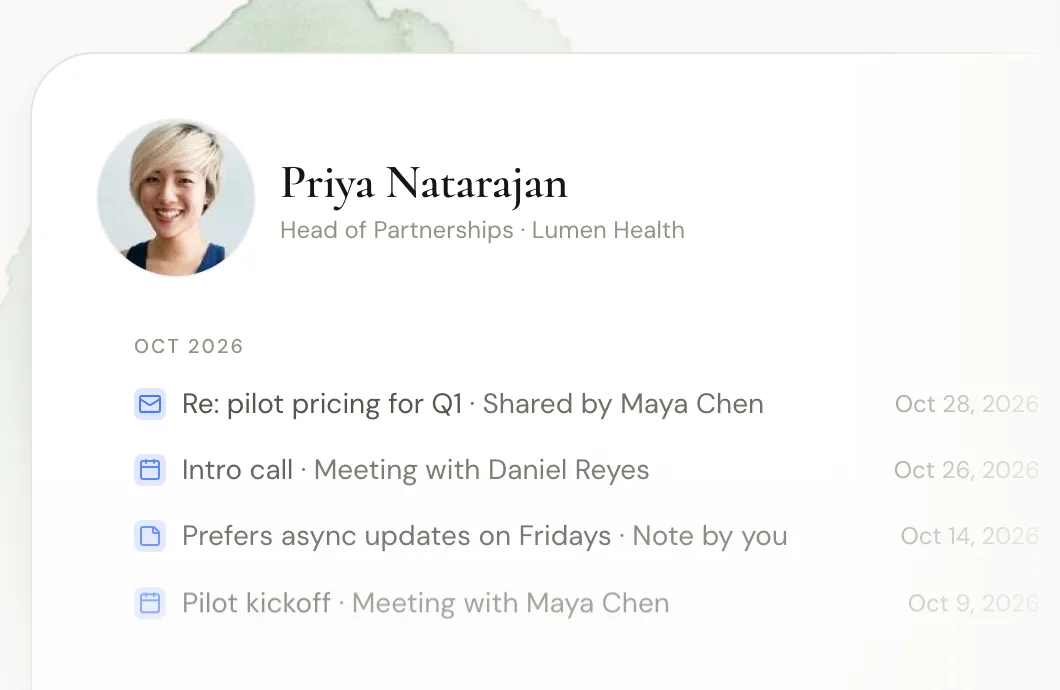
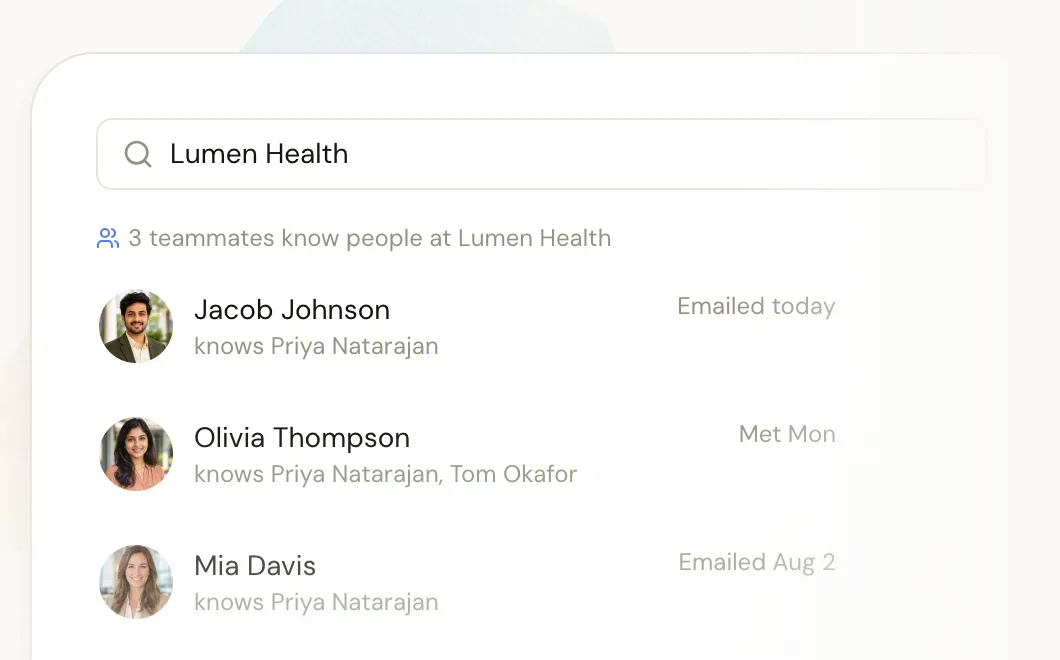
Last comes surfacing, which is the part you use day to day. Search a company and see three teammates with a connection. Open a contact and read the history before a meeting. Get a nudge that you haven't spoken to a key person in 90 days.
Signal | Where it comes from | What it tells you |
|---|---|---|
Email frequency | Gmail, Outlook | How active the relationship is |
Meeting history | Google Calendar, Outlook | Whether you've met in person or on a call |
Recency | All sources | Whether the connection is warm or cooling |
Reciprocity | Email replies | Whether they write back, or you're shouting into the void |
Shared connections | Possible paths when nobody knows them directly | |
Notes | Typed or dictated by your team | Context no metadata can capture |
Why relationship intelligence matters: the warm introduction
The reason people pay for this is simple. Warm introductions work better than cold outreach, and this kind of software finds them.
There's solid research behind the idea that the useful connections are often not your closest ones. In 1973, sociologist Mark Granovetter published "The Strength of Weak Ties," showing that people often found jobs through acquaintances rather than close friends. In 2022, a team from LinkedIn, MIT, Stanford, and Harvard tested the idea on 20 million LinkedIn users and published the results in Science. Moderately weak ties produced the most job mobility.
That's the gap this software fills. Your strong ties you already remember. It's the moderately weak ones (a former colleague of your co-founder, someone your new hire met twice) that fall through the cracks, and those are the ties most likely to open a new door. We go deeper on the research in our post on the strength of weak ties.
5 ways small teams use relationship intelligence
You don't need a 500-person firm for this to pay off. Here's how smaller teams use it.
Team | Question it answers | What changes |
|---|---|---|
Venture firm (3 to 10 people) | Who can introduce us to this founder? | Sourcing through warm intros instead of cold DMs |
Recruiting firm | Who on the team has placed someone at this company before? | Fewer cold calls, faster client wins |
Agency or consultancy | Who knows the new VP who just joined our client? | Accounts don't go cold when a contact changes jobs |
Foundation | Who has history with this grantee's staff? | One shared record instead of a dozen inboxes |
Startup raising money | Which investors does our team already know? | A fundraising list sorted by warmth, not by guesswork |
The common thread is that the knowledge already exists inside the team. The software just makes it searchable.
The privacy question
Any tool that reads email raises a fair question: what can my teammates see? This is where relationship intelligence platforms differ most, and it's the question to ask before you buy.
Some enterprise tools pull activity from everyone's inbox into a firmwide view by default. That works in a law firm with a policy behind it. In a small team, it can feel invasive, and people quietly stop connecting their accounts.
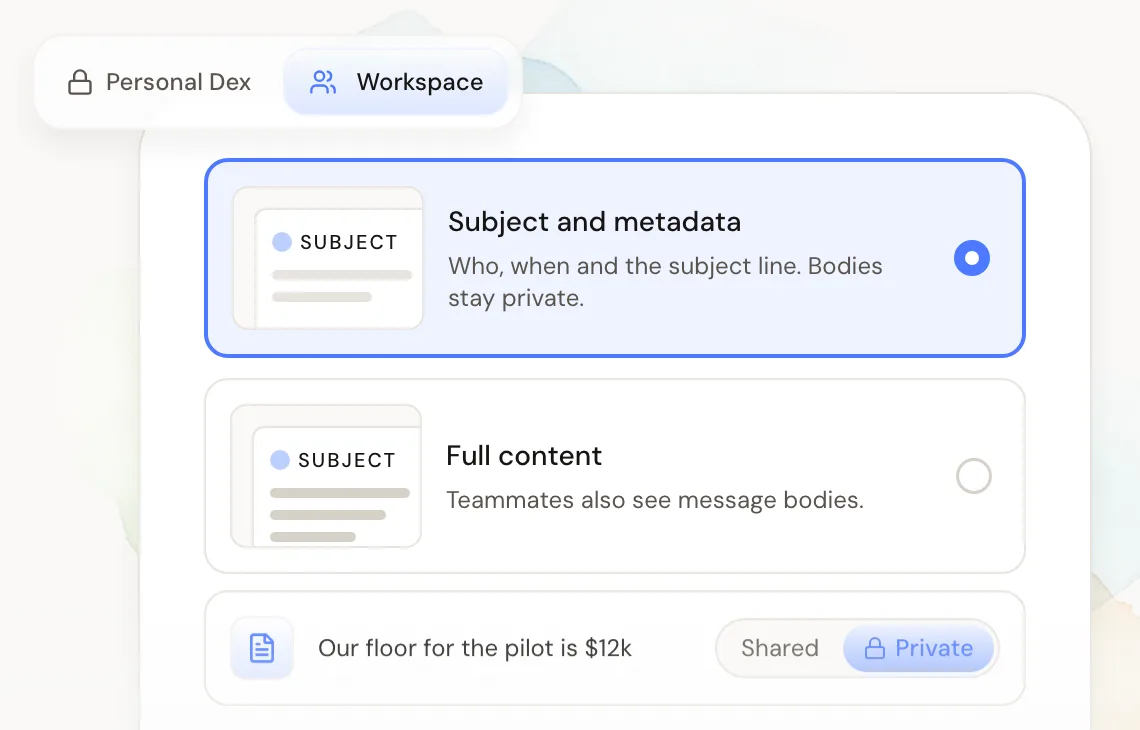
A better pattern lets each person decide. In Dex for Teams, for example, each member chooses whether the shared workspace sees only email subject lines and metadata, or full content. Notes can be shared or kept private, and nothing from a personal account goes into the workspace unless its owner adds it. Whatever tool you pick, read its security and privacy page and get a straight answer to "who sees my email bodies?"
What separates good tools from bad ones
Not every product that claims to map your network does the job well. When you try one, these are the details that decide whether your team keeps using it.
Good sign | Warning sign |
|---|---|
It works the day you connect your inbox, using past activity | It needs weeks of manual setup before it shows anything |
Each person controls what the team sees | Everything is shared by default and you can't opt out |
Duplicates are merged across email, calendar, and LinkedIn | The same person shows up three times under different names |
It shows the history behind a score | It gives you a number with no way to check it |
It reminds you when a relationship is cooling | It only answers questions you think to ask |
Two of these deserve a closer look. First, scores. A strength score is a shortcut, and shortcuts are wrong sometimes. Someone you email once a quarter might be a close friend, and someone you email daily might be a vendor you barely know. Tools that show the history (last meeting, number of emails, who replied) let you judge for yourself.
Second, reminders. Most of the value of relationship mapping is in finding a path to someone new. But a lot of the value of a network comes from not letting good relationships fade in the first place. A tool that tells you "you haven't spoken to your best referral partner in four months" saves more deals than one that only answers searches.
Finally, check how the tool handles people leaving. When a teammate moves on, their connections should stay visible to the team (within whatever privacy settings they chose), so the next person can pick up the relationship without starting from zero.
How to start with relationship intelligence
You can start before buying anything.
Write down your 20 most important external relationships as a team: investors, clients, partners, hires you want to make.
Ask each person to mark who they know on that list and how well (met once, talk monthly, close).
Note the last time anyone spoke with each one. You'll find a few that went cold without anyone noticing.
Pick one owner per relationship, so a key contact doesn't slip because everyone assumed someone else had it.
Set a check-in rhythm. Monthly for the most important, quarterly for the rest.
If that exercise is useful, the software automates it. It builds the list from your actual email and calendar, keeps it current, and reminds you when a relationship is cooling. Dex does this with keep-in-touch reminders, and our comparison of relationship intelligence platforms for small teams covers the other options.
This short walkthrough shows how a small business owner sets up Dex to keep track of who they know:
Who this isn't for
If your team sells to thousands of leads you've never met, this won't fix your funnel. You need a sales CRM and an outreach tool. It's also overkill if your business depends on a handful of relationships that one person manages well. It pays off when a team's network is bigger than any one person can hold in their head.
FAQ
What is relationship intelligence in simple terms?
It's knowing who on your team knows a given person, how well, and what was said last, usually with software that works this out from email and calendar data.
Is relationship intelligence the same as a CRM?
No. A CRM is a database you update. Relationship intelligence is insight built automatically from activity. Many modern CRMs now include these features.
What data does relationship intelligence software use?
Mostly email and calendar metadata (who, when, how often), plus LinkedIn connections, notes, and sometimes messaging apps like WhatsApp.
Is it only for big companies?
No. It started in law firms and venture funds, but tools like Dex, folk, and Attio bring it to teams of two to 20 at much lower prices.
What's a relationship strength score?
A rating of how strong a connection is, usually based on how often and how recently two people have been in touch and whether communication goes both ways.
How does it help with warm introductions?
Search the person or company you want to reach. The tool shows which teammates have a connection and how recent it is. Ask the strongest one for an intro, with context from the shared history.
The bottom line
Relationship intelligence is a fancy name for something good teams have always wanted: knowing who knows whom without asking around. It works by capturing email, calendar, and LinkedIn activity, matching it into one map, scoring connection strength, and surfacing the warm path when you need it. For small teams, the payoff is more warm introductions, fewer relationships that go cold by accident, and a shared memory that doesn't leave when someone does. Pick a tool that lets each person control their privacy, and start with your 20 most important relationships.
Ready to see your team's network in one place? Start your free Dex trial and put it to work this week.
Related guides