Affinity CRM Alternatives: Relationship Intelligence for Small Teams
Affinity CRM costs $2,000 to $2,700 per user per year and is built for venture and private equity deal teams. Small teams that want its relationship intelligence for less usually pick Dex for Teams, Attio, or folk. Investment firms that need deal flow tools look at 4Degrees.


Affinity CRM is very good at one job: showing a deal team who in the firm knows a founder, a co-investor, or an LP, and how warm that connection is. It captures email and calendar activity automatically, scores relationship strength, and finds the warmest path to anyone. For a fund with a full deal pipeline, that's worth a lot.
It's also priced for funds. Affinity's pricing page lists Essential at $2,000 per user per year, Scale at $2,300, and Advanced at $2,700, all billed annually through sales. A five-person team pays $10,000 a year before anyone adds PitchBook. Small teams that want the relationship intelligence without that bill have cheaper options.
This guide covers what Affinity CRM does, what it costs, and seven Affinity alternatives for small teams, with prices checked on each vendor's site in November 2026.
Fast facts:
Affinity pricing is per user per year: Essential $2,000, Scale $2,300, Advanced $2,700, Enterprise custom. Every tier goes through "Contact sales," and no free trial is listed.
Every Affinity tier includes automatic email and calendar capture, relationship scoring, and a deal pipeline. AI Chat, Notetaker, and the MCP server start on Scale.
For a 5-person team, the Affinity cost on Essential is $10,000 a year. Dex for Teams costs $2,400, Attio Plus about $2,160, and folk Standard $1,440.
Dex for Teams is the closest match for teams that want Affinity's who-knows-whom search without a deal pipeline. Attio and folk add pipelines. 4Degrees is the pick for small investment firms.
If your firm lives on PitchBook data and fund-level permissions, Affinity is probably still the right tool.
What Affinity CRM does well
Affinity calls itself "the CRM built for deal teams," and its industry pages are aimed at venture capital, private equity, private credit, and investment banking firms. It does three things especially well.
Automatic activity capture. Affinity CRM reads email and calendar activity across the firm and creates records on its own, so nobody has to log a meeting.
Relationship intelligence. It scores relationship strength, builds a firm-wide relationship graph, and shows the warmest intro path to any person or company. Our explainer on what relationship intelligence is covers how this works.
Deal flow management. Pipelines, smart lists, and reporting built for sourcing and tracking deals, plus data enrichment and, on Advanced, PitchBook, Dealroom, and Crunchbase.
Affinity also gives firms control over what's synced. Admins set policies at the team level, and people can manage what's shared from their own inbox.
Affinity pricing: what a small team pays
Here's the Affinity pricing table as published, with what each tier adds.
Affinity plan | Price per user per year | 5 users per year | What it adds |
|---|---|---|---|
Essential | $2,000 | $10,000 | Activity capture, relationship scoring, firm-wide history, deal pipeline |
Scale | $2,300 | $11,500 | Notetaker, AI Chat, Ascend agents, MCP server, inferred connections |
Advanced | $2,700 | $13,500 | PitchBook, Dealroom, Crunchbase enrichment, Slack and Salesforce integrations, workflow automations |
Enterprise | Custom | Custom | Fund-level permissions, enterprise SSO, unlimited API |
So what does Affinity cost in practice? At $2,000 a seat, the Affinity cost for one person is about $167 a month, which is several times what most small-team CRMs charge. The PitchBook integration also needs your own PitchBook subscription. A fund closing deals worth millions won't notice that. For a five-person agency, a nonprofit development team, or a startup BD team, it's most of the software budget.
Affinity pricing also has no self-serve checkout. Every tier, including Essential, routes to sales, and the pricing page lists no free trial. That's normal for enterprise software and a real hurdle for a small team that wants to test before it buys.
Affinity alternatives compared
Here are seven Affinity alternatives, with a year's cost for a five-person team on the lowest plan most small teams would pick.
Tool | Best for | Entry price | 5 users per year | Free trial or plan |
|---|---|---|---|---|
Affinity (reference) | VC and PE deal teams | $2,000 per user per year | $10,000 | None listed |
Dex for Teams | Relationship-first small teams | $40 per user per month | $2,400 | 14-day trial, no card |
Attio | Startups building a custom CRM | Free up to 3 users; Plus $40 + $35 per extra user per month | About $2,160 | Free plan |
folk | Small teams that also do outreach | $24 per member per month | $1,440 | 14-day trial, no card |
4Degrees | Small investment and advisory firms | Quote only | Quote only | Demo |
HubSpot | Teams growing a sales function | Free for 2 users; Professional $90 per seat per month | $5,400 + $1,500 onboarding | Free plan |
Cloze Business | Service businesses on a budget | Silver $21 per user per month | $1,260 | 14-day trial, no card |
Copper | Google Workspace teams | Basic $23 per seat per month | $1,380 | Free start, no card |
Prices are annual billing where offered, except Dex for Teams, which is billed monthly. Sources: Attio pricing, folk pricing, the HubSpot, Cloze, and Copper pricing pages, and the Dex for Teams page.
How to pick an Affinity alternative
Most small teams don't use all of Affinity CRM. Work out which part you need, and the shortlist gets short.
You want "who knows whom" and warm intros. That's the relationship intelligence layer. Dex for Teams is built around it.
You want a flexible CRM with relationship data inside. Attio or folk, which add pipelines and custom fields.
You run a deal pipeline at a small fund or advisory firm. 4Degrees is closest to Affinity in focus.
You need a sales CRM that can grow. HubSpot.
You want the lowest price. Cloze or Copper.
Then check two things in any demo or trial: whether each person controls what the team sees from their inbox, and whether you can start without talking to sales.
1. Dex for Teams: best for relationship-first small teams
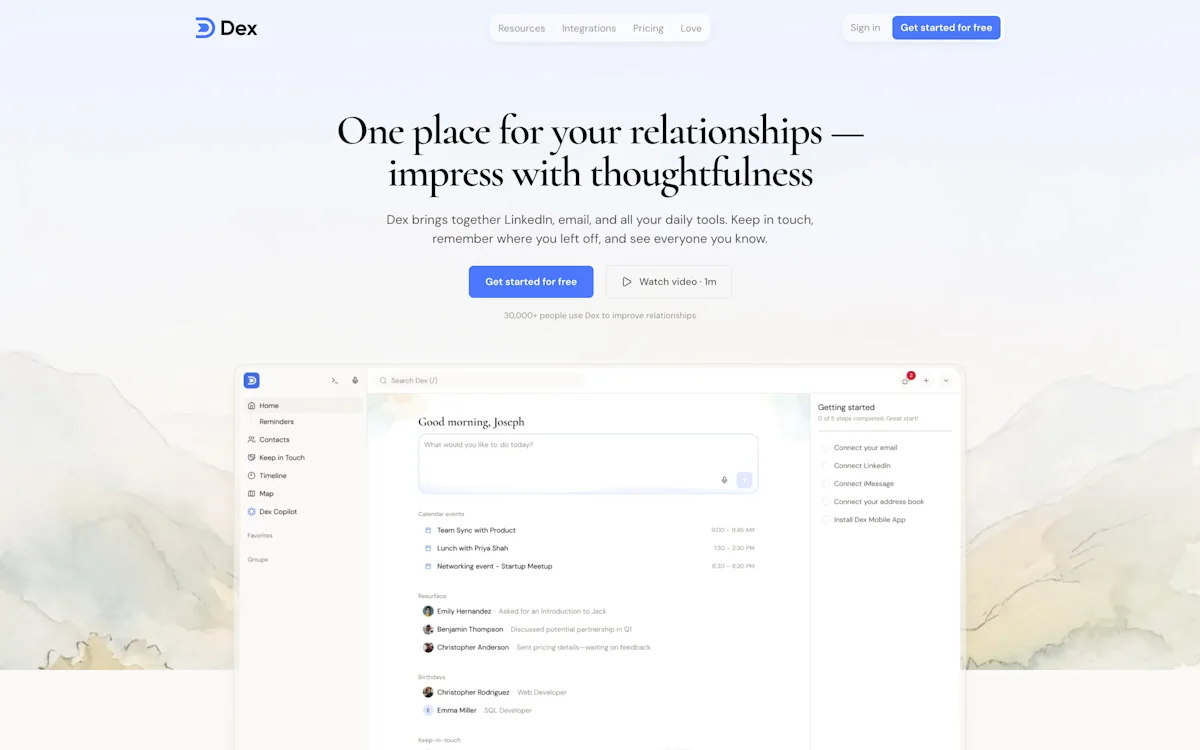
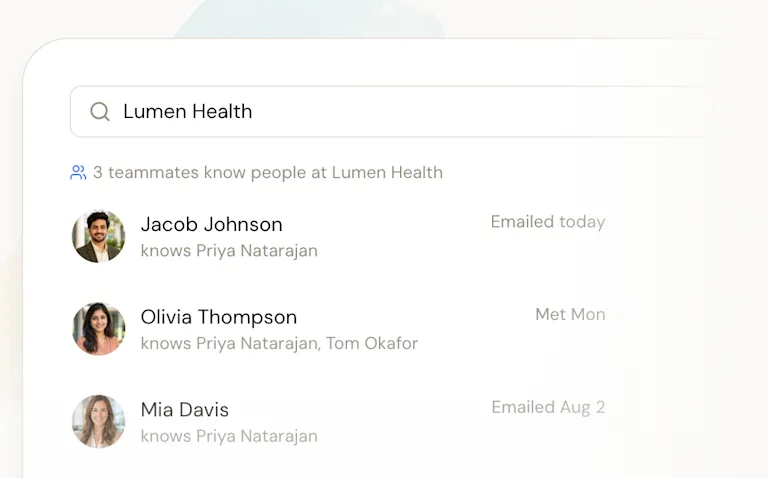
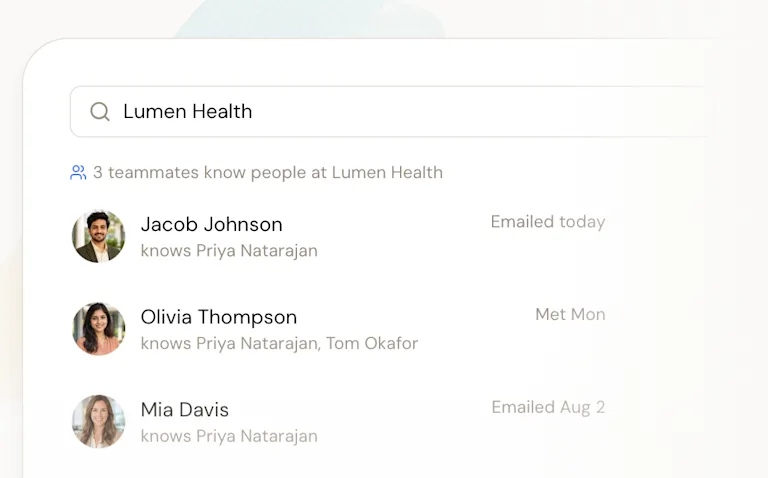
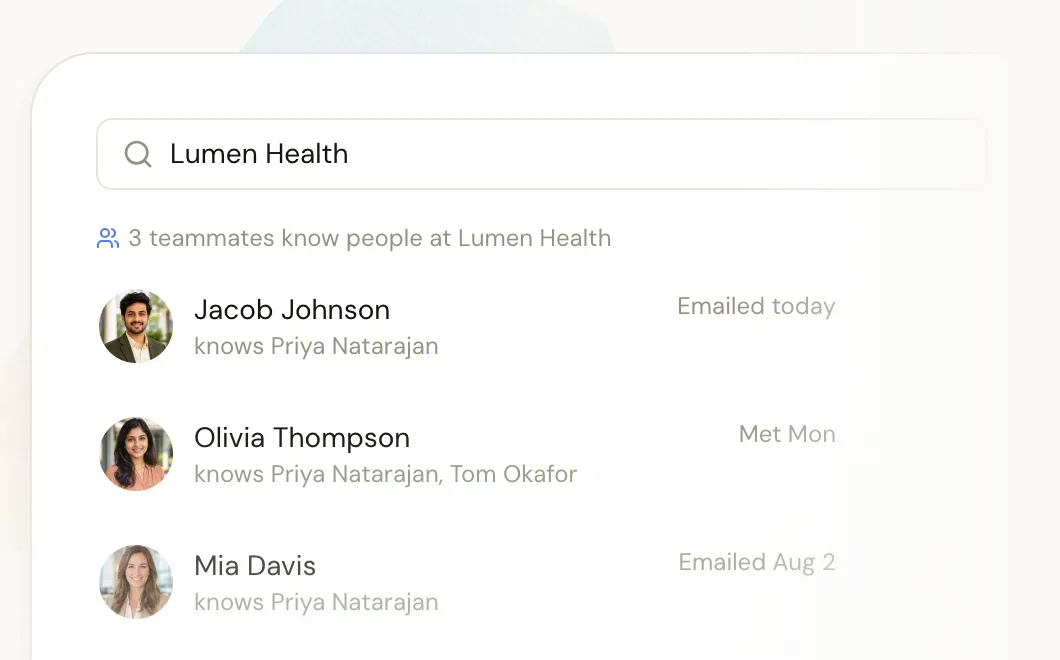
Dex began as a personal CRM and added a shared team workspace, which makes it the closest alternative to Affinity CRM for teams that want the relationship graph without the deal machinery. Search any person or company and Dex for Teams shows which teammates are connected, when each last talked to them, and one shared timeline of emails, meetings, and notes.
Privacy is set per person, like Affinity's selective sync. Everyone keeps their own private Dex, and the workspace is a separate space they add to. Each member chooses whether the team sees just email subject lines and metadata, or full content, and every note can be shared or kept private. Each member's LinkedIn syncs into the workspace about every two days, so the shared network stays current. Team and personal keep-in-touch reminders stop relationships going cold, and the Dex MCP server lets you ask Claude or ChatGPT who on the team knows someone.
Price: $40 per user per month, billed monthly, with CRM integrations, SAML SSO, and 50 research credits a month. The /teams/ page offers a 14-day trial with no card.
Where Affinity is better: deal pipelines, PitchBook and Dealroom data, relationship strength scores, and fund-level permissions. Dex doesn't track deal stages. Teams that need them can run Dex next to a pipeline tool. Venture teams can see how this works in our Dex for venture firms guide.
Best for: agencies, consultancies, nonprofits, partnership teams, and small funds whose real question is "who can introduce us?"
2. Attio: best for startups building a custom CRM
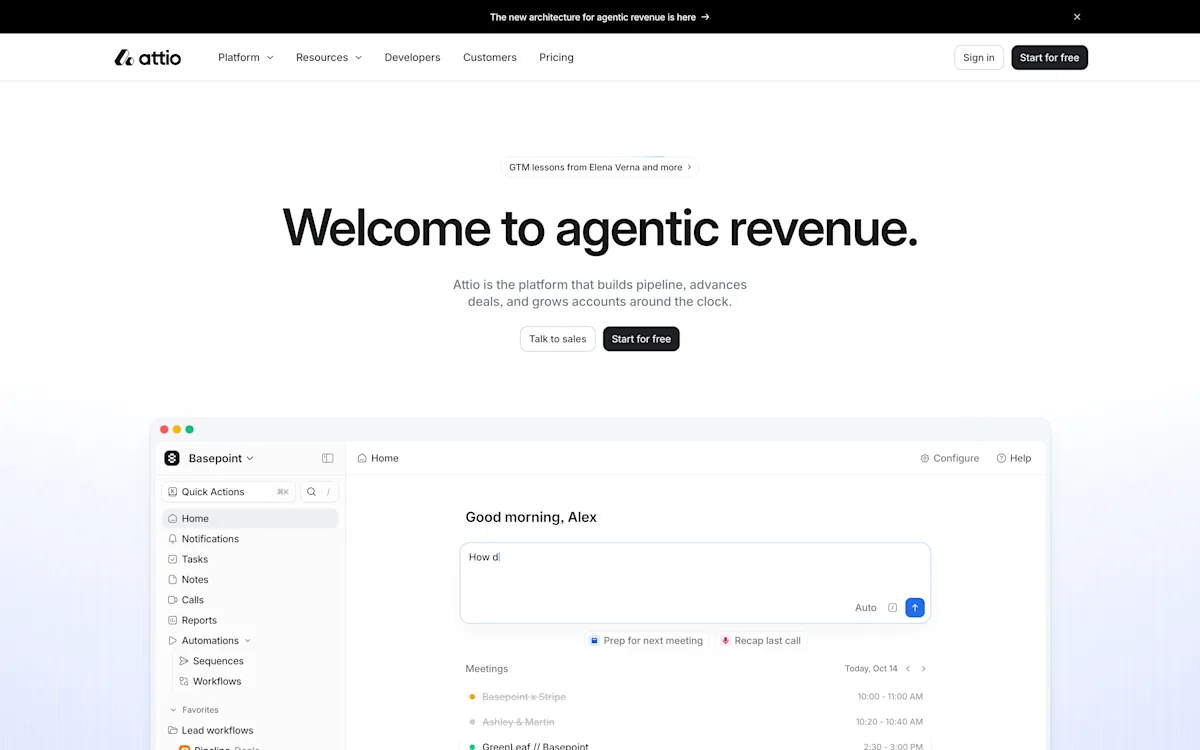
Attio syncs email and calendar, builds records automatically, and shows relationship strength, all inside a data model you design yourself. Many early-stage funds and startups use it as a flexible alternative to Affinity CRM.
Attio vs Affinity: Attio is a general-purpose CRM you shape to fit, with deals, custom objects, and automations. Affinity comes built for dealmaking, with investor data integrations out of the box. Attio is cheaper and has a free plan. Affinity needs less setup for a fund.
Price: free up to 3 users; Plus is $40 a month for the workspace including one user, plus $35 per extra user (annual). Pro is $100 plus $79 per extra user.
Best for: teams with someone who'll own the CRM setup. See our Dex vs Attio comparison.
3. folk: best for small teams that also do outreach
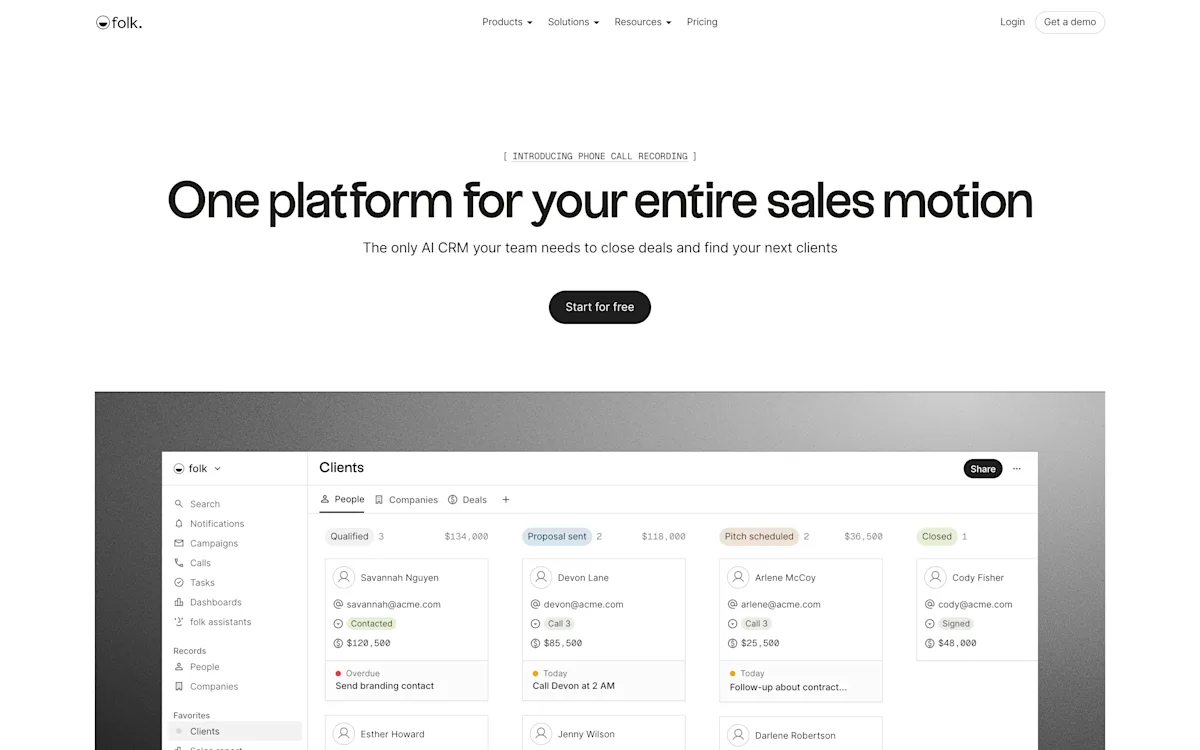
folk syncs email, calendar, and WhatsApp, captures contacts from LinkedIn with a Chrome extension, and adds email campaigns and enrichment on its entry plan. It's the cheapest of the full-featured Affinity alternatives here.
Watch the plan limits. Workspace roles, the API, Zapier, and full interaction history are on Premium at $48 per member, and group-level permissions are on Enterprise.
Price: Standard $24 per member per month (annual).
Best for: small BD, partnership, and fundraising teams that send a lot of outreach. Our folk alternatives guide covers when teams outgrow it.
4. 4Degrees: best for small investment and advisory firms
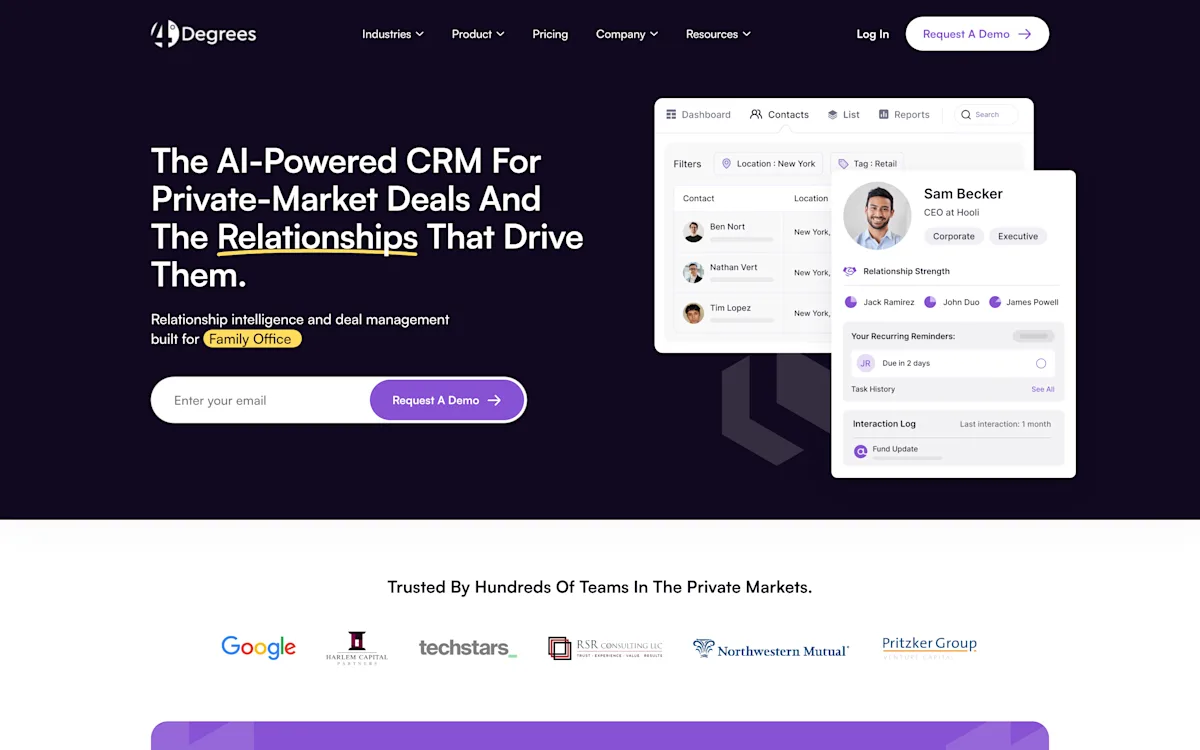
4Degrees is the closest Affinity alternative in focus. It combines relationship intelligence with deal flow management for venture capital, private equity, M&A advisory, commercial real estate, and consulting firms, and it was designed by former investors.
It doesn't publish prices. The pricing page says it charges per user per month and asks you to fill in a form for a quote. Customers on its site describe it as more affordable than other deal flow tools, but you'll need a sales call to find out. If Affinity pricing is the blocker, ask 4Degrees for a quote alongside it.
Price: quote only, per user per month.
Best for: small funds and advisory firms that want an Affinity-style deal pipeline at a lower price.
5. HubSpot: best for teams growing a sales function
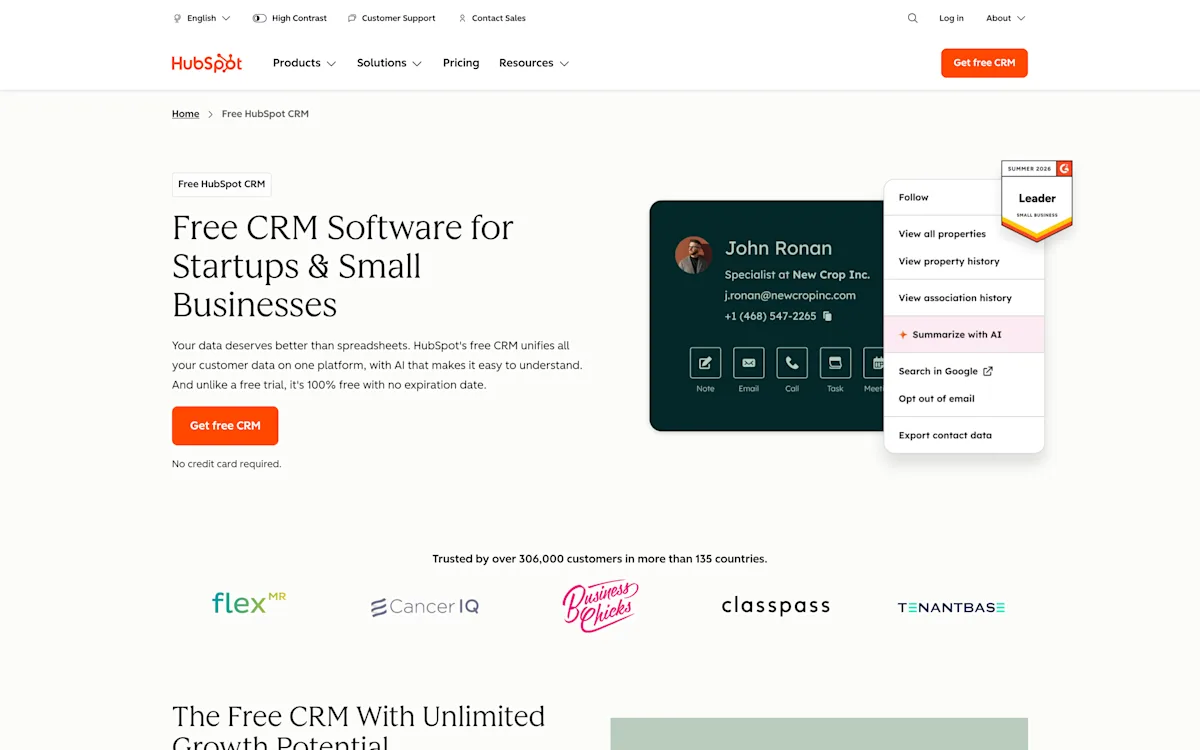
HubSpot isn't a relationship intelligence tool in the Affinity sense, but many small firms pick it because it does contacts, deals, email tracking, and marketing on one platform. The free CRM covers 2 users.
The paid tiers add up fast. Sales Hub Professional is $90 per seat per month on annual billing plus a $1,500 onboarding fee, so a five-person team pays about $6,900 in year one.
Price: free for 2 users; Starter from $20 per seat; Professional $90 per seat (annual) plus $1,500 onboarding.
Best for: teams that care more about a sales and marketing pipeline than who-knows-whom.
6. Cloze Business: best for service businesses on a budget
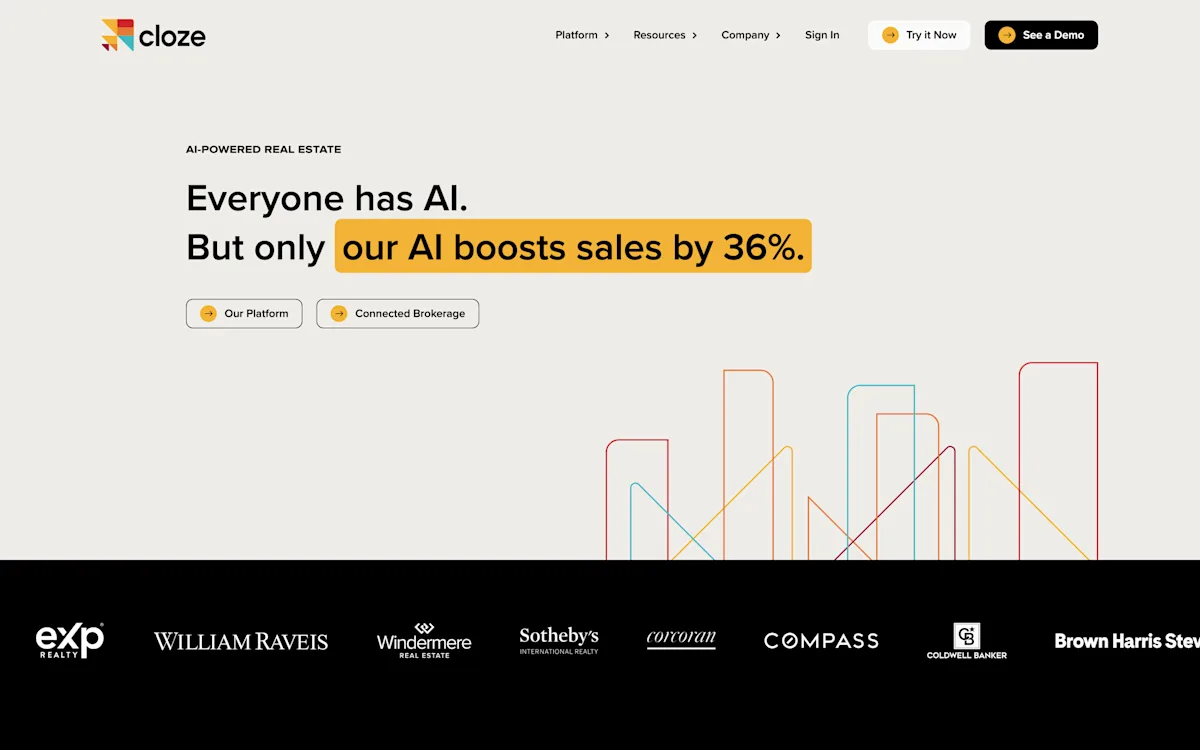
Cloze captures email, calendar, and phone activity and suggests who to follow up with. It has moved toward real estate and other service businesses, with industry integrations, and it has no LinkedIn integration.
Price: Business Silver $21, Gold $29, Platinum $42 per user per month (annual). 14-day trial, no card.
Best for: financial advisors, insurance, and real estate teams that want follow-up prompts more than relationship mapping. See our Dex vs Cloze comparison.
7. Copper: best for Google Workspace teams
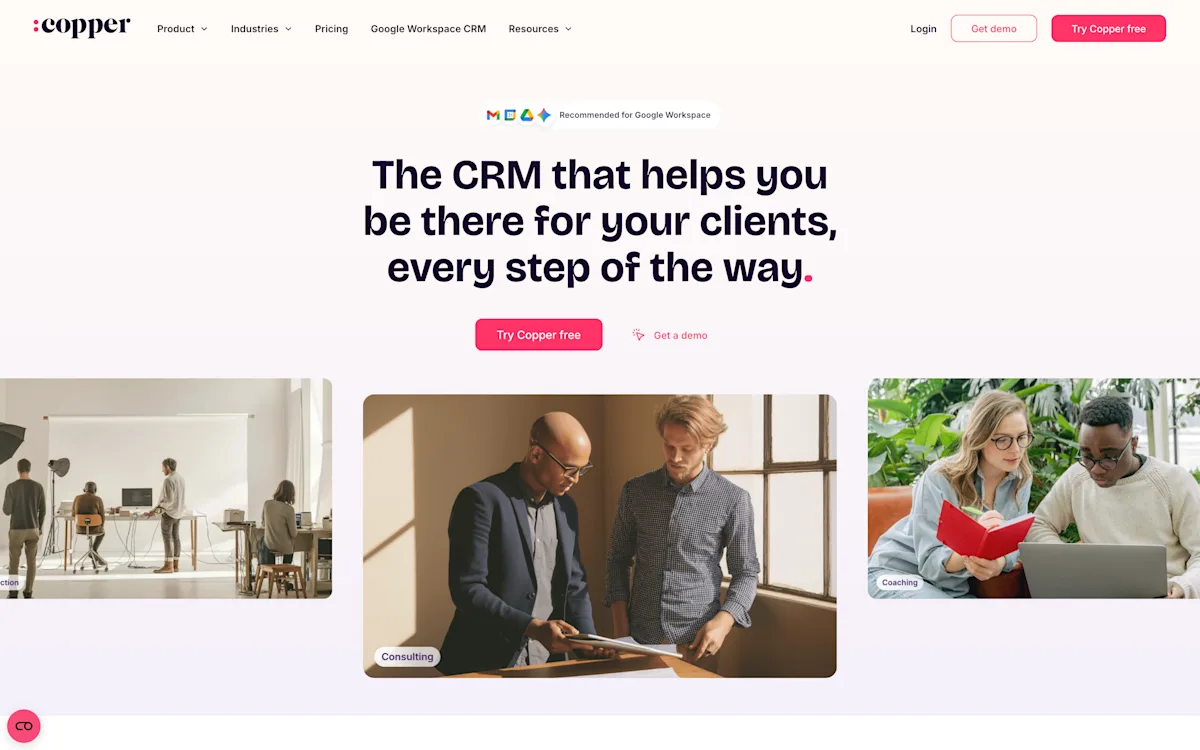
Copper pulls contacts and conversations from Gmail and Google Calendar and shows the CRM in a Gmail sidebar. It handles pipelines and team collaboration on Basic, with workflows and bulk email on Professional.
Price: Basic $23, Professional $59, Business $99 per seat per month (annual). You can start free without a card.
Best for: small firms fully on Google Workspace. It's a poor fit if anyone uses Outlook.
What about Introhive?
Introhive is the other big relationship intelligence name, aimed at professional services firms like law and accounting. Like 4Degrees, it's quote-only, and it's built for large firms rolling out to hundreds of people, so it rarely makes sense for a small team.
Who this isn't for
If your firm runs on deal flow, pulls PitchBook data every day, and needs fund-level permissions for compliance, stay on Affinity CRM. The Affinity cost makes sense for that work, and switching would cost you features you use. The same goes for firms with dozens of investment professionals, where Affinity's firm-wide graph gets more useful as more people join. The alternatives here are for teams of roughly 2 to 20 people who want the relationship intelligence part of Affinity without paying for the rest.
FAQ
How much does Affinity CRM cost?
Affinity CRM costs $2,000 per user per year on Essential, $2,300 on Scale, and $2,700 on Advanced, billed annually. Enterprise is custom. A five-person team pays $10,000 a year on Essential.
Does Affinity have a free trial?
Affinity's pricing page lists no free trial or free plan. Every tier routes to "Contact sales."
What are the best Affinity alternatives for small teams?
Dex for Teams for who-knows-whom search and shared relationship history, Attio and folk for flexible CRMs with pipelines, 4Degrees for small investment firms, and Cloze or Copper for the lowest price.
Attio vs Affinity: which is better?
Affinity is better for venture and private equity firms that want deal flow tools and investor data built in. Attio is better for startups and small teams that want a flexible, cheaper CRM with a free plan for up to 3 users.
What is relationship intelligence in a CRM?
It's the layer that reads email, calendar, and contact data to show who on your team knows whom, how strong each connection is, and the warmest path to an introduction.
Can I move from Affinity to another CRM?
Yes. Export your lists from Affinity as CSV and import them into the new tool. Dex supports CSV import. Then have each person connect email and calendar so history fills back in.
The bottom line
Affinity CRM is a strong product for deal teams, and Affinity pricing reflects that: $2,000 to $2,700 per user per year, sold through sales, with no listed trial. If your firm uses the deal pipeline, the investor data, and the permissions every day, the Affinity cost is justified.
Most small teams only need part of it. If you want Affinity's relationship intelligence for small teams (who knows whom, a shared history for each contact, and privacy each person controls), Dex for Teams does that for $40 a user. Attio and folk add flexible pipelines, 4Degrees suits small funds, and Cloze and Copper keep costs lowest. Of the Affinity alternatives here, pick the one that matches the part of Affinity you'd actually use.
Start your free Dex trial and see who your team knows by the end of the day.
Related guides