Dex vs Affinity: CRM for Real Estate Investors in 2026
Affinity is a deal-team platform starting at $2,000 per user per year with no self-serve signup. Dex is a relationship CRM at $12/month. For a real estate investor, the split is whether the network being tracked belongs to a firm or to you.


Most software built for this job is not built for you. Search for a CRM for real estate investors and you get lead-routing tools for listing agents, drip campaigns for buyer inquiries, and transaction pipelines that assume a closing date already exists. None of that describes acquisitions work, where the deal you close in November came from a broker you met at a conference two years ago and stayed in touch with for no particular reason.
Affinity and Dex are two of the few products that take the relationship itself as the object rather than the transaction. They arrive at wildly different prices. Affinity starts at $2,000 per user per year. Dex is $12 a month. That is not a small gap, and it is not arbitrary either.
Here is what the money is actually buying, and how to tell which side of the line you are on.
Fast facts:
Affinity is a relationship intelligence CRM for private capital: venture, private equity, investment banking, and commercial real estate deal teams.
Affinity CRM pricing runs $2,000 per user/year on Essential, $2,300 on Scale, and $2,700 on Advanced, with Enterprise custom. Every tier is behind a "Contact sales" button.
Dex is a relationship CRM at $12/month for Premium and $20/month for Professional on annual billing, with a 7-day free trial.
Affinity's model is the firm's collective network. Dex's model is one person's network, which stays yours when you leave.
Both automatically capture email and calendar activity. Only Dex tells you when a contact changes jobs, which is the moment a broker becomes reachable at a new shop.
What Affinity is built for
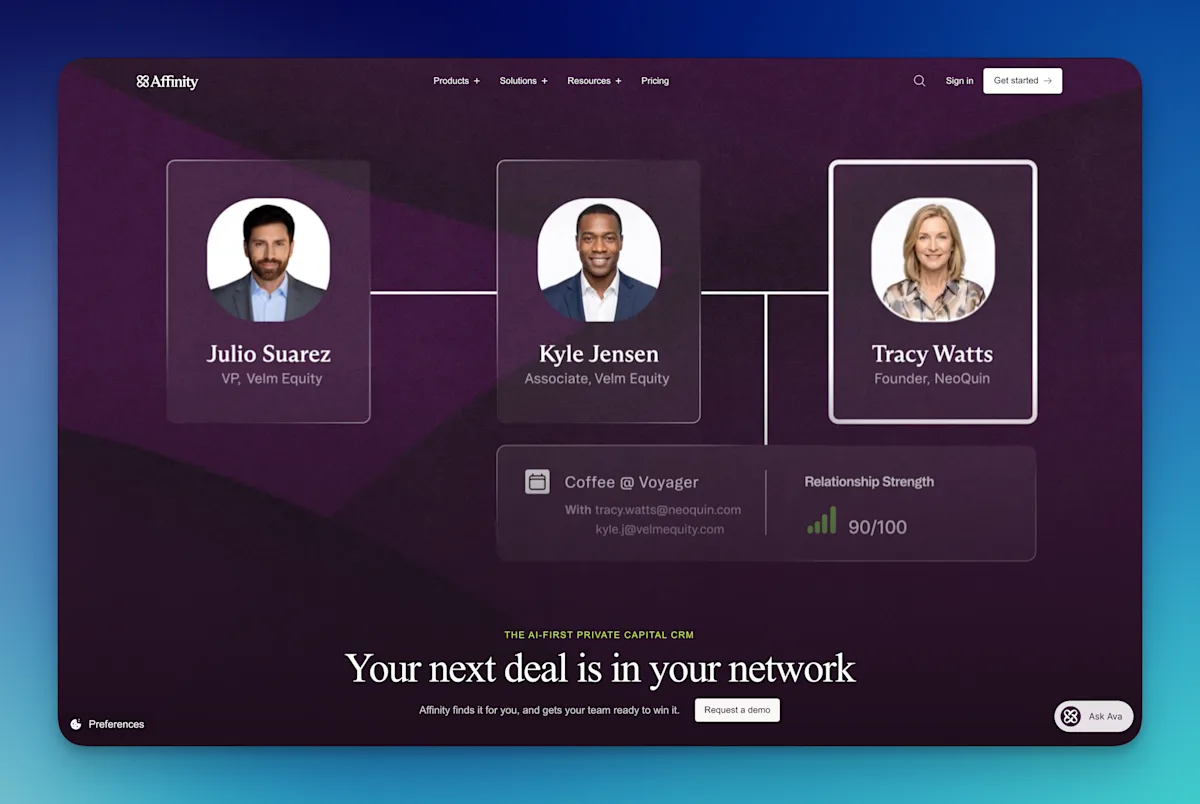
Affinity's landing page. Photo taken from: affinity.co.
Affinity sells to firms, and the product makes sense once you accept that framing. It reads the email and calendar traffic of everyone at the firm, builds a graph of who knows whom and how well, then scores those relationships from real communication patterns rather than from whatever a partner remembered to type in.
The payoff is the warm-path question. A seller's counsel is someone your firm needs to reach. Affinity can tell you that an associate two desks over exchanged forty emails with them last year. That is a real answer to a real problem, and it is a problem you cannot have alone.
The plan structure follows the same logic. Essential covers activity capture, relationship scoring, interaction history, and deal pipeline tracking. Scale adds a meeting notetaker, AI chat, and inferred network connections. Advanced brings enrichment from PitchBook, Dealroom, and Crunchbase plus packaged Salesforce, Slack, and Box integrations. Enterprise handles fund-level permissions, SSO, and unlimited API access for firms running several vehicles at once.
Affinity also publishes its own buyer's guide to CRM software for real estate investors, and reading it tells you plainly who it is for. The language is "your firm," "your team," portfolio management at scale.
What Dex is built for
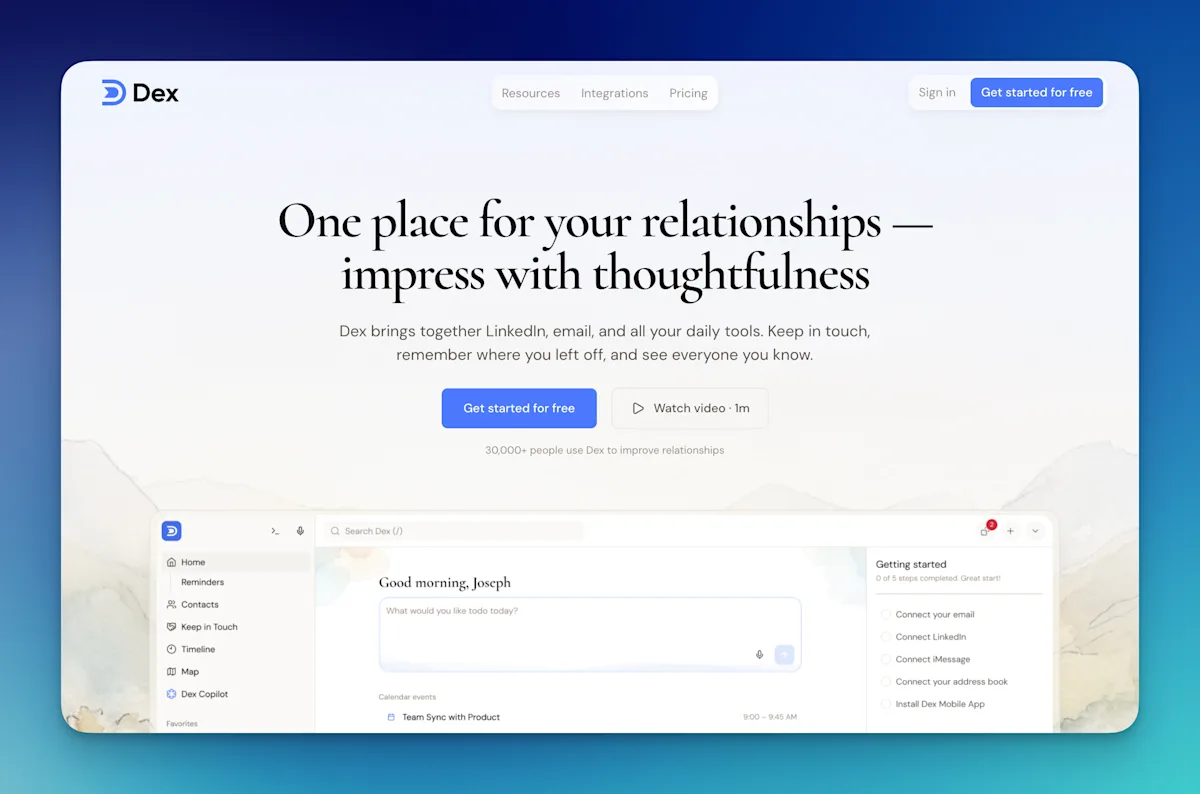
Dex's landing page. Photo taken from: getdex.com
Dex is a relationship CRM for an individual. It pulls contacts from LinkedIn, Gmail, Outlook, calendar, WhatsApp, iMessage, and a whole lot more (see: integrations) then puts a keep-in-touch cadence on the ones that matter so they resurface instead of decaying.
A few pieces of it map unusually well onto acquisitions work.
Keep-in-touch cadences are the whole game with brokers. A broker who hears from you twice a year remembers you when something quiet comes across their desk. A broker who hears from you when you want something does not. Dex lets you set that rhythm per contact and then stops you from forgetting.
Job change alerts, pulled from LinkedIn, catch the thing that silently kills a sourcing network. Brokers move houses constantly. When your contact at one shop lands at another, that is both a congratulations note and a new set of listings, and it is exactly the update you would otherwise learn about eight months late.
Map view puts your contacts on geography. For anyone who buys in specific submarkets, seeing which property managers, lenders, and brokers you already know inside a given metro before you fly there is more useful than it sounds on paper.
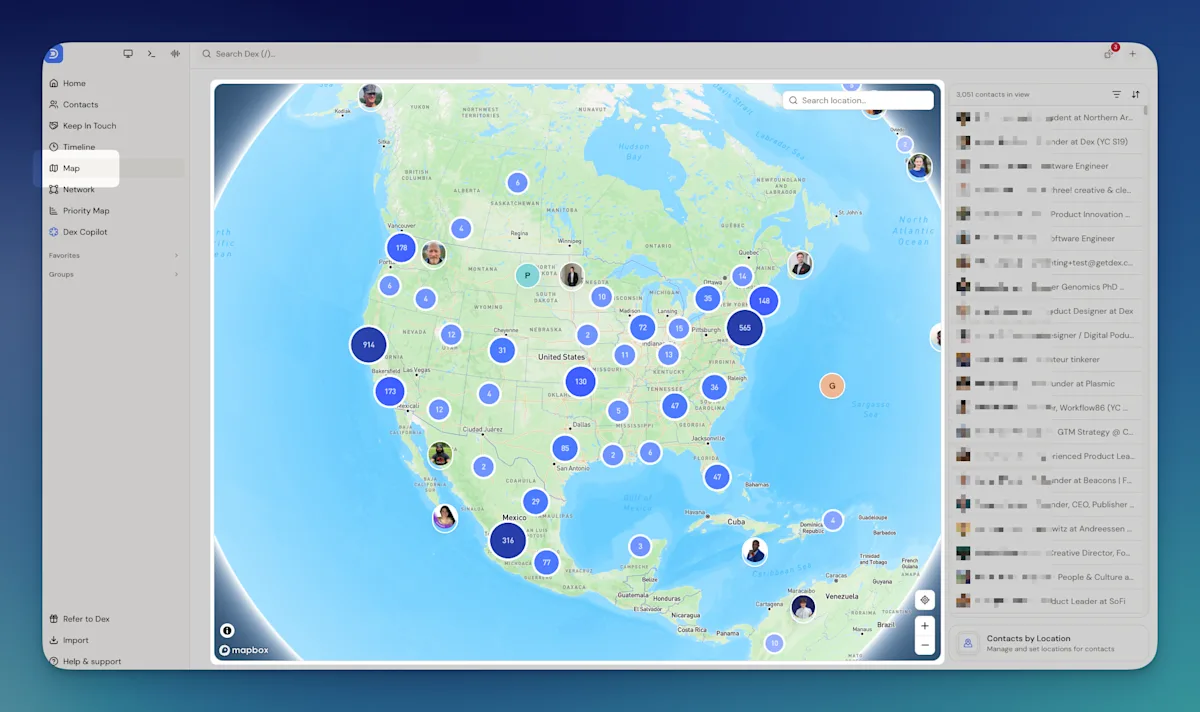
Dex's Map View
Notes, tags, and custom fields carry the rest: which asset classes a seller likes, what an LP said about their check size, the cap rate a broker mentioned in passing.
The dividing line for real estate investors: whose network is it
Feature grids will not settle this, because the overlap is genuine. Both products capture activity automatically. Both keep an interaction history. Both are trying to stop good relationships from going stale.
The split is ownership.
Affinity treats the network as firm property. That is correct for a firm. When an analyst leaves, their relationships stay in the system, and the next person picks up a warm thread instead of a cold one. Everything in the product follows from that premise: shared pipelines, permissioning, admin controls, seat-based pricing.
Dex treats the network as personal property. Your brokers, your lenders, your LPs, your contractors, your one guy who always knows when a family is about to sell. That set follows you between deals, between partnerships, and between firms.
Ask which sentence describes your situation and the decision usually makes itself. Most people evaluating a CRM for real estate investors are not sitting in an investment committee. They are one or two or three people who need to remember five hundred humans, and the collective-network problem Affinity solves elegantly is not a problem they have yet.
| Affinity | Dex |
|---|---|---|
Built for | Deal teams at private capital firms | Individual investors and small teams |
Network model | Firm-wide, shared, permissioned | Personal, portable |
Entry price | $2,000/user/year | $144/year ($12/mo annual) |
Self-serve signup | No, contact sales on every tier | Yes, 7-day free trial, no card |
Automatic activity capture | Yes, firm-wide email and calendar | Yes, personal email and calendar |
Relationship scoring | Yes, core feature | Cadence-based, not scored |
Warm intro paths across colleagues | Yes | No |
Deal pipeline tracking | Yes | Custom fields and tags, not a pipeline |
Job change alerts | Not surfaced as alerts | Yes, via LinkedIn sync |
Contacts by geography | No | Yes, map view |
Data enrichment | PitchBook, Dealroom, Crunchbase (Advanced) | Research credits, 10 to 50/month by plan |
WhatsApp and iMessage sync | No | Yes |
Affinity CRM pricing against a real estate investor's budget
This is where the comparison stops being close.
Plan | Price | 1 seat/year | 3 seats/year |
|---|---|---|---|
Affinity Essential | $2,000/user/year | $2,000 | $6,000 |
Affinity Scale | $2,300/user/year | $2,300 | $6,900 |
Affinity Advanced | $2,700/user/year | $2,700 | $8,100 |
Affinity Enterprise | Custom | Contact sales | Contact sales |
Dex Premium | $12/month annual | $144 | $432 |
Dex Professional | $20/month annual | $240 | $720 |
Affinity Essential costs roughly fourteen times Dex Premium per seat. Third-party procurement data puts typical Affinity annual contracts in the $15,000 to $40,000 range once seat counts and tiers settle out, which tells you the size of buyer the sales motion is built around.
There is also no way to try it. Every tier routes through a sales conversation, so the evaluation itself costs you a week of calls before you see the product against your own data. Dex is a signup and a 7-day trial with no card. For a solo investor, that difference in friction matters nearly as much as the price, and it is the main reason people go looking for an Affinity CRM alternative in the first place.
None of this makes Affinity overpriced. A fund closing eight-figure acquisitions recovers $2,700 on a single avoided miss. It makes Affinity mispriced for a specific reader, which is the one deciding whether to spend $200 or $8,000 on a CRM for real estate investors this year.
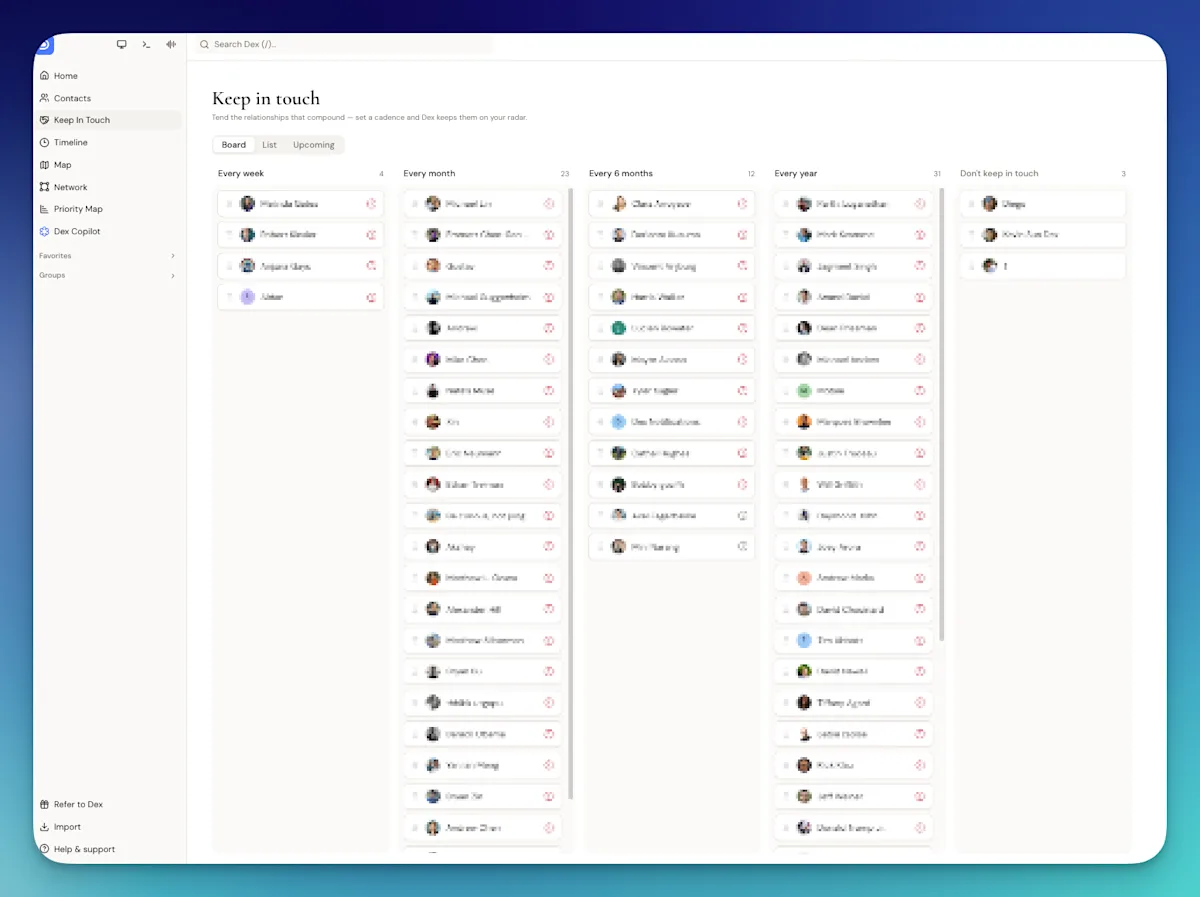
Dex's Keep-In-Touch Kanban Board
What a quarter of sourcing looks like in each CRM
In Affinity, a quarter looks like pipeline. Deals move through stages, the team sees who owns which relationship, activity logs itself, and analytics tell the partners where flow is coming from. Someone runs a report. The value compounds with headcount, because every additional colleague adds edges to the graph.
In Dex, a quarter looks like a list. Forty-two brokers, lenders, property managers, and past sellers, each on a cadence you set once. Twelve are due this week. You send twelve short notes that reference the last real conversation, because the last real conversation is on the screen. Two of them mention something not yet listed.
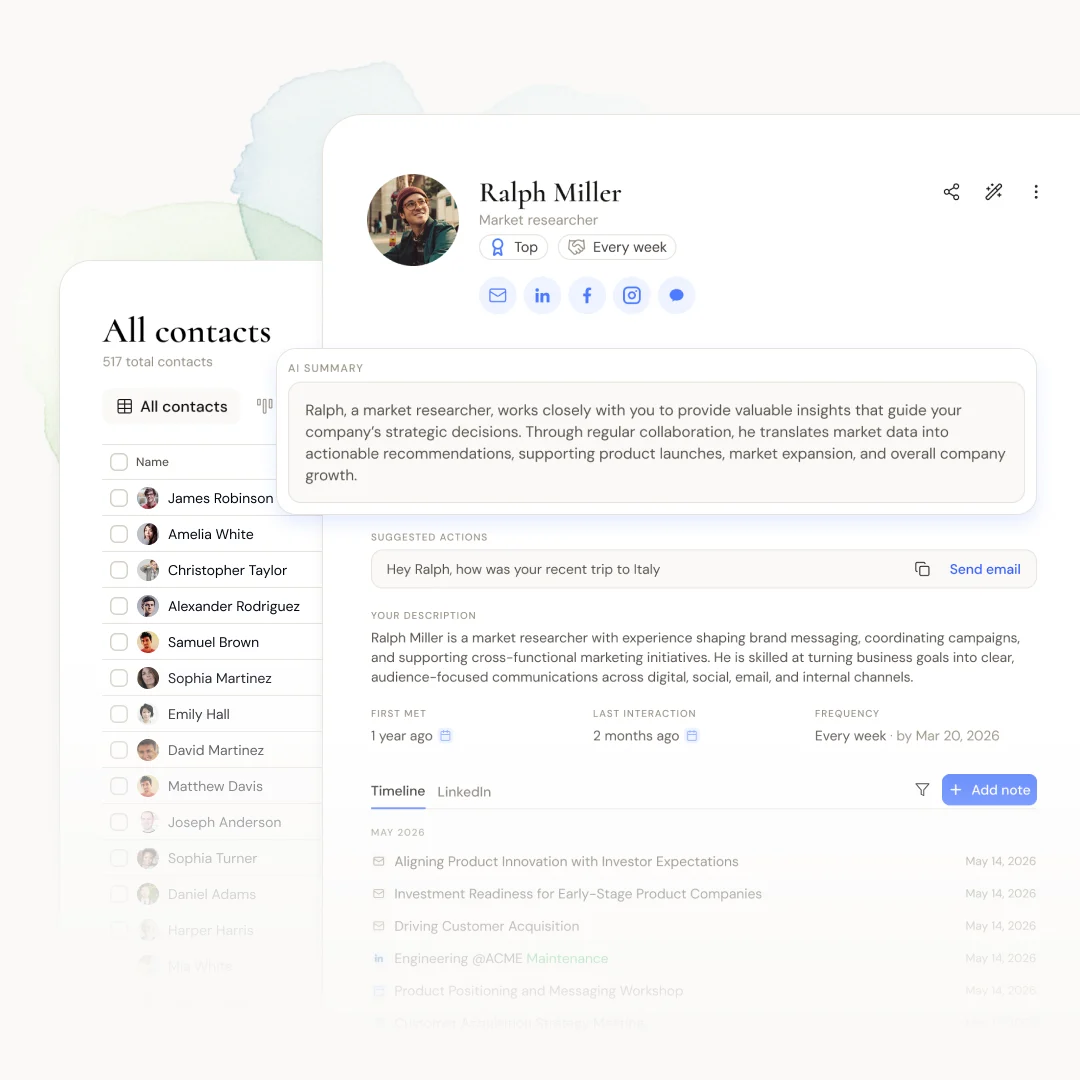
A peek into what a Dex contact looks like. Featuring: AI summary
The second version is not more sophisticated. It is what actually happens when nobody else is going to make the call. The NAR reports that Realtors typically earn 20% of their business from repeat clients and another 21% from referrals by past clients, and that among agents with sixteen or more years in the business, 40% say repeat clients make up more than half their book (NAR, 2025 Profile of Home Buyers and Sellers). Nobody publishes the investor version of that number, but anyone who has been buying for a decade recognizes the shape of it. The pipeline is mostly people you already know, and keeping them takes upkeep.
Where Affinity is the better buy
I would rather say this straight than pretend the comparison runs one way.
If your firm has an investment committee, buy Affinity. Shared pipeline visibility, permissioning, and firm-wide relationship scoring are the product, and Dex has no answer to any of the three.
If the warm-path question comes up often, which it does the moment you have more than about five people, Affinity's graph across everyone's inbox is a category of information Dex structurally cannot produce from one person's data.
If you need enrichment on entities and sponsors, Advanced wires in PitchBook, Dealroom, and Crunchbase. Dex's research credits are a lighter tool aimed at a different job.
If compliance, SSO, fund-level permissions, or data retention policies are in the conversation, that is an Enterprise CRM purchase, and Dex's Enterprise plan is a smaller version of the same idea rather than a peer.
Affinity's own research claims relationship intelligence lifts deal flow and pipeline by 25% and shortens time to close by the same margin. Treat vendor numbers as vendor numbers, but the mechanism is real, and it needs a team for the math to work.
Who this isn't for
If you are a listing agent working inbound buyer leads, neither of these is your tool. You want a transaction CRM with lead routing and drip campaigns. We covered the closest personal-CRM-shaped option in our Cloze CRM review, since Cloze pivoted hard toward agents. If you are an agent who works by referral, see how Dex works as a real estate CRM for your sphere.
If you need a sales pipeline with forecasting and quota attached, you want a sales CRM, and we wrote about why sales CRMs and relationship CRMs are built on different objects.
If you manage tenants, leases, and maintenance requests, that is property management software. A relationship CRM will not do it and should not try.
If you own three doors and know everyone involved by first name, use your phone's contacts. Software will not add anything yet.
If your firm requires that every contact record live in a company system, a personal CRM alongside it just creates a second copy to go stale.
Choosing a CRM for real estate investors
A few things worth carrying out of this.
Affinity is a genuinely strong product aimed at firms, priced from $2,000 per seat per year, with no self-serve path in. Dex is $12 a month with a free trial you can start in the next two minutes. The gap is not a feature gap so much as a buyer gap.
What decides it is ownership rather than features. Affinity models a firm's shared network, Dex models yours. Affinity wins the moment colleagues' inboxes become part of the answer, and it wins decisively. Dex wins when the person doing the following up is you, alone, across brokers and lenders and sellers who have no reason to remember you unless you give them one.
The failure mode almost nobody buys software to fix is the quiet one, where a deal is lost not to a missing pipeline stage but because a good conversation in March had nothing attached to it by September.
If you are one investor or a small team choosing a CRM for real estate investors this year, start with the cheap end and find out whether your problem was ever really tooling. Start your free 7-day Dex trial.
Frequently Asked Questions
How much does Affinity CRM cost?
Affinity lists Essential at $2,000 per user per year, Scale at $2,300, and Advanced at $2,700, with Enterprise priced custom. Every tier routes through a sales conversation rather than a self-serve checkout. Third-party procurement listings put typical annual contracts between $15,000 and $40,000.
Is Affinity a good CRM for real estate investors?
For firms, yes. Affinity publishes a buyer's guide aimed at commercial real estate investment teams, and its relationship scoring across a whole firm's email and calendar traffic is built for exactly that setting. For a solo investor or a two-person acquisitions shop, the per-seat price and the missing trial make it a poor fit long before the feature list matters.
What is the best Affinity CRM alternative for a solo investor?
Dex covers the part of Affinity that one person actually uses: automatic contact capture from email, calendar, LinkedIn, and messaging, plus keep-in-touch cadences, notes, and job change alerts. It is $12 a month on annual billing and starts with a 7-day free trial with no credit card. If you want the wider field before deciding, our comparison of relationship CRMs for networking covers the rest of the category.
Can Dex track deals and a pipeline?
Not as a stage-based pipeline. Dex is organized around people rather than deals, though custom fields and tags handle lightweight tracking such as asset class, submarket, or LP check size. Anyone who needs real pipeline stages and forecasting should pair Dex with a deal tool or buy a deal-team CRM.
Does Dex tell me when a broker changes firms?
Yes. Dex pulls job change alerts through LinkedIn sync, which covers up to 2,500 connections on Premium and 9,000 on Professional. Brokers move between shops constantly, and the move is usually the best moment to reach out.
Do I need a relationship CRM if I already use property management software?
They solve different problems. Property management software tracks tenants, leases, and maintenance on assets you already own. A relationship CRM tracks the brokers, lenders, sellers, and partners who bring you the next one. Most investors past a few properties end up running both.
Related reading: Best personal CRM for networking · Networking CRM: the best way to manage your contacts · Best CRM for small business owners · Dex vs Attio