7 Best folk Alternatives for Small Teams
The best folk alternative depends on why you're leaving. Dex for Teams suits relationship-first teams that need who-knows-whom search. Attio fits teams that want a custom data model, Pipedrive and HubSpot fit pipeline-driven sales, Copper and Streak live inside Google Workspace, and Cloze suits service businesses.


folk is one of the friendliest CRMs a small team can buy. It's $24 per member per month on annual billing, it pulls contacts from LinkedIn and Gmail in a click, and it doesn't ask for a credit card to start a trial. Most people looking for a folk alternative still like folk. Something specific stopped fitting, and the fix depends on what that was.
Maybe the team needs Zapier or the API, which folk's pricing page only includes from Premium at $48 per member. Maybe you want workspace roles, more than one synced inbox per person, or a CRM that answers "who on our team knows this person?" instead of "what's in this pipeline?" Those point to different tools.
This guide lists seven folk alternatives for small teams, what each does better than folk, what it does worse, and what five users cost per month. Prices come from each vendor's pricing page in November 2026.
Fast facts:
folk Standard is $24 per member per month (annual). Zapier, Make, the REST API, workspace roles, and full interaction history start on Premium at $48.
The cheapest folk alternatives for a 5-person team are Cloze Business Silver ($105 a month), Copper Basic ($115), and Pipedrive Growth ($120). Attio is free for up to 3 users.
Dex for Teams ($40 per user, billed monthly) is the pick for teams that run on relationships and warm intros rather than a sales pipeline.
HubSpot and Pipedrive are better than folk for pipeline-heavy sales teams. Copper and Streak suit teams that live in Gmail.
Every tool on this list offers a free plan or a free trial. Most don't ask for a card.
Why small teams look for a folk alternative
folk does a lot well: unlimited contacts on every plan, email campaigns, AI fields, a Chrome extension, WhatsApp sync, and a mobile app on iOS and Android. The reasons people go looking for a folk CRM alternative tend to come from the plan limits, not the product's basics.
What the team needs | Where it is in folk | Folk alternative that fixes it |
|---|---|---|
Zapier, Make, or API access | Premium ($48) | Attio, HubSpot, Pipedrive |
Workspace roles (owner, admin, member) | Premium ($48) | Dex for Teams, Attio |
More than one synced email or calendar per person | Premium (5 per member) | Dex for Teams |
Full interaction history | Premium ($48) | Dex for Teams, Cloze |
Group-level permissions | Enterprise ($80+) | Dex for Teams (per-person sharing) |
"Who on our team knows this person?" | Not a core feature | Dex for Teams |
Forecasting and deal-stage reporting | Dashboards on Premium | Pipedrive, HubSpot |
If none of those rows describe your problem, stay on folk. Switching CRMs means a few weeks of cleanup, and folk Standard is good value for a small team that mostly tracks contacts and sends campaigns. Our folk CRM review covers the product in more detail.
folk alternatives compared
Here are the seven folk alternatives side by side, with folk for reference. "5 users per month" uses the lowest plan most small teams would buy, on annual billing where the vendor offers it.
Tool | Best for | Entry price | 5 users per month | Free trial or plan |
|---|---|---|---|---|
folk (reference) | Contacts plus outreach | $24 per member | $120 | 14-day trial, no card |
Dex for Teams | Relationship-first teams | $40 per user, monthly | $200 | 14-day trial, no card |
Attio | Custom data models | Free up to 3 users; Plus $40 workspace + $35 per extra user | $180 | Free plan |
HubSpot Sales Hub | Growing sales teams | Free for 2 users; Starter from $20 per seat | $100 | Free plan |
Pipedrive | Pipeline-first selling | Lite $14, Growth $24 per seat | $120 (Growth) | 14-day trial, no card |
Copper | Google Workspace teams | Basic $23 per seat | $115 | Free start, no card |
Streak | Teams that live in Gmail | Pro $49 per user | $245 | 14-day trial on Pro+ |
Cloze Business | Service businesses | Silver $21 per user | $105 | 14-day trial, no card |
Sources: Attio pricing, Pipedrive pricing, HubSpot, Copper, Streak, and Cloze pricing pages, and the Dex for Teams page. Prices change often, so check before you buy.
How to choose the best CRM for small teams
Picking the best CRM for small teams starts with four questions. Answer them before you look at the list, and they'll cut it from seven tools to two.
What's the one job? If it's "close more deals," you want a pipeline CRM. If it's "stop losing track of people and find warm intros," you want a relationship CRM. folk sits between the two, which is why teams that lean hard either way outgrow it.
Where does your team already work? Gmail-only teams get the most from Copper or Streak. Teams split across Gmail, Outlook, LinkedIn, and WhatsApp need broader sync.
What can each person keep private? On a small team, people won't connect their inbox if the whole company can read it. Check whether sharing is set per person or per company.
How many seats will be used every week? Price out only those. Seats for people who log in once a month are the easiest money to save on a CRM for small teams.
Then trial your top two with real contacts for two weeks. Our guide on how to pick a CRM for teams has a checklist for that trial.
1. Dex for Teams: best for relationship-first teams
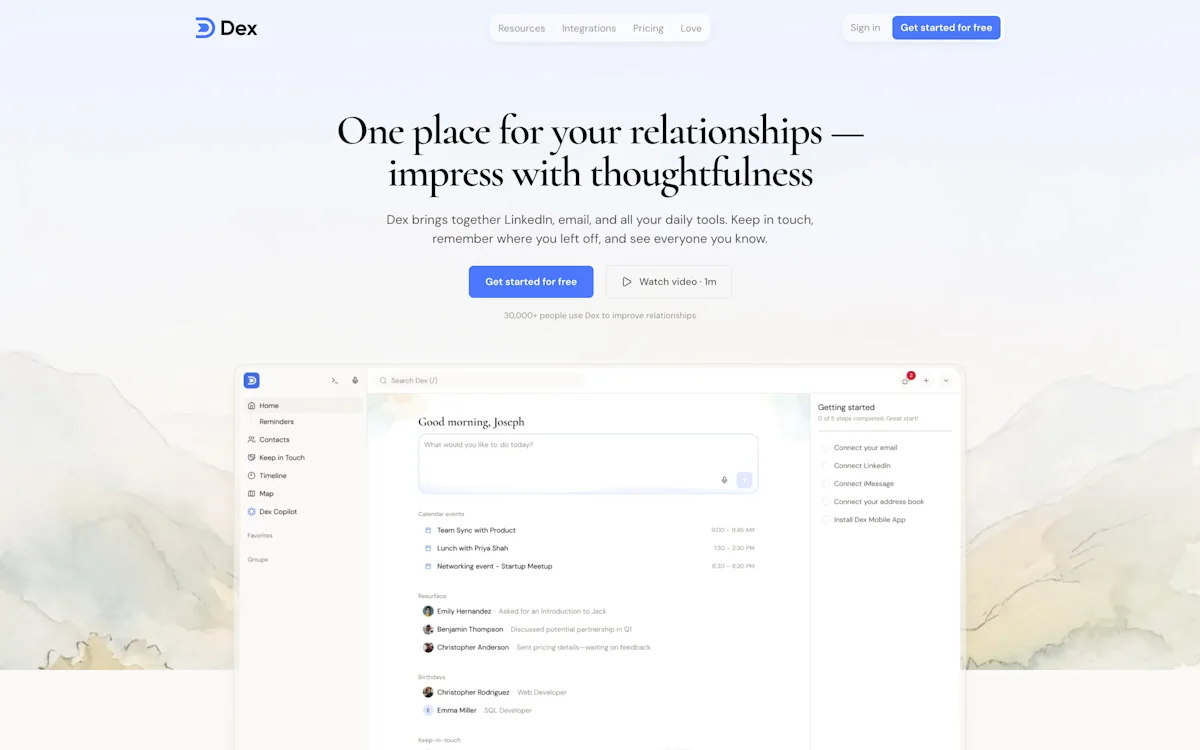
Dex is a personal CRM that added a shared team workspace. Everyone keeps their own Dex, and the workspace is a separate space they add to it. That matters for small teams, because people choose which accounts and contacts the team sees, and nothing from someone's personal Dex is shared unless they add it.
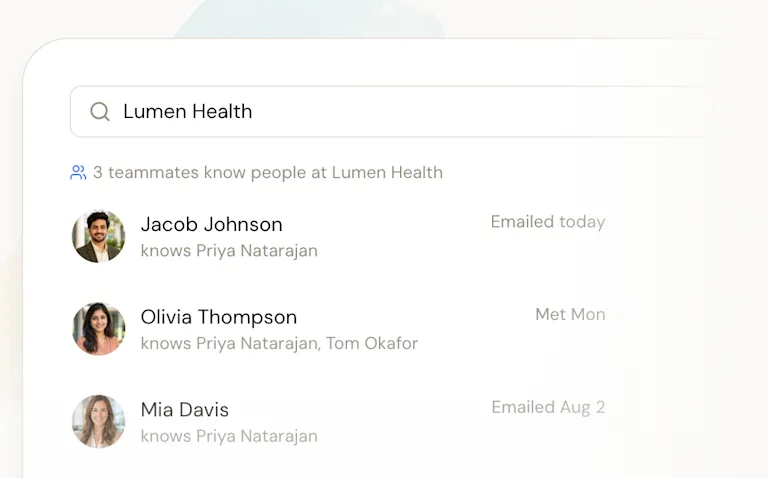
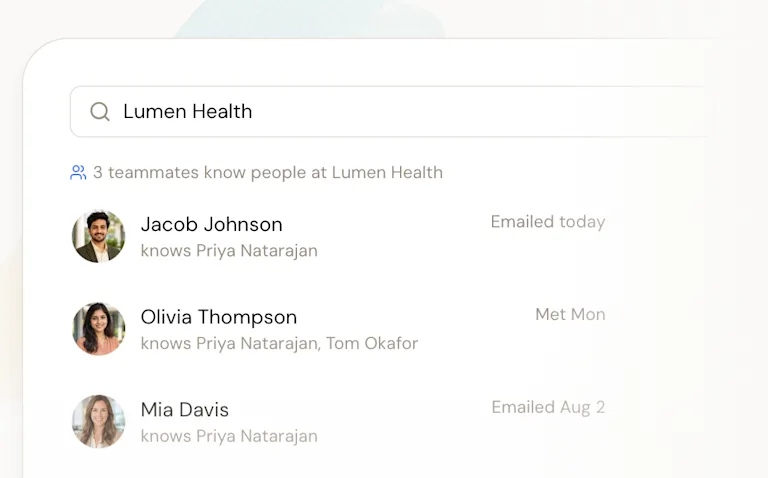
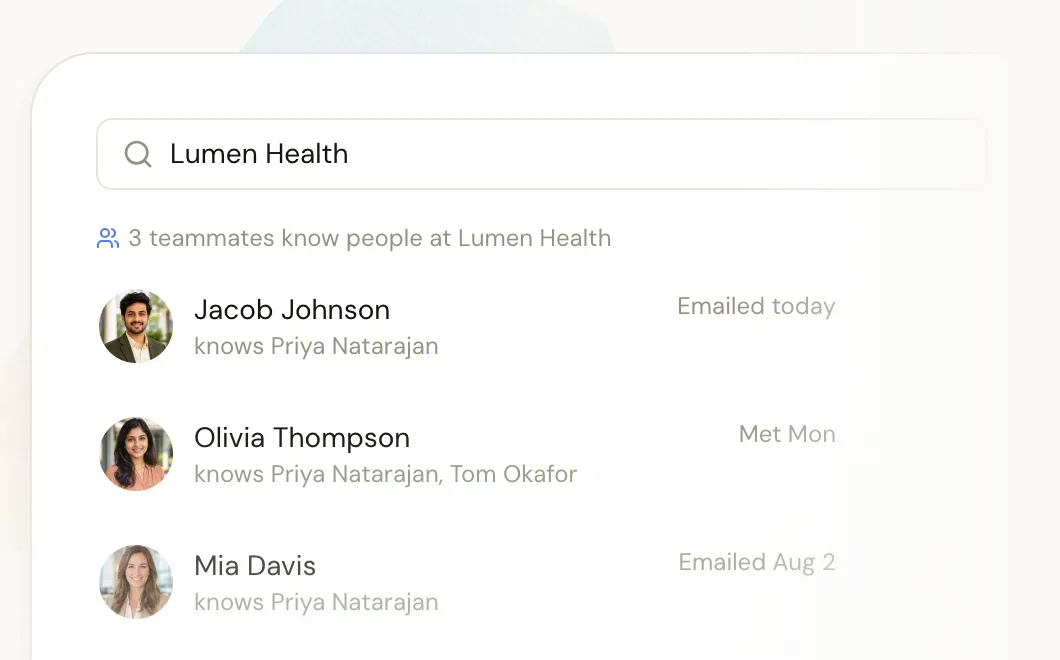
As a folk alternative, it wins on the question small teams ask most: who here knows someone at this company? Search a person or company and Dex for Teams shows which teammates are connected, when each last talked to them, and one shared timeline of emails, meetings, and notes. Each member decides whether the workspace sees only email subject lines and metadata, or full content, and every note can stay private.
Each member connects their own LinkedIn, and the workspace refreshes it about every two days. Shared and personal keep-in-touch reminders keep important relationships from going cold when someone is busy. Roles are owner, admin, member, and viewer, and the Dex MCP server lets the team ask Claude or ChatGPT about its shared network.
Price: $40 per user per month, billed monthly. The Team plan includes CRM integrations, SAML SSO, and 50 research credits a month.
Where folk is better: folk has email sequences, contact enrichment credits, and pipeline views built in, and it's cheaper per seat. Dex doesn't do deal stages or forecasting. Teams that need them can run Dex next to a sales CRM.
For a head-to-head, see our Dex vs folk comparison.
Best for: agencies, consultancies, investors, and partnership teams whose work depends on who they know.
2. Attio: best for custom data models
Attio is the folk alternative for teams that want to design their own CRM. You build objects, attributes, and views the way you'd build a database, and it syncs email and calendar to fill records in.
The pricing is unusual. Attio charges per workspace: Plus is $40 a month including one user, then $35 per extra user on annual billing, and Pro is $100 plus $79 per extra user. The free plan covers up to 3 users, which makes it the cheapest serious option for a team of two or three.
Attio vs folk: folk is quicker to start and better for outreach, with campaigns and enrichment on the entry plan. Attio is more flexible and gives you more room to grow into, but someone has to own the setup. If nobody on your team enjoys building in Airtable or Notion, folk or Dex will be used more. That's the short version of the Attio vs folk question most teams ask.
Price: free up to 3 users; Plus $40 per month for the workspace plus $35 per extra user (annual).
Best for: startups with someone technical who will own the CRM. See our Dex vs Attio comparison for more.
3. HubSpot: best for teams that will grow into a sales org
HubSpot's free CRM covers up to 2 users with no credit card, and Sales Hub Starter starts at $20 per seat per month on monthly billing, with discounts for new customers on annual plans. You get contact records, deals, email tracking, meetings, and a huge app marketplace.
The catch is the jump. Sales Hub Professional is $90 per seat per month on annual billing, plus a $1,500 onboarding fee, and that's where sequences, forecasting, and most automation live. For five people that's $450 a month before onboarding.
Where folk is better: folk is simpler, and its $24 plan includes things like AI fields and email campaigns that HubSpot puts on paid tiers.
Price: free for 2 users; Starter from $20 per seat; Professional $90 per seat (annual) plus $1,500 onboarding.
Best for: teams that expect to hire salespeople and want one platform for marketing, sales, and service.
4. Pipedrive: best for pipeline-first selling
Pipedrive is built around the deal pipeline. You drag deals between stages, it nudges you about stalled ones, and every plan works with AI assistants like Claude. If folk felt like a contact list with a pipeline attached, Pipedrive is the opposite.
Plans are Lite at $14, Growth at $24, Premium at $49, and Ultimate at $69 per seat per month on annual billing. Growth is where email automation and follow-ups come in, so teams weighing Pipedrive as a folk alternative usually compare folk Standard with Pipedrive Growth: same $24 price, different focus.
Where folk is better: relationship context. Pipedrive is about deals, and contacts who aren't in a deal tend to get forgotten.
Price: Lite $14, Growth $24 per seat per month (annual). 14-day trial, no card.
Best for: small sales teams with a clear sales process. Our Dex vs Pipedrive comparison covers how the two fit together.
5. Copper: best for Google Workspace teams
Copper is a CRM made for Gmail and Google Calendar. It pulls contacts and conversations from your Google account and shows the CRM in a Gmail sidebar, so there's little to log by hand.
Basic is $23 per seat per month on annual billing ($29 monthly), Professional is $59, and Business is $99. Basic covers pipelines and team collaboration. Workflows, revenue tracking, and bulk email are on Professional.
Where folk is better: folk works with Outlook and Microsoft 365 too, plus WhatsApp. Copper is a poor fit if anyone on the team isn't on Google.
Price: Basic $23, Professional $59 per seat per month (annual). You can start free without a card.
Best for: Google Workspace teams that want the CRM to feel like part of Gmail.
6. Streak: best for teams that live in their inbox
Streak puts a CRM right inside Gmail. Pipelines appear as rows in your inbox, and email threads become records. If your team's real CRM is Gmail labels, Streak is the smallest change you can make.
Pro is $49 per user per month on annual billing, Pro+ is $69, and Enterprise is $129. That's more than folk per seat, and AI features use credits that are pooled across the team.
Where folk is better: price, contact enrichment, and LinkedIn capture. Streak is about email threads more than people.
Price: Pro $49 per user per month (annual). 14-day trial on Pro+.
Best for: small teams that handle deals, hiring, or support entirely through Gmail. See Dex vs Streak.
7. Cloze Business: best for service businesses on a budget
Cloze pulls in email, calendar, and phone activity and suggests who to follow up with. In recent years it has leaned toward real estate and service businesses, with integrations for those industries.
Business Silver is $21 per user per month on annual billing, Gold is $29 (adding text-message sync and Mailchimp, HubSpot, and Salesforce integrations), and Platinum is $42. It's the cheapest folk alternative here for a five-person team.
Where folk is better: LinkedIn capture and the overall feel. folk is cleaner, and Cloze has no LinkedIn integration.
Price: Business Silver $21 per user per month (annual). 14-day trial, no card.
Best for: insurance, financial advice, real estate, and other service teams that want follow-up prompts more than a database. See our Dex vs Cloze comparison.
Who this isn't for
If your team mostly needs a tidy contact list and the odd email campaign, you don't need a folk CRM alternative. folk Standard does that at $24 a seat, and it's hard to beat. Teams of 50 or more with complex territories, quotas, and compliance needs should look at Salesforce or HubSpot Enterprise rather than anything here. And if you're a solo user, a personal CRM is a better fit than any team tool. Our list of the best free personal CRMs is a good place to start.
FAQ
What is the best folk alternative?
It depends on why you're leaving folk. Dex for Teams is best for relationship-first teams that need who-knows-whom search. Attio is best for custom data models, Pipedrive and HubSpot for pipeline-driven sales, Copper and Streak for Gmail teams, and Cloze for service businesses.
Is there a cheaper folk CRM alternative?
Yes. Attio is free for up to 3 users, HubSpot's free CRM covers 2 users, and Cloze Business Silver ($21), Copper Basic ($23), and Pipedrive Lite ($14) cost less per seat than folk Standard ($24) on annual billing.
Attio vs folk: which is better for a small team?
folk is faster to set up and better for outreach, since campaigns and enrichment come on the entry plan. Attio is more flexible and free for up to 3 users, but it needs someone to design and maintain the data model.
Does folk have an API?
Yes, but only on Premium ($48 per member per month, annual) and up. Zapier and Make integrations are also Premium features. Standard doesn't include them.
What's the best CRM for small teams that share contacts?
A tool that lets each person choose what to share. Dex for Teams lets every member decide whether the workspace sees only email subjects and metadata or full content, and notes can stay private.
How do I move from folk to another CRM?
Export your groups from folk as CSV, then import them into the new tool. Dex supports CSV import, as do Attio, HubSpot, Pipedrive, Copper, and Cloze. Reconnect email and calendar afterward so history fills back in.
The bottom line
folk is a good CRM for small teams, and $24 a seat is fair. The best folk CRM alternative is the one that fixes the specific thing folk Standard doesn't do for you. If you need integrations and roles, settle the Attio vs folk question by pricing folk Premium against Attio. If you need a real sales pipeline, look at Pipedrive or HubSpot. If your team lives in Gmail, try Copper or Streak, and if you want the cheapest option for a service business, Cloze. The best CRM for small teams is the one people open every week.
And if what your team really needs is to know who knows whom, keep everyone's relationship history in one place, and let each person keep their inbox private, Dex for Teams is the folk alternative built for that. Start your free Dex trial and see your team's shared network in a day.
Related guides