Attio Alternative for Individuals: Dex vs Attio (2026)
Attio is built for sales teams. Dex is built for people. Compare features, pricing, and usecases to find the right Attio alternative for you.


Attio is a great CRM. It's also a team CRM. Pipeline stages, workspace permissions, per-seat pricing, all built for a company with a sales motion. None of that helps if you're one person trying to remember when you last talked to a key investor or whether your former colleague ever left Stripe.
That's where most solo founders, freelancers, and operators get stuck. They sign up for Attio because it looks modern, then cancel a couple months later when they realize they're paying for team infrastructure they don't use.
Dex was built for the other problem: managing real relationships across LinkedIn, email, WhatsApp, and in-person meetings without a sales team behind you.
Here's how the two compare.
What Attio does well
Attio is a modern, AI-native CRM designed for B2B teams. The interface is clean, customizable, and genuinely pleasant to use, which is rare for CRMs. It pulls in email data automatically, enriches company records, and lets teams build custom objects and workflows around their specific sales process.
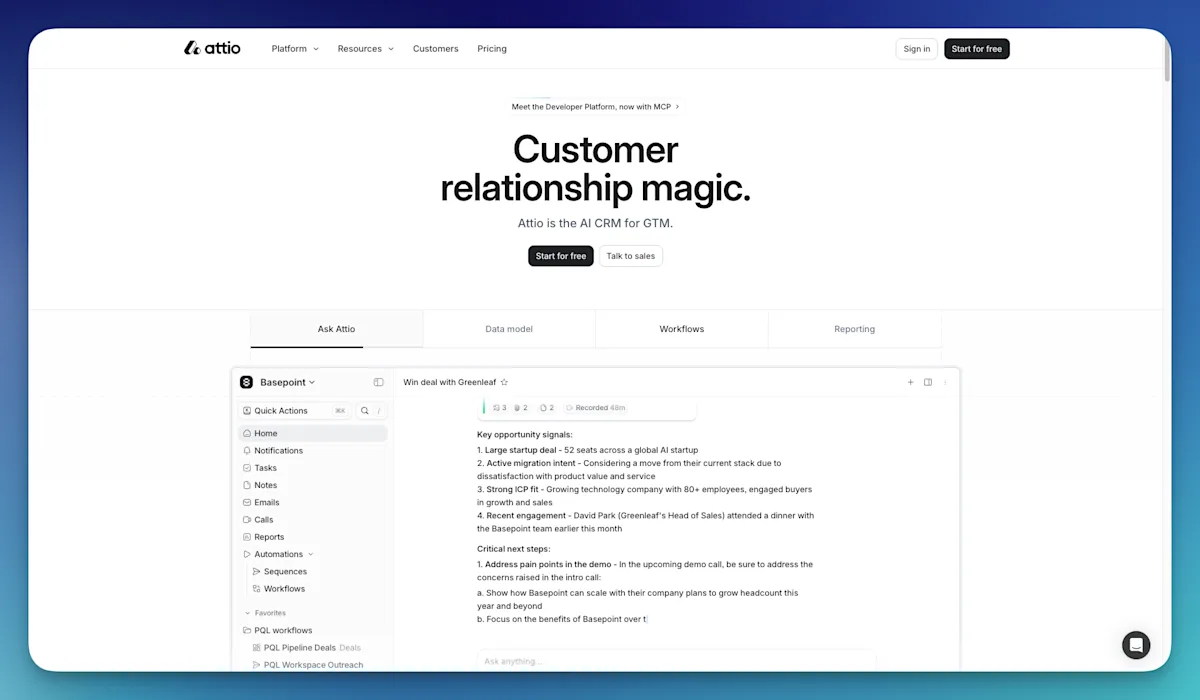
Image from: attio.com
The AI features are real, not just marketing. Attio can auto-populate company and contact data from public sources, surface relationship insights across a team's collective email history, and help reps figure out who in the org has the strongest connection to a prospect. For a five-person sales team trying to close mid-market deals, this is valuable.
Attio also handles reporting and pipeline management well. Custom views, filtered lists, kanban boards for deal stages, and analytics dashboards. For the job of running a structured sales operation, Attio competes directly with HubSpot and Pipedrive but with a cleaner design and more flexible data model.
None of that is an accident. Attio raised over $30 million and built a product specifically for revenue teams. That focus is also exactly why it doesn't work as a personal CRM.
Where Attio breaks down for individuals
The friction starts with pricing. Attio charges per seat, per month, because it's a team product. Their free plan is limited, and the paid plans assume multiple users sharing a workspace. For a single person managing their own network, per-seat pricing for features designed around team collaboration means paying for infrastructure that never gets used.
Then there's the data model. Attio organizes everything around companies, deals, and pipelines. That makes sense if you're tracking accounts through a sales funnel. It makes less sense if you're trying to remember that you met someone at a YC demo day, they mentioned they're hiring, and you promised to introduce them to a friend. Personal relationships don't have deal stages. They have context.
The integration story is also different. Attio connects well to business tools: Gmail, Outlook, Slack. What it doesn't do is sync with LinkedIn, WhatsApp, iMessage, Instagram, or Facebook. For anyone whose professional relationships live partly on social and messaging platforms, that's a significant gap. Most professionals don't conduct their entire professional lives inside Gmail. They DM on LinkedIn, text on WhatsApp, and catch up on Instagram. A CRM that only sees email is looking at a fraction of the relationship.
And there are no keep-in-touch reminders. No recurring nudge that says "you haven't talked to Sarah in three months." No kanban board for relationship maintenance. Attio tracks deals. It doesn't track friendships, mentorships, or loose professional ties that might matter later.
Feature comparison: Attio vs Dex
Feature | Attio | Dex |
|---|---|---|
Built for | Sales teams | Individuals |
Pricing model | Per seat/month | Flat $12/month |
LinkedIn sync | No | Yes (up to 9,000 connections) |
Gmail sync | Yes | Yes (full history) |
Outlook sync | Yes | Yes |
WhatsApp sync | No | Yes |
iMessage sync | No | Yes |
Instagram sync | No | Yes |
Facebook sync | No | Yes |
Keep-in-touch reminders | No | Yes (kanban board) |
Pre-meeting briefs | No | Yes (auto-generated) |
Job change alerts | No | Yes |
AI features | Yes (team-focused) | Yes (personal: Copilot, AI Assist, Messaging Dex) |
Deal pipelines | Yes | No |
Team workspaces | Yes | No |
Custom objects | Yes | No (custom fields instead) |
Business card scanner | No | Yes |
Mobile app | Yes | Yes (iOS + Android) |
Browser extension | No | Yes (Chrome) |
The table makes the distinction clear. Attio has pipeline management, team workspaces, and custom objects. Dex has social integrations, relationship reminders, and AI tools designed for one person managing their own network. Different tools for different problems.
Who should use Attio
Attio is a good fit if any of these apply: running a sales team of two or more people who need shared visibility into deals and contacts, tracking revenue through defined pipeline stages, needing custom reporting on team activity, professional communication happening almost entirely over email, or wanting a modern alternative to HubSpot or Pipedrive that doesn't feel like it was designed in 2012.
For that situation, Attio is one of the better options available.
Who should look for an Attio alternative
The Attio alternative question usually comes from people who tried it and realized they were paying for team infrastructure they didn't need. The people looking for an Attio alternative tend to fit a few profiles.
Solo founders and entrepreneurs are managing investor relationships, advisor conversations, potential hires, and partner intros without a sales team and without deal stages. They have 300 people to stay in touch with, and those relationships are spread across LinkedIn, email, and WhatsApp. A personal CRM for founders that pulls all of that into one place and surfaces who's overdue for a check-in is more useful than a pipeline board.
MBA students and recent grads generate an enormous number of new contacts in a short time - classmates, alumni, recruiters, company contacts from case competitions. Attio's team-CRM model doesn't map to this use case. What works is a tool that imports contacts from everywhere, lets you tag and group people by context, and sends reminders to stay in touch after graduation when life gets busy.
Freelancers and consultants have client relationships, referral sources, and past collaborators where the relationships are personal even when the work is professional. Per-seat CRM pricing makes no sense when it's just one person, and what matters isn't a deal pipeline but knowing when to check in with a client who might have another project coming up. Plenty of personal CRMs work well for freelancers without the enterprise overhead.
Anyone whose network lives beyond email will find Attio structurally limited. If significant professional relationships happen on LinkedIn, WhatsApp, or iMessage, Attio can't see them. That means the CRM is always incomplete. Dex syncs with all of those platforms and builds a unified timeline so every interaction is in one place regardless of where it happened.
How Dex handles the things Attio doesn't
The gap between a business CRM and a personal CRM isn't just about features. It's about assumptions.
Attio assumes you're closing deals. Dex assumes you're maintaining relationships. That difference shapes everything from the data model to the daily workflow.
In Dex, the core unit is a person, not a deal. Each contact has a timeline that pulls in emails, calendar events, messages, and notes automatically. Custom fields let you track anything: how you met, gift ideas, their kids' names, what they're working on without forcing it into a sales schema.
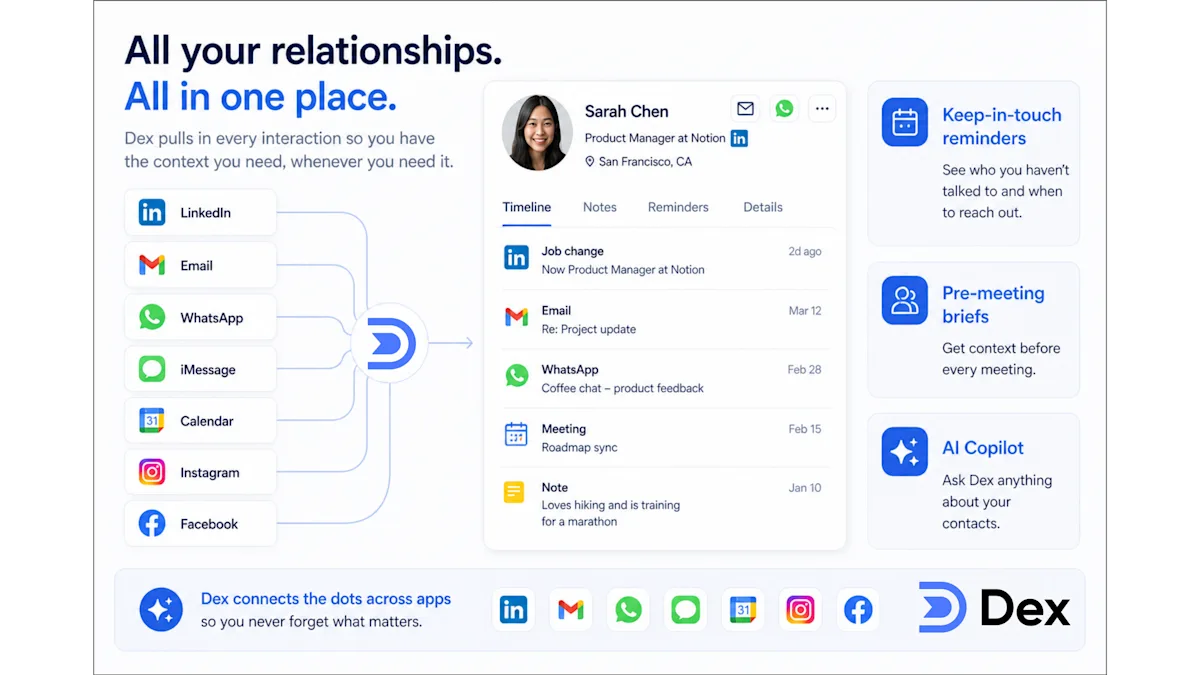
Dex brings everything together in one place.
The keep-in-touch board is the feature that comes up most from users. It's a kanban-style board where you set a cadence for important contacts (every two weeks, monthly, quarterly) and Dex surfaces who's overdue. It turns relationship maintenance from something you hope you'll remember into something you can actually see and act on.
Pre-meeting briefs are the other standout. Before a calendar event, Dex sends a summary: who's attending, the last time you met, what you discussed, any notes saved. For founders in fundraising, this makes the difference between walking into an investor meeting cold and showing up knowing what was discussed six weeks earlier — which makes the conversation feel continuous instead of restarted.
The AI features: Copilot, AI Assist, Messaging Dex, and more are all built for individual use. You can text Dex on WhatsApp or SMS to log a note after a meeting, ask it to remind you about a contact, or get a daily digest of who to reach out to. There's no team dashboard because there's no team. Just one person and their network.
Pricing breakdown
Attio's pricing scales with team size. Their free plan supports limited features, and paid plans start around $29–$34 per user per month. For a team of five, that's $145–$170/month. For a solo user, the per-seat price was designed for team economics.
Dex costs $12/month on Premium, $20/month on Professional. Flat rate, not per seat. The Professional plan adds deeper LinkedIn sync (9,000 connections vs 2,500), mail merge, Outlook integration, API access, and Zapier. Both plans come with a seven-day free trial.
For an individual, the math is straightforward. Dex Premium costs roughly a third of what Attio's entry paid plan costs, and it includes the social and messaging integrations that Attio doesn't have at any price.
Frequently asked questions
Is Attio good for personal use?
Attio can technically be used by one person, but the product is designed for teams. The pricing, features (deal pipelines, team workspaces, shared permissions), and data model all assume a business use case. For personal relationship management, a dedicated personal CRM like Dex is a better fit because it's built around individual networking rather than team sales workflows.
What's the best Attio alternative for individuals?
For individuals managing professional or personal relationships, Dex is the most direct Attio alternative. It offers LinkedIn, WhatsApp, iMessage, and Instagram sync that Attio lacks, plus keep-in-touch reminders and pre-meeting briefs. Other options worth considering include Clay (now Mesh) for Twitter-heavy networks and Monica for open-source privacy-focused use. The full comparison of personal CRM apps covers more options.
Can Attio be used as a personal CRM?
It can, but the result is paying for team features that never get used (shared workspaces, team analytics, multi-seat permissions) while missing personal features that actually matter (social media sync, relationship reminders, messaging integration). It's like renting a four-bedroom house when a studio is what's needed. It works, but it's not built for the problem.
How is a personal CRM different from a business CRM?
A business CRM like Attio, HubSpot, or Salesforce organizes contacts around deals, pipelines, and revenue. A personal CRM like Dex organizes contacts around relationships, context, and staying in touch. Business CRMs are built for sales teams. Personal CRMs are built for individuals who want to manage their own network without the overhead of enterprise software. The best personal CRM guide digs deeper into the differences.
Does Dex integrate with LinkedIn?
Yes. Dex syncs up to 2,500 LinkedIn connections on Premium and 9,000 on Professional. It imports connection data, tracks job changes, and provides network updates when someone in your network moves to a new role. The LinkedIn integration also works with the Dex browser extension for adding and updating contacts while browsing LinkedIn.
Manage your personal relationships smarter with Dex, an Attio alternative
Try Dex free for seven days and see if it fits. Import contacts from LinkedIn, email, and your phone in about five minutes. If it works, the difference between managing relationships with a personal CRM versus a sales tool becomes obvious fast.