Personal CRM vs Sales CRM: Dex vs Pipedrive for Your Network
Pipedrive is a sales CRM built on the deal, starting at $14 per seat per month annually with no free tier. Dex is a personal CRM built on the person, at $12 a month. The personal CRM vs sales CRM choice comes down to one question: does the contact you are tracking have a close date?


Plenty of people try to run their network out of Pipedrive. It is a reasonable thing to attempt. You already pay for it, it holds people, it reminds you to follow up, and setting up a second tool feels like admitting your first one failed.
It usually stops working somewhere around month three, and not for the reason most comparisons give. Pipedrive is not too complicated, and it is not bloated. It is built very well around an assumption that does not hold for the people in your network.
Here is what that assumption is, and how to tell whether the personal CRM vs sales CRM split lands on your side of the line.
Fast facts:
Pipedrive is a sales CRM organized around deals moving through a pipeline, used by more than 100,000 sales teams.
Pipedrive pricing on annual billing runs $14 per seat/month on Lite, $24 on Growth, $49 on Premium, and $69 on Ultimate. There is a 14-day free trial and no free tier.
Pipedrive renamed its plans. Most comparison articles still cite Essential, Advanced, Professional, Power, and Enterprise, which no longer appear on the pricing page.
Dex is a personal CRM at $12/month for Premium and $20/month for Professional on annual billing, with a 7-day free trial.
Pipedrive flags deals as rotting after a set number of inactive days, and the flag ignores any activity you have scheduled for the future. Dex has no equivalent, on purpose.
What Pipedrive gets right
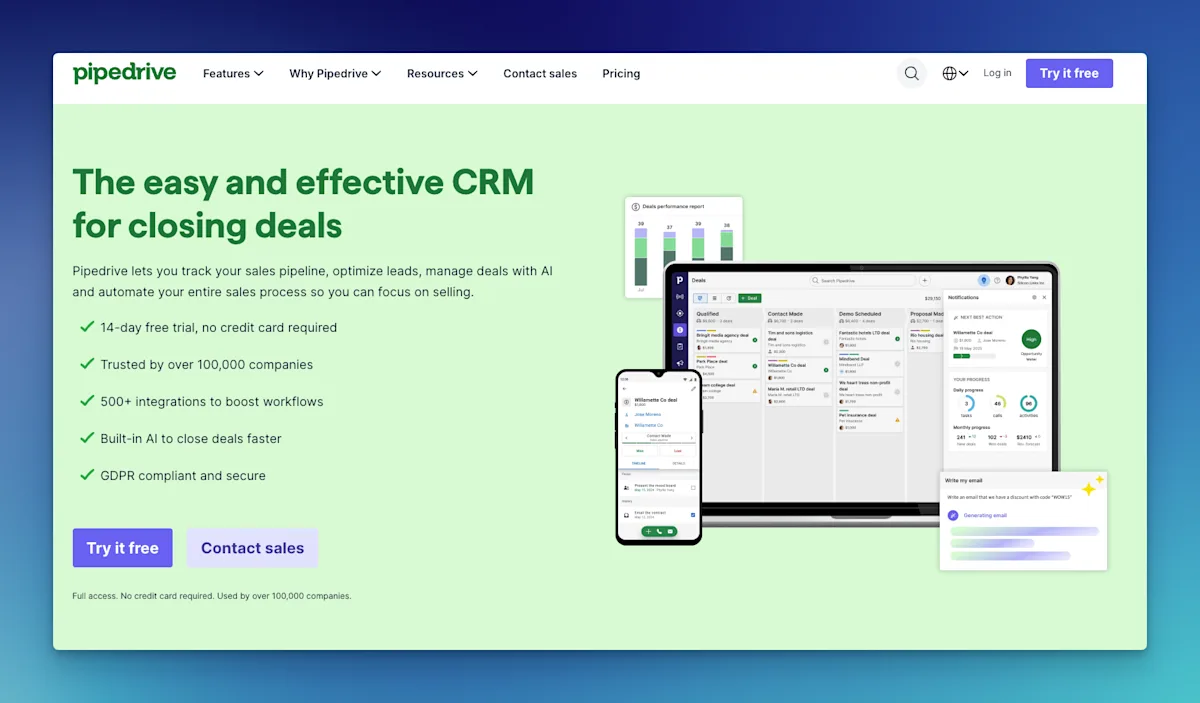
Pipeline's Landing page. Photo taken from: pipeline.com
Pipedrive was built on activity-based selling. The premise is that you cannot control whether a deal closes, only what you do next, so the software should refuse to let any contact sit without a scheduled next action. Open Pipedrive and it tells you what to do today. Close a call and it asks what happens after it.
That is not sales advice. That is relationship advice. It is very close to the entire thesis of a personal CRM, and Pipedrive arrived at it years before the category existed. Anyone who tells you a sales CRM cannot possibly help you stay in touch has not looked at how Pipedrive actually works.
The rest of the product is competent in the same unglamorous way. Email sync, a visual pipeline that people genuinely enjoy dragging things across, workflow automation, reporting that answers real questions. It is one of the better executed pieces of software in its category, which is why it has lasted.
Where it breaks
Pipedrive has a feature called rotting. In the pipeline editor you switch on "Rotting in (days)" for a stage and set how many inactive days it takes before a deal sitting there counts as rotten. Cross the line and the deal tile turns red in your pipeline view. Activity on the deal resets the count (Pipedrive, The Rotting feature).
For a deal, that is correct. A prospect who stops replying for six weeks is a problem, and you want to know.
Now put a person in there who is not buying anything. A former colleague you like. The founder who gave you an hour of advice two years ago. Someone you met at a conference who may matter enormously in 2029 and not at all before then. Every one of them goes quiet for months at a stretch. That is what those relationships are supposed to look like.
Pipedrive sees decay. The tile goes red. And within a few weeks you have a board full of red cards you are not going to act on, so you start ignoring the colour, and once you are ignoring the colour the software has stopped working for you entirely.
There is one detail that makes this harder to work around than it looks. Rotting ignores the next activity date, so a deal with an activity scheduled well into the future still goes rotten. The obvious fix, booking the next check-in six months out the way you would with a friend, does not stop the tile turning red. Pipedrive is not asking whether you have a plan for this person. It is asking what you have done lately.
This is the thing worth understanding about the personal CRM vs sales CRM question. The failure is not that Pipedrive lacks a feature. It is that Pipedrive is measuring against a clock, and the clock is calibrated to a sales cycle. In sales, silence is decay. In a friendship, silence is just Tuesday.
The second half of the same problem is the deal object. Pipedrive's reporting, automation, forecasting, and most of its useful surfaces orbit deals. People and organizations exist, but a contact with no deal attached does not appear in the parts of the product that do work on your behalf. So you face a choice nobody enjoys: invent a fake deal for your friend, or accept that your network sits in a corner of the CRM that the CRM ignores.
The dividing line
Feature grids will not settle this one, because there is real overlap. Both tools capture email. Both remind you to follow up. Both keep a history of what was said.
The split is what the software is counting.
A sales CRM counts progress toward a close. Every object, timer, and report exists to answer whether this is moving. That is the correct design for revenue, and Pipedrive executes it well.
A personal CRM counts elapsed time since you last spoke, and the context in which your relationship lives. There is no stage to advance, no forecast to corrupt, no red card. Dex asks you to pick a cadence per person, quarterly for some, twice a year for others, and then it resurfaces them and necessary information on schedule. The relationship does not need to be going anywhere to be worth keeping.
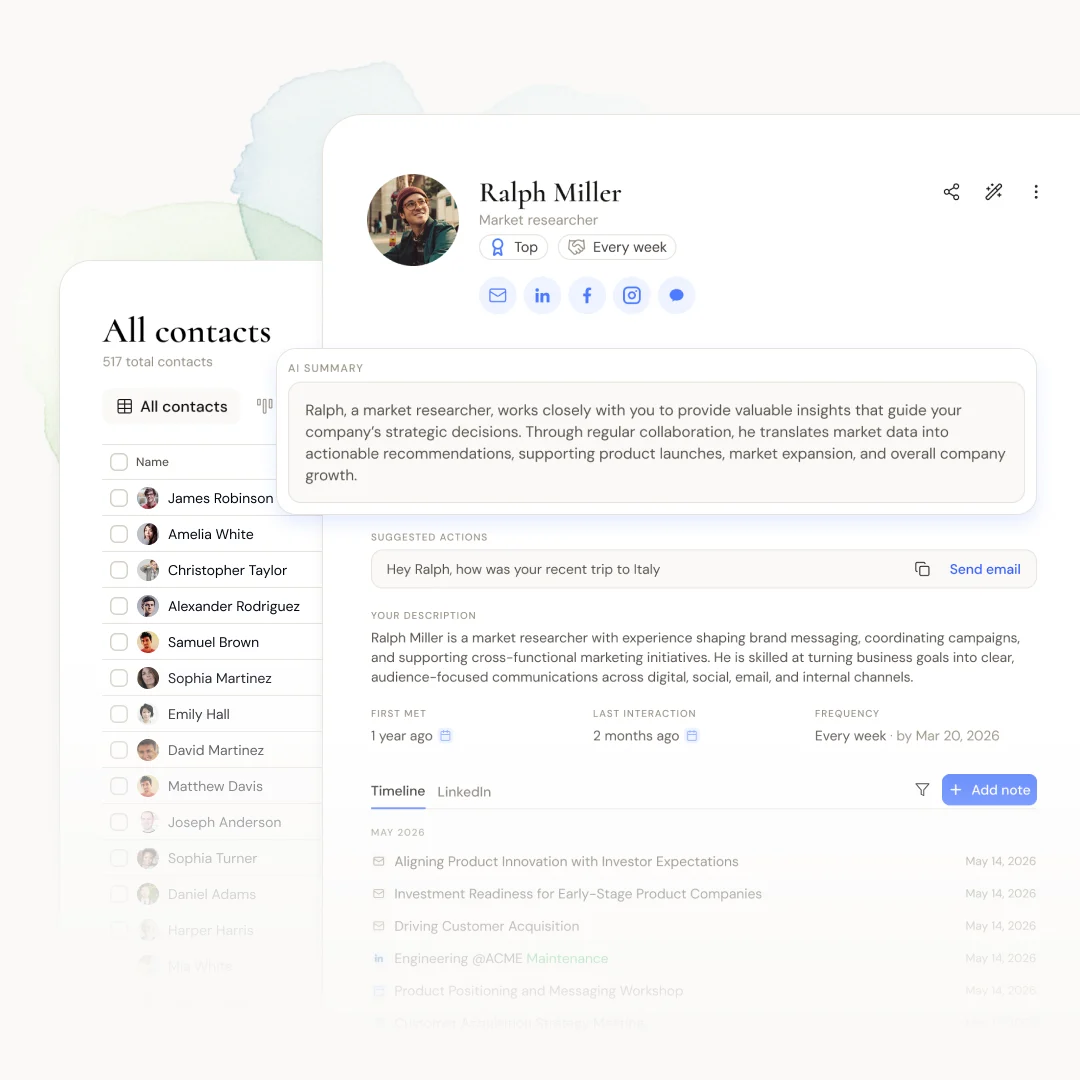
What Dex's contact card looks like
| Pipedrive | Dex |
|---|---|---|
Core object | The deal | The person |
What it measures | Progress toward a close | Time since last contact |
Inactivity | Flagged as rotting | Expected, cadence-driven |
Entry price | $14/seat/month annual | $12/month annual |
Free tier | No, 14-day trial | No, 7-day trial, no card |
Pipeline stages and forecasting | Yes, core | No |
Workflow automation | Yes | Limited |
Team pipeline visibility | Yes | Enterprise only |
Keep-in-touch cadences | Manual activities only | Yes, per contact |
LinkedIn sync | No, via third-party tools | Yes, 2,500 to 9,000 connections |
Job change alerts | No | Yes |
WhatsApp and iMessage sync | No | Yes |
Contacts by geography | No | Yes, map view |
What Pipedrive costs for people who will never buy anything
Plan | Per seat/month (annual) | 1 seat/year |
|---|---|---|
Pipedrive Lite | $14 | $168 |
Pipedrive Growth | $24 | $288 |
Pipedrive Premium | $49 | $588 |
Pipedrive Ultimate | $69 | $828 |
Dex Premium | $12 | $144 |
Dex Professional | $20 | $240 |
At the entry tier the two are close enough that price is not the argument. Lite is $168 a year against Dex Premium at $144, and if Pipedrive did the job, twenty-four dollars would not be a reason to switch.
The gap opens further up. Most people who want automation and email sequencing land on Growth or Premium, which is $288 or $588 a year. Add-ons are priced separately again: LeadBooster from $32.50 a month, Web Visitors from $41, Smart Docs from $32.50, Campaigns from $13.33, Projects from $16. {{VERIFY: add-on pricing current as of publish date}}
Every one of those is built to generate and convert demand. If a meaningful share of your contacts will never be invoiced, you are paying a per-seat sales price to store people the sales machinery cannot use.
Neither product has a free tier, so this is not a free versus paid argument. It is $144 against $288 or more, for tools that are counting different things.
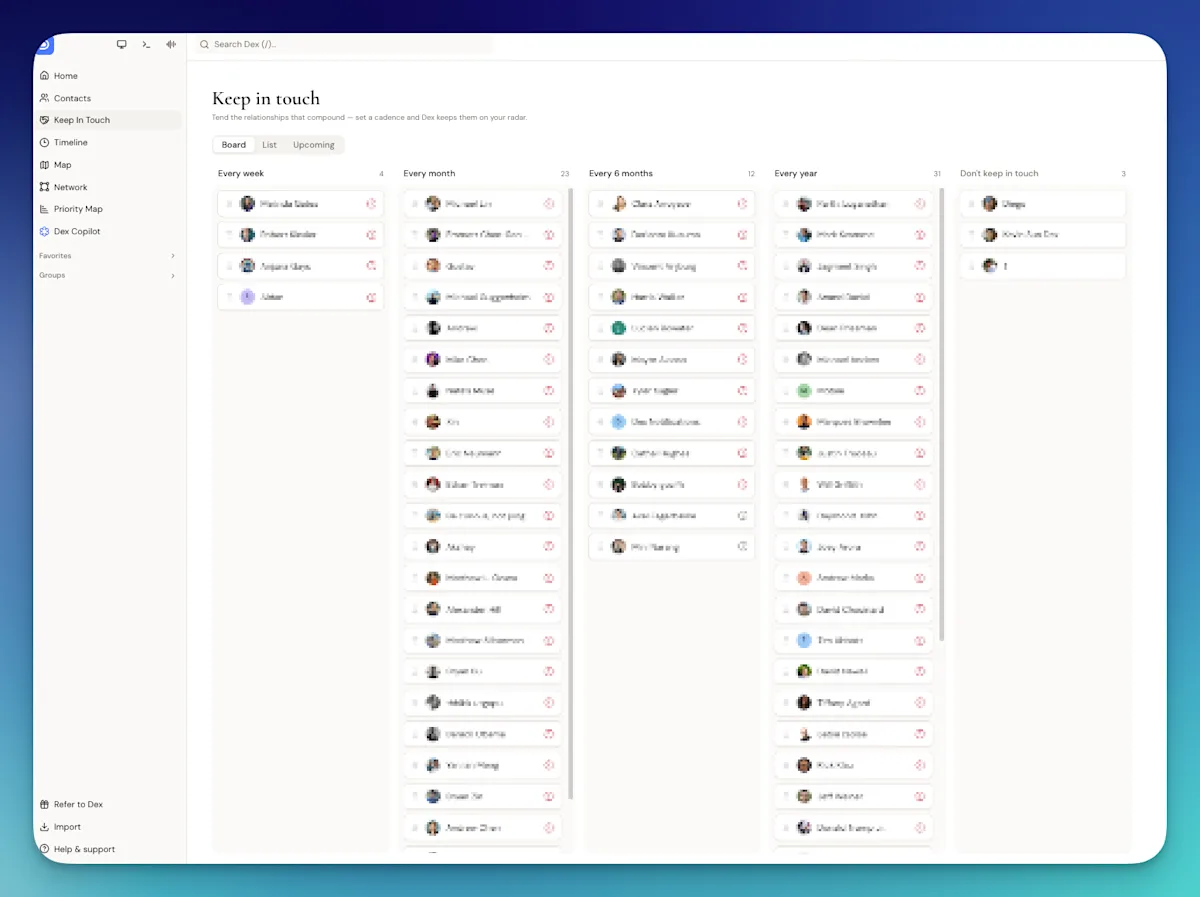
Keep-in-touch list showing contacts due for follow-up in a personal CRM
What a quarter looks like in each
In Pipedrive, a quarter looks like a board. Deals enter, move through stages, and either close or rot. On Friday you look at what is stuck. The reporting tells you conversion by stage and where things died. It is a good quarter if the board moved.
In Dex, a quarter looks like a list. Sixty people on cadences you set once. Nine are due this week. You send nine short notes that reference the last real conversation, because the last real conversation is on the screen in front of you. Nothing moves through a stage. Two of those people will matter a great deal in eighteen months and you have no way of knowing which two.The second version has no metric attached, which is exactly why it does not survive inside a sales CRM. There is nothing for the pipeline to report.
Where Pipedrive is the better buy
If you are selling something with a close date, buy Pipedrive. Dex has no pipeline, no stages, and no forecast, and it is not trying to acquire them.
If you have a team that needs shared visibility into who is working which account, that is a sales CRM purchase. Dex's model is one person's network, and shared pipelines are not the shape of it.
If your follow-ups should fire automatically off a trigger, Pipedrive's workflow automation does that properly. Dex will remind you; it will not run a sequence for you.
If you need to know conversion rates by stage, average deal size, or where revenue is leaking, none of that exists in a personal CRM and should not.
And if you are a consultant or freelancer with both problems, real deals and a real network, the honest answer is that you probably want both, with the pipeline in Pipedrive and the people in Dex. That is not a cop-out. They are counting different things, and one tool doing both would do neither well.
Who CRMs isn't for
If every contact you track has a dollar amount attached, you do not need a personal CRM. Buy Pipedrive and stop reading comparisons.
If you need a full sales pipeline with forecasting inside a heavier enterprise stack, we covered why relationships have nowhere to live in Salesforce.
If you mostly want a free tool to start with, both of these charge from day one. Our roundup of free personal CRM apps is the better starting point.
If you know everyone in your network by first name and there are forty of them, your phone's contacts app is fine. Software will not add anything yet.
If your employer requires every contact record to live in the company CRM, adding a personal one alongside it just creates a second copy to go stale.
The summary
Pipedrive is a well-built sales CRM starting at $14 per seat per month on annual billing, and its activity-based selling philosophy is genuinely right about follow-up. Dex is a personal CRM at $12 a month with a 7-day trial you can start in the next two minutes.
What decides the personal CRM vs sales CRM question is not features or price, both of which are closer than you would expect. It is whether the contacts you are trying to keep have a close date. Pipedrive is built to notice when nothing is moving. That instinct is correct for revenue and wrong for people, and no amount of custom fields will talk it out of the assumption.
Most people find this out the slow way. They spend a year adding people to a CRM that keeps telling them those people are going stale, until they stop believing the warnings and stop opening the tool.
If the people you are tracking are worth keeping whether or not they ever buy anything, start your free 7-day Dex trial.
Frequently Asked Questions Personal CRM vs. Sales CRM
Can you use Pipedrive as a personal CRM?
You can, and people do, but it fights you. Pipedrive's reporting, automation, and reminders are built around deals, so a contact with no deal attached sits outside most of what the product does for you. Its rotting indicator will also flag healthy relationships as decaying, because it measures inactivity against a sales cycle. It works best if you are willing to create a placeholder deal for every person, which most people abandon within a few months.
What is the difference between a personal CRM and a sales CRM?
A sales CRM counts progress toward a close. A personal CRM counts time since you last spoke. That single difference produces everything else: pipelines, stages, and forecasting on one side, keep-in-touch cadences and contact history on the other. The personal CRM vs sales CRM decision comes down to whether your contacts have a close date.
How much does Pipedrive cost?
On annual billing, Pipedrive lists Lite at $14 per seat per month, Growth at $24, Premium at $49, and Ultimate at $69. There is a 14-day free trial and no free tier, and add-ons such as LeadBooster, Web Visitors, and Smart Docs are priced separately on top. {{VERIFY: pricing current as of publish date}}
Is Dex cheaper than Pipedrive?
At the entry tier, barely. Dex Premium is $144 a year against Pipedrive Lite at $168. The gap widens on the plans most people actually buy, since Pipedrive Growth is $288 and Premium is $588 per seat per year before add-ons. Price is not the real argument between them.
Can Dex track deals?
No, not as pipeline stages with forecasting. Dex is organized around people, and custom fields and tags handle lightweight tracking. Anyone who needs a real pipeline should keep a sales CRM for it and use Dex for the relationships that sit outside it.
Do I need both Pipedrive and Dex?
Consultants, freelancers, and founders often do. If you have live deals with close dates and a wider network of people who may never buy anything, the two jobs do not fit in one tool. Keep the pipeline where it belongs and stop asking it to hold your friends.
Related reading: Networking CRM: the best way to manage your contacts · Dex vs Salesforce · HubSpot for personal use vs Dex · Monday CRM alternative for individuals · Best CRM for small business owners