
Networking at Conventions: How to Keep the Contacts You Make
Convention contacts are the most valuable kind of weak tie and the kind most likely to vanish. A before, during, and after system for keeping them, and where Dex fits.



Convention contacts are the most valuable kind of weak tie and the kind most likely to vanish. A before, during, and after system for keeping them, and where Dex fits.
A question we get from people evaluating Dex, almost word for word: "Would this work for business contacts I make at conventions?"
The short answer is yes. That’s what it’s best at. The longer answer is this post, because the interesting question isn’t whether a personal CRM can hold a contact from a trade show. Of course it can. The real question is why those contacts are worth keeping, why they tend to disappear faster than almost any other kind, and what it actually takes to turn a quick handshake into a relationship that, eight months later, is still useful to both of you.
Did you know:
Acquaintances, not close contacts, deliver most new opportunities. Mark Granovetter documented it in 1973 and a 2022 study of 20 million LinkedIn users proved the effect is causal.
Memory for new material collapses within a day. In a 2015 replication of Ebbinghaus's forgetting experiments, about a quarter of what was learned survived the first twenty-four hours.
Reconnecting late still works. A 2011 Organization Science study found advice from contacts dormant for three or more years was as useful as advice from active ones, and took less effort to get.
Conventions are not going anywhere. The exhibition industry's own index forecasts another year of growth in 2026.
Why convention contacts are worth more than they feel
Think about who you meet at a convention. Almost by definition, they are people you would never have met otherwise: a different company, a different city, often a different corner of the industry. You share a badge color and a coffee line and roughly nothing else.
That is exactly the profile of a weak tie, and fifty years of research says weak ties are where new information comes from. The people you already see every week know what you know. The person you talked to for twelve minutes outside Hall B knows about a role, a client, or a problem that had no other route to you. Granovetter called these connections bridges, and a convention is the most efficient bridge-building machine most professionals ever walk into.

The catch is that the value is delayed. Almost nobody gets hired or signs a deal on the show floor. The contact pays off months later, when they change jobs, or you do, or one of you needs an introduction the other happens to have. Which means the entire return on the trip depends on whether the two of you are still in touch when that moment arrives.
Why networks gained disappear anyway
Three things go wrong, and they go wrong in order:
Capture - Business cards go into a jacket pocket. Badge scans go into an event app you will lose access to when the organizer shuts it off. LinkedIn requests go out to people whose faces you have already stopped attaching to names. The raw data survives, sort of, scattered across four places.
Memory - By the flight home, the context is gone. Hermann Ebbinghaus measured this in the 1880s and a 2015 replication in PLOS ONE got nearly the same curve: after a single day, only about a quarter of freshly learned material was retained. A name and a company are not what made the person interesting. What made them interesting was the offhand thing they said about their hiring plans, and that is the part that evaporates first.
Trigger - Even if you saved the card and wrote the note, nothing in your normal life brings the person back up. Your calendar tracks meetings you already booked. Your inbox tracks people already emailing you. Weak ties have no built-in touchpoint, so they drift, silently, until the reconnect feels awkward enough that you skip it.
Any system for convention networking has to solve all three. Most advice only covers the first.
Before the convention: decide what "keep" means
The mistake is treating every card as equal. You will meet forty people and have the energy to follow up with six, so decide in advance what the six look like. A hiring manager in your field. Someone building the thing you are trying to buy. A peer at a company you admire. Write the categories down; it makes the sorting on the floor nearly automatic.
Then make a home for the event before it starts. In Dex that means creating a group with the show's name and year, so every contact you add over the next three days lands in one place. It takes thirty seconds and saves you from doing it retroactively, which you will not do.
Finally, check who you already know is attending. Speaker lists and the event app are public; your own network is in your CRM. If someone you have not spoken to in two years is going to be there, a message the week before beats an awkward wave across the exhibit hall. This is the networking-goals version of packing a suitcase: boring, and the reason the trip goes well.
During: capture the context, not just the card
The card is the least important thing you collect. Everyone who has ever tried to follow up a month later knows this: you have the name, you have the title, and you have no idea what you talked about.
So the one habit that matters is the thirty-second note. After every conversation worth keeping, before the next one starts, write down three things. What you discussed. What you promised, if anything. One detail that was about them rather than their job: the marathon, the move to Denver, the kid starting college. That third item is the difference between a follow-up that reads as human and one that reads as a template.
Where you write it depends on what is in your hand. If you are carrying paper cards, photograph or scan them on the spot and attach the note to the scan. If the event issued badges with QR codes, most organizer apps let you export the leads as a CSV; do it the same evening while you still remember which scan was which. If your hands are full, dictate. Walking between halls is exactly enough time to say a sentence into your phone.
Here is what a useful capture looks like next to a useless one:
Useless version | Useful version | |
|---|---|---|
Who | Card in pocket | Name, company, card photo attached |
Context | (nothing) | "Met at the analytics panel Q&A, Tuesday" |
Hook | (nothing) | "Rebuilding their onboarding; frustrated with current vendor" |
Promise | (nothing) | "Send the churn benchmark deck" |
Personal | (nothing) | "Just moved to Austin, training for a half marathon" |
Cadence | (nothing) | Follow up Thursday, then quarterly |
The right-hand column takes about as long to write as the left-hand one takes to lose.
After: the two-day follow-up and the six-month one
The first follow-up is the easy one and most people manage it. Within a day or two, send a short message that references the conversation specifically, do the thing you promised, and stop. No pitch, no "let's find time to connect." You are confirming that you were paying attention, and that is all.
The second follow-up is where convention networking is actually won, and almost nobody does it. Three or four weeks later, send something with no ask attached: an article on the problem they mentioned, an introduction to someone in your network who is relevant to them, a note that their company was in the news. Then set a cadence, quarterly or twice a year, and let it run.
The research is reassuring here. In the Organization Science study mentioned above, executives who reconnected with contacts they had not spoken to in three or more years got advice rated as valuable as what they got from current contacts. The dread of reaching out after a gap is mostly in your head. But the six-month follow-up only happens if something reminds you to do it, and that is the part a system has to provide.
One more trigger worth building in: job changes. Someone who just started a new role is the single most receptive contact in your network, and they are usually looking for the exact things a recent acquaintance can offer. If you find out a month late, you missed it.
Where Dex comes in
Back to the original question. Dex is a personal CRM, and a convention is close to the ideal case for one, because every failure point above maps onto a specific feature.

Dex's business card scanner on mobile.
Capture - The Dex mobile app has a business card scanner on iPhone and Android. Point it at a card and it reads the fields into a form you can edit before saving; the photo of the card is attached to the contact automatically, so a misread name is a two-second fix rather than a mystery. Save one and you drop straight back into the scanner, which matters when you are working through a stack of thirty at the hotel bar.
If the convention center has no signal, the scan is stored on the phone and syncs, image included, when you reconnect. Badge-scan exports from the organizer's app come in through CSV import, and if you already knew the person from LinkedIn or email, you can merge the two records into one instead of keeping a duplicate.
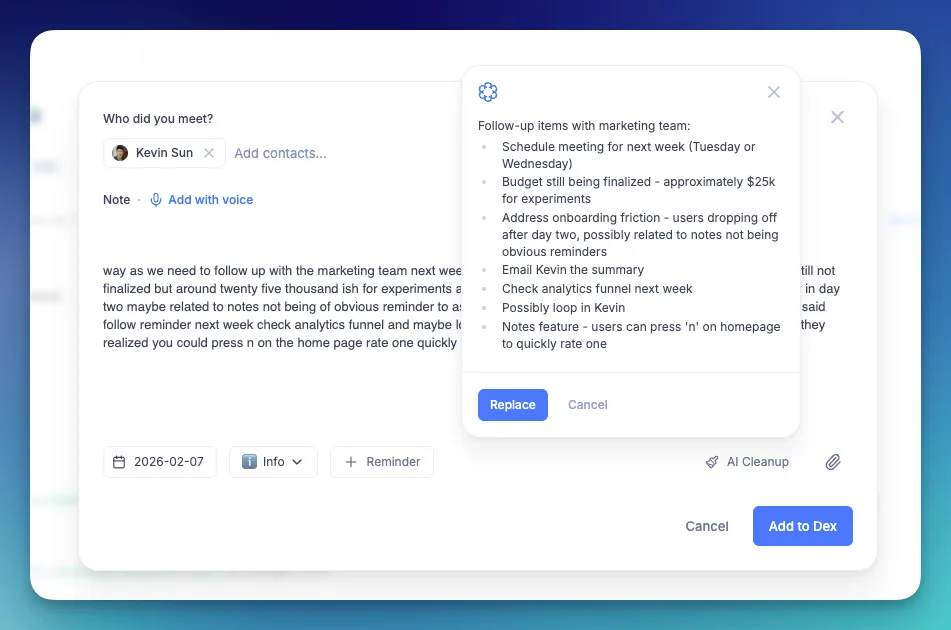
Dictate a note, then let AI Cleanup turn it into something readable.
Memory - Every contact has notes and a timeline. On mobile, tap Add with voice and talk; AI Cleanup turns the rambling transcript into a structured note with the follow-up items pulled out. The note is dated and attached to the person, so the "moved to Austin" detail is sitting there in March when you finally message them.
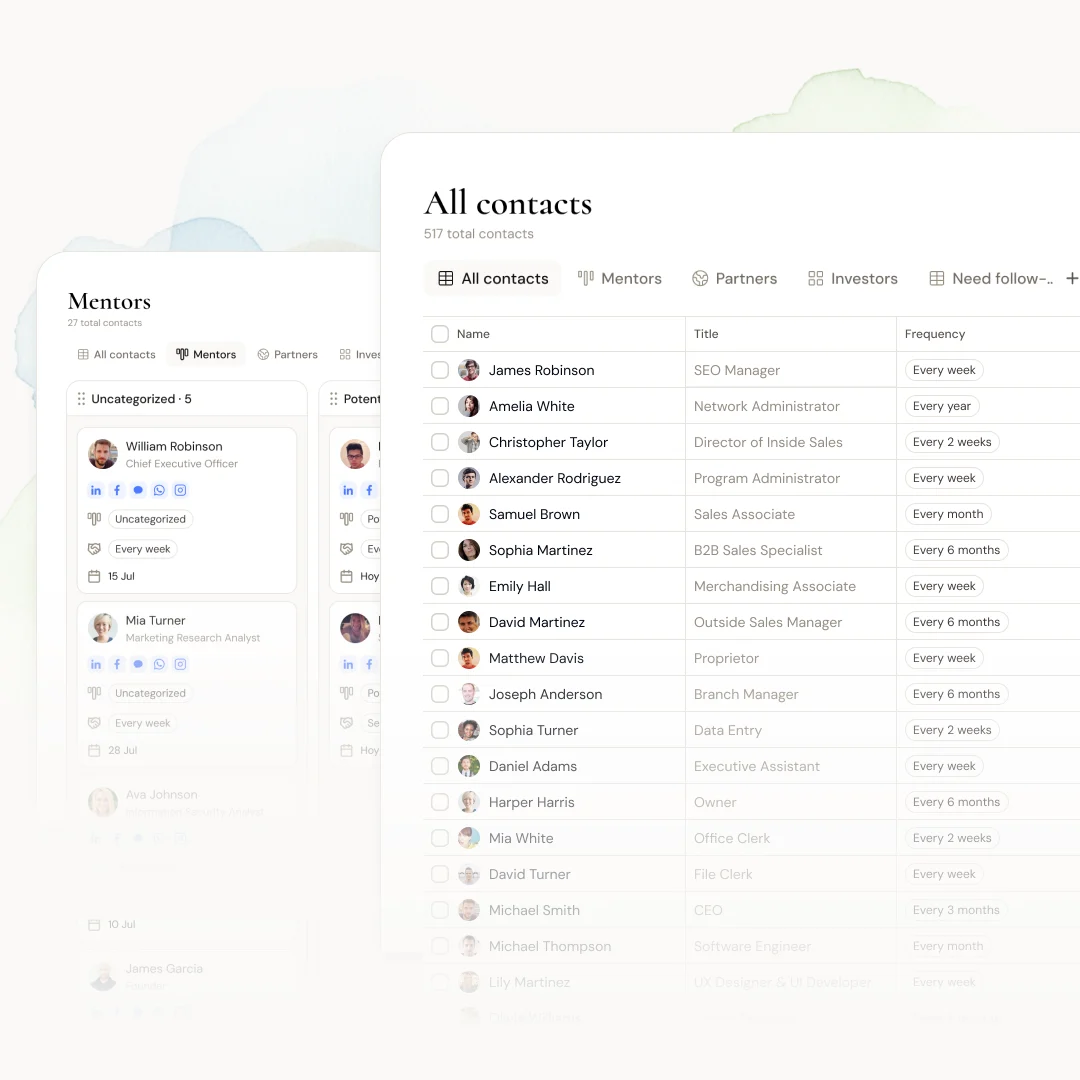
Organization - Groups hold everyone from a given event, and tags cut across events: "potential client," "hiring manager," "wants intro to investors." From the Contacts page you can select a whole group and, in one pass, apply a tag, set a keep-in-touch cadence, or archive the ones you have decided not to pursue. Saved views let you keep a filter like "in this year's show group, no interaction in the last 30 days" permanently open, so the people you have not gotten back to are always one click away.
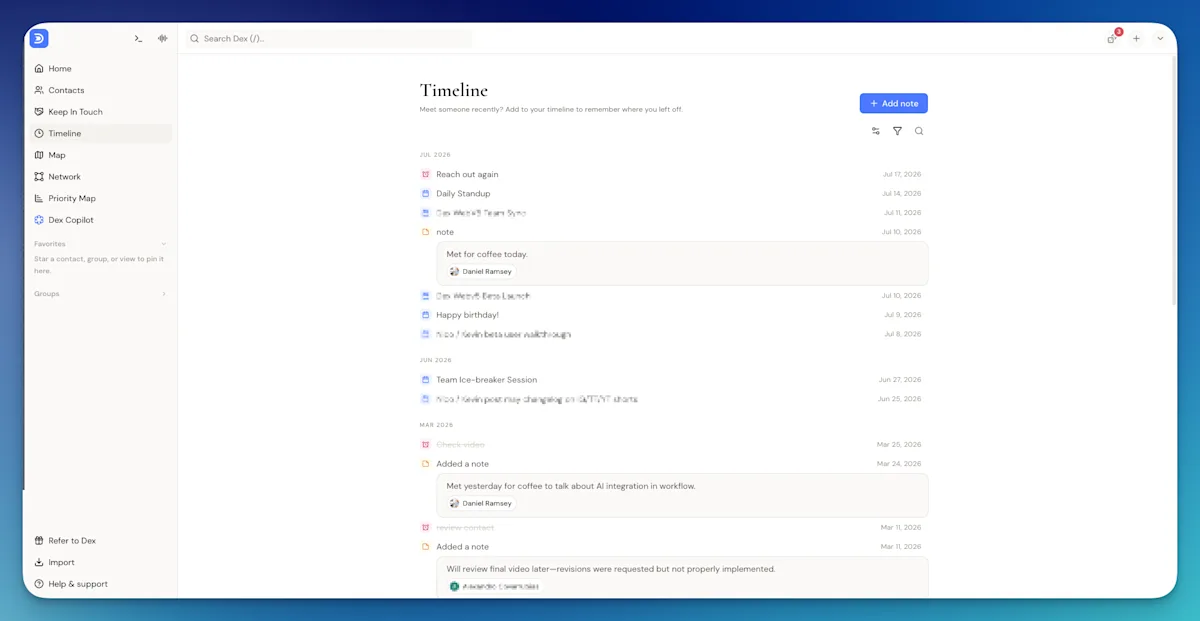
The timeline: every note, meeting, and reminder for a person in one place.
Trigger - This is the core of the product. Set a keep-in-touch frequency on the dozen people worth keeping, and Dex emails you the morning it is time and sends a push on your phone. Log the interaction when you reach out and the next reminder recalculates from that date, so cadences stay honest instead of drifting. For the promise you made on the floor, add a one-off reminder while you are writing the note.
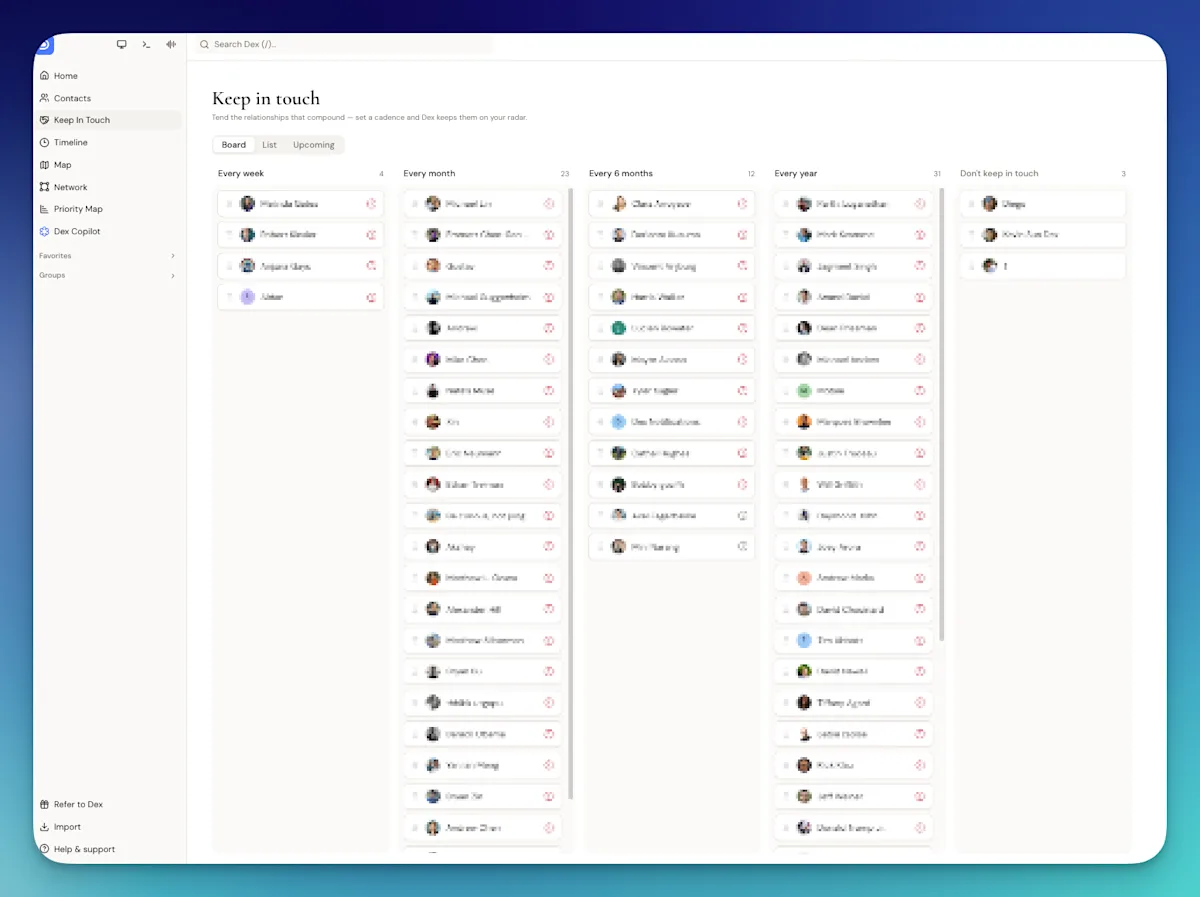
A one-off reminder for the promise you made; keep-in-touch cadences handle the long run.
Job changes - Dex syncs with LinkedIn, so when someone from last year's show starts a new role, it surfaces in your updates. That is usually the best moment to reach out, and the one you would otherwise miss entirely.
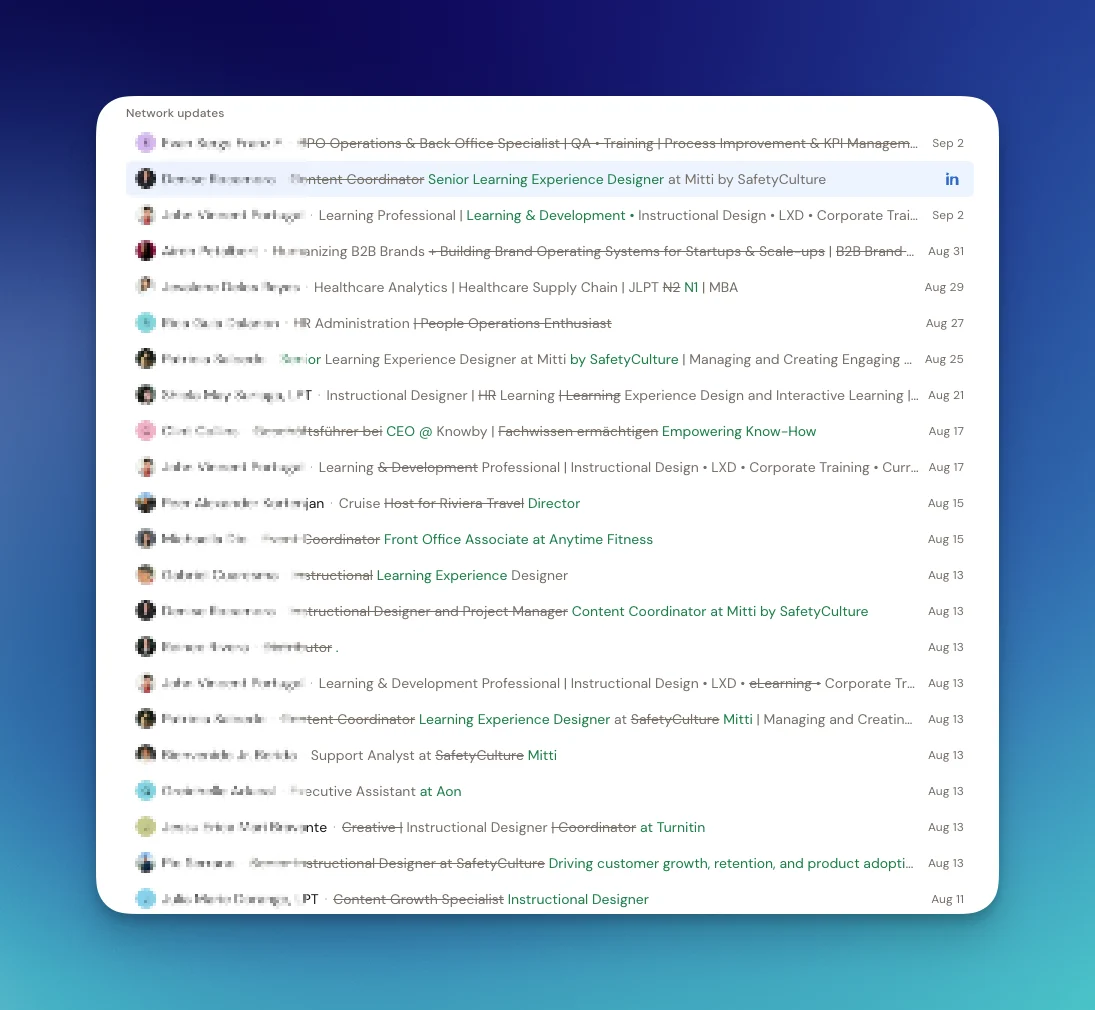
Job title changes from LinkedIn, updated in real-time
Who Dex isn't for
If you are staffing a booth and the leads belong to your company, you need a sales CRM and a badge scanner that feeds it, not a personal one. We have written about where that line falls and about why a sales CRM and a personal CRM are different tools.
If you attend one convention a year and come home with five cards, a notes app and a calendar reminder will do. The system pays off when the volume exceeds what you can hold in your head.
If you have no intention of following up with anyone, no tool changes that. Dex will remind you; it cannot make you want to.
Expand Your Network with Dex
The convention was the expensive part. Flights, hotel, three days out of the office, a badge that cost more than a month of any software. The follow-up is the cheap part, and it is the part nobody budgets time for, which is why most of that spend evaporates by the end of the following month.
The fix is not to network harder at the next one, but to keep the people from the last one.
Try Dex for free for 7 days, and scan your first card with the mobile app.
Frequently Asked Questions
Does Dex work for business contacts made at conventions?
Yes. Dex is a personal CRM, and convention contacts are the case it fits best: scan the business card on your phone, dictate a note about the conversation, put the person in a group for the event, and set a keep-in-touch cadence. Dex reminds you when it is time to reach out and flags when the person changes jobs.
Can I scan business cards into Dex?
Yes, on both iPhone and Android. The card scanner reads the card into an editable form, attaches the card photo to the contact, supports scanning a stack back to back, and works offline, syncing when you reconnect.
How soon should I follow up after a convention?
Within a day or two for the first message, while the conversation is still fresh for both of you. Then a second, no-ask touch three or four weeks later, and a recurring cadence, quarterly or twice a year, after that. The second and third touches are where most of the value is, and they are the ones people skip.
What should I write in a convention follow-up?
Reference the specific conversation, deliver anything you promised, and stop. Skip the pitch. The goal of the first message is to confirm you were paying attention; the relationship is built over the next several touches, not this one.
How do I keep contacts from different conventions organized?
Create a group per event (the show name and year) and use tags for categories that cross events, such as "potential client" or "hiring manager." Bulk actions let you tag a whole group or set a cadence for all of them at once.
Is a personal CRM overkill if I only go to one or two events a year?
Probably, if you come home with a handful of contacts. It becomes worth it when the number of people you want to keep exceeds what you can reliably remember, which for most people is somewhere around thirty.
Related reading: The strength of weak ties · Best ways to keep in touch after an event · Why offline networking still matters · How to use a personal CRM for networking