The Strength Of Weak Ties: Why Your Next Opportunity Comes from Someone You Barely Know
Weak ties (acquaintances, not close friends) drive more job leads than strong ties. Granovetter (1973) found it in 282 Boston job-seekers; a 2022 Science study of 20M LinkedIn users proved it's causal.



Weak ties (acquaintances, not close friends) drive more job leads than strong ties. Granovetter (1973) found it in 282 Boston job-seekers; a 2022 Science study of 20M LinkedIn users proved it's causal.
Think about the last good thing that happened in your career: a job, a client, an intro that turned into something real. Now think about who actually put it in front of you.
For most people, it wasn't a close friend. It was someone a couple of rungs out: a coworker from a job you left in 2019, someone you talked to for twenty minutes at a conference and never again, the friend of a friend at a wedding who mentioned their team was hiring.

Sociologists have a name for those people. They're your weak ties, and fifty years of evidence says they matter far more than their place in your life would suggest.
Fast facts:
Mark Granovetter's 1973 study found 27.8% of job leads came from contacts people saw "rarely" (about once a year or less).
A 2022 causal study of 20 million LinkedIn users confirmed it: weaker ties produce more job mobility than strong ones.
The sweet spot isn't the weakest possible tie. It's a moderately weak one, around ten mutual connections.
Weak ties decay fast and silently. Nothing in a normal calendar or inbox tracks them.
What Granovetter actually found
In 1973, sociologist Mark Granovetter published a paper in the American Journal of Sociology with the title that gave the idea its name: "The Strength of Weak Ties." The research behind it was unglamorous. He surveyed 282 men in the Boston area about how they'd found their current jobs.

Among the people who got their job through a personal contact, only 16.7% saw that contact often. About 55.6% saw them occasionally. And 27.8% saw them rarely, which in his coding meant roughly once a year or less.
So the people who delivered the job lead were mostly not the people in the daily rotation. They were the ones on the edges.
Granovetter's explanation is the part that stuck. The people closest to you tend to know the same people you know, read the same things, and hear about the same openings around the same time. Whatever they can tell you, you were probably going to find out anyway. A weak tie sits in a different cluster; when they pass something along, it's information that had no other route to you. Granovetter called these connections bridges, and argued that most of the genuinely new information in anyone's life crosses one.
Someone finally tested it on 20 million people
For decades this was a well-liked finding with a small sample and no way to prove causation. Maybe people with more weak ties were just better at their jobs to begin with, and the ties were a symptom, not a cause.
That changed in 2022. A team from LinkedIn, MIT, Stanford, and Harvard published "A causal test of the strength of weak ties" in Science. Between 2015 and 2019, LinkedIn ran controlled experiments on its People You May Know algorithm, showing some users more weak-tie suggestions and others more strong-tie ones. The scale was enormous: about 20 million users, 2 billion new connections, 70 million job applications, and 600,000 new jobs.
The theory held. Weaker connections produced more job mobility, and the researchers said so plainly: the stronger a newly added tie was, the less likely it was to lead to a job.
There was a wrinkle worth knowing, though. The relationship isn't a straight line, it's an inverted U. Extremely weak ties, people with almost no overlap with you at all, didn't help much either. The sweet spot was moderately weak, with roughly ten mutual connections sitting near the inflection point: close enough to vouch for you, distant enough to know things you don't. The effect was also strongest in digital and software-heavy industries, where job information moves fast and informally.
Granovetter (1973) vs. the LinkedIn causal study (2022)
Study | Method | Sample | Key finding | Type of evidence |
|---|---|---|---|---|
Granovetter, "The Strength of Weak Ties" (1973) | Survey of job-finding history | 282 men, Boston area | 27.8% of job-contact ties were seen about once a year or less | Correlational |
LinkedIn/MIT/Stanford/Harvard, "A causal test of the strength of weak ties" (2022) | Five years of randomized experiments on the People You May Know algorithm | ~20 million users, 2 billion new connections, 70 million job applications, 600,000 new jobs | Weaker ties caused more job mobility; ~10 mutual connections was the effective sweet spot | Causal |
The catch
Weak ties decay, and they decay silently. Close relationships maintain themselves through ordinary life. You'll see your best friend because you'll see your best friend. Nothing does that for the product manager you met at a meetup last spring. Miss six months and the reconnect gets awkward. Miss two years and you're an unfamiliar name in an inbox.
The good news is that the awkwardness is mostly in your head. A 2011 study in Organization Science by Levin, Walter and Murnighan had 129 executive MBA students reconnect with contacts they hadn't spoken to in three years or more. The advice from those dormant ties was rated as useful as advice from current contacts, and it took less effort to get.
There's also a memory problem. A large weak-tie network is, by definition, made of people you don't think about often. You can't maintain what you can't recall. Most people can name maybe thirty contacts off the top of their head, and their weak ties are almost none of them.
This is the gap Dex was built for.
Where Dex comes in
Dex is a personal CRM, a system for not losing people.
The core mechanic is keep-in-touch reminders. You set a cadence on a contact, quarterly, twice a year, whatever fits, and Dex resurfaces them when it's time. That sounds trivial until you realize it's the exact function nothing else in your life performs. Your calendar tracks meetings you already booked. Your inbox tracks people already contacting you. Neither tracks the acquaintance drifting quietly out of range.
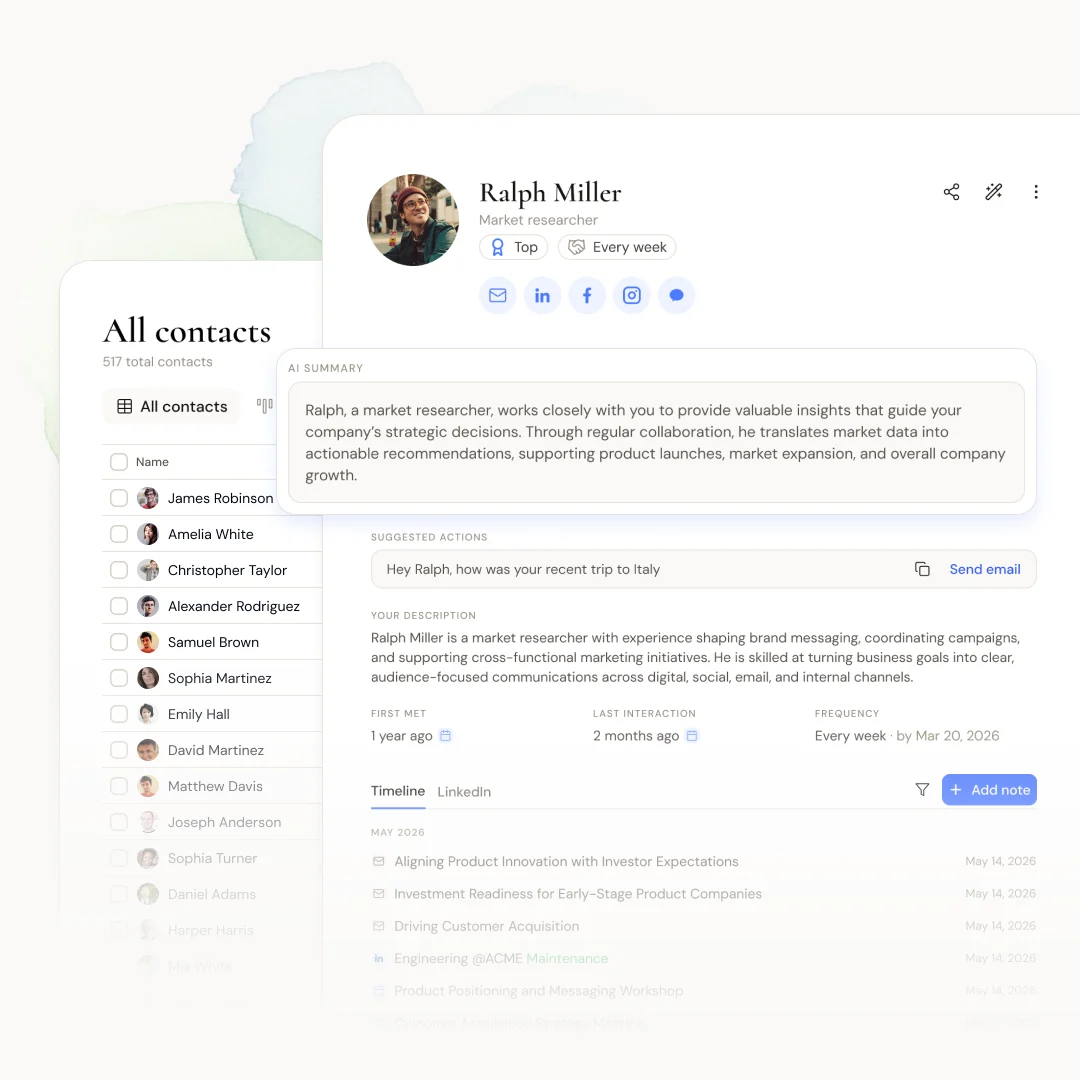
Dex pulls contacts in from LinkedIn, Gmail, Outlook, Google Calendar, WhatsApp, socials, and more, as well a browser extension, so the network you already built becomes something you can actually work with. It also syncs job titles from LinkedIn, one of the more useful signals available: someone changing companies is the single best moment to reach out, and it's a moment you'll otherwise miss.
Strong ties vs. weak ties, at a glance
| Strong ties | Weak ties |
|---|---|---|
Example | Best friend, family, daily coworkers | Ex-coworker, conference contact, friend of a friend |
Information you get | Mostly things you'd already know | New information from a different social cluster |
How it's maintained | Maintains itself through ordinary daily contact | Decays silently without a deliberate reminder |
Best for | Emotional support, trust, immediate help | Job leads, market intel, unexpected opportunities |
Four ways people actually use it
After a conference. You come home with forty new names and the energy to follow up with maybe six. Dex lets you drop them in, tag the event, and space the follow-ups out over the following months rather than firing off forty identical messages in one evening and never speaking to any of them again.
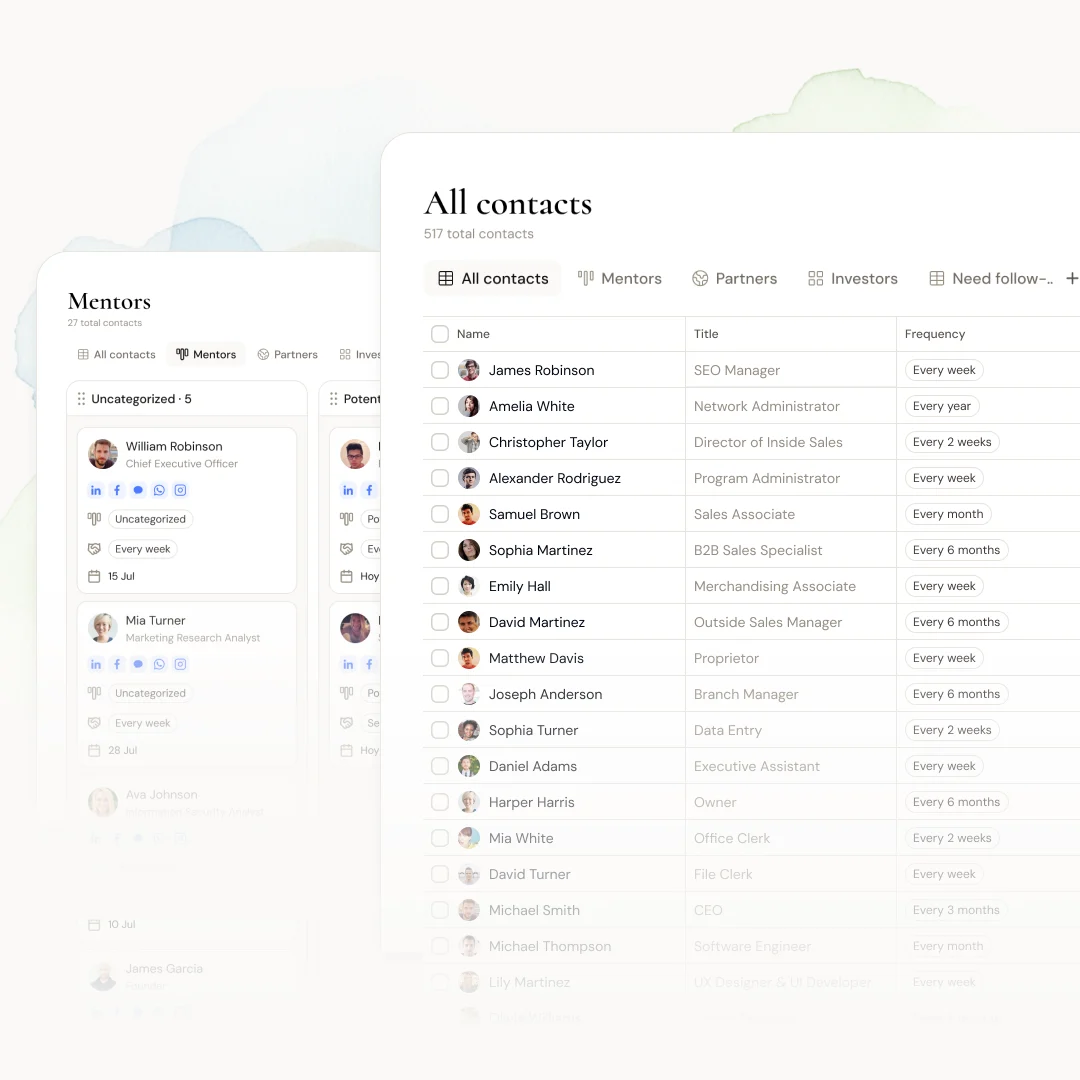
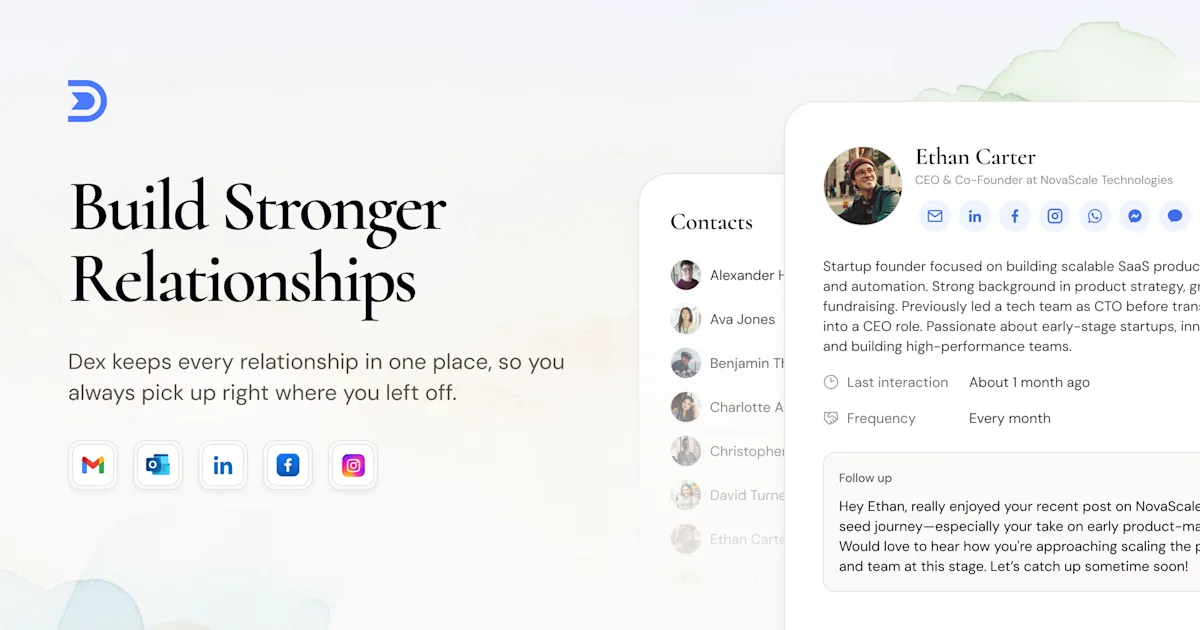
Dex allows you to seamlessly view your contacts and notes in one sleek, intuitive interface.
Reconnecting without the cold-open. People avoid reaching out to weak ties because it feels transactional. Dex stores notes and a timeline per contact, so the message can start with something real. You remember they were moving to Lisbon, or that their kid was applying to schools, because it's written down. That's the difference between a message that gets a reply and one that doesn't.
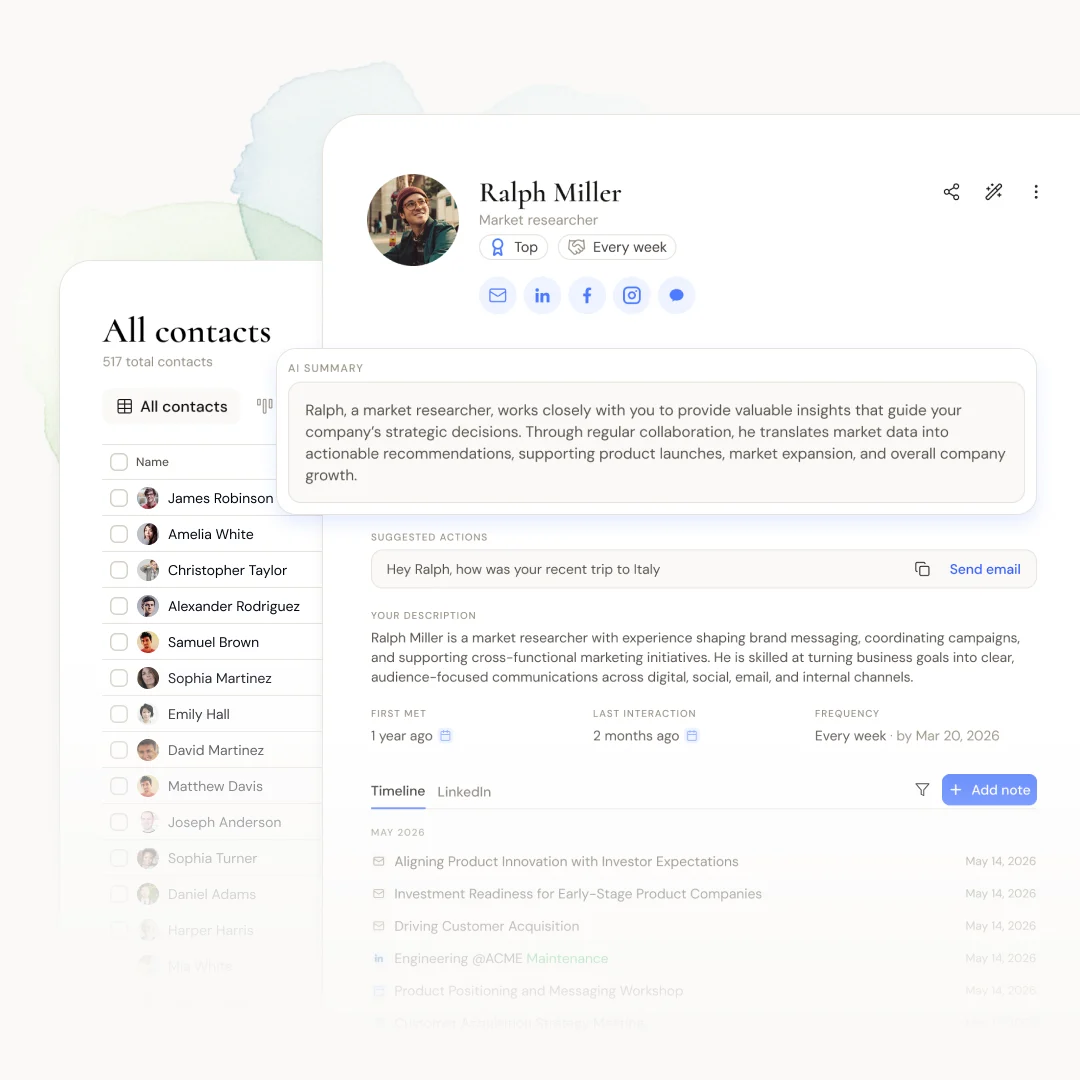
Dex surfaces the most important details about your contact from the get-go.
Job searching, quietly. The LinkedIn study's finding maps almost directly onto a workflow: don't blast your close circle, work the middle band. The NIH's career office recommends something similar, building a list of about 100 varied contacts and working outward from the lower-stakes ones first. Dex lets you filter for the people at the right distance and the right companies, and work through them methodically over weeks instead of panic-messaging everyone at once.
The weekly review. The habit that makes any of this work is a fifteen-minute pass once a week: who surfaced, who changed jobs, who you owe a reply. Dex is the surface that makes that possible, and the ritual matters more than the tool.
Who this isn't for
A personal CRM isn't the right tool for everyone, and it's worth saying so plainly.
If your network is under roughly fifty people and you already remember everyone in it, this is overhead you don't need.
If you're not looking to change roles, industries, or clients any time soon, the job-mobility research matters less. The LinkedIn study measured job outcomes specifically; it doesn't prove the same effect for, say, making friends or finding a hobby group.
If your industry is small and tight-knit, where everyone already knows everyone, the "bridge" effect weakens. Weak ties only help when they connect you to a genuinely different cluster, and in a small world, they might not.
If any system for managing relationships feels transactional to you no matter how it's framed, that discomfort is real and worth listening to. A tool doesn't erase it.
The uncomfortable part
Systematizing your friendships feels a little grim. That objection isn't wrong, exactly.
But the alternative isn't some purer, more spontaneous version of relationship maintenance. The alternative is losing track of people you liked because you had a busy quarter. Nobody feels good about that either.
The strength of weak ties is that they're the part of your life most likely to disappear through pure neglect, and most likely to matter when they do.

Dex's Network Map lets you see how people in your network relate to each other. Organize with AI to group and sort them intuitively.
Granovetter's contacts weren't doing favors. Most of them barely knew the person they helped. They just happened to be standing somewhere else in the network when a piece of information came through.
You can't control who's standing where. You can control whether they still remember your name.
Try Dex for free for 7 days.
Frequently Asked Questions
What is the "strength of weak ties" theory?
Coined by sociologist Mark Granovetter in a 1973 paper in the American Journal of Sociology, it holds that loose acquaintances, not close friends, are more likely to pass along genuinely new information, such as job leads, because they belong to social circles you don't already move in.
Was Granovetter's theory ever proven, not just observed?
Yes. A 2022 study in Science, run by researchers from LinkedIn, MIT, Stanford, and Harvard, used five years of controlled experiments on LinkedIn's People You May Know algorithm across 20 million users. It found that weaker ties caused more job mobility, and that moderately weak ties, around ten mutual connections, worked best.
Why do weak ties fade faster than close friendships?
Close relationships tend to maintain themselves through routine contact, since you'll naturally see a best friend or daily coworker. Weak ties have no built-in touchpoint, so without a deliberate reminder they drift out of memory within months.
What is a personal CRM?
A personal CRM is software for tracking personal and professional relationships, similar to a sales CRM but built for individuals. Tools like Dex import contacts from sources such as LinkedIn, Gmail, and WhatsApp, then track notes, job changes, and reminders for when to reach back out.
How often should you reach out to a weak tie to keep it alive?
The research doesn't set one universal number. In practice, keep-in-touch tools like Dex work best with a per-contact cadence, quarterly for some people, twice a year for others, adjusted so a relationship resurfaces before it's gone cold rather than after.