Dex vs Salesforce: Building Professional Relationships
Salesforce is a per-seat sales system built on deals with amounts and close dates, from $25 to $550/user/month once you outgrow its two-user free tier. Dex is $12/month and built for building professional relationships that have no deal attached. If the relationship has a dollar figure, use Salesforce.



Salesforce is a per-seat sales system built on deals with amounts and close dates, from $25 to $550/user/month once you outgrow its two-user free tier. Dex is $12/month and built for building professional relationships that have no deal attached. If the relationship has a dollar figure, use Salesforce.
Someone somewhere is trying to log a coffee with a former colleague into Salesforce, and the form is asking them for an expected close date.
That moment is the whole comparison. Both tools store people and both remind you to follow up, so on paper they overlap. Underneath they are built on different objects, and that difference decides which one is wasting your time.
Anyone comparing these two is usually doing one of two jobs: running a sales process, or building professional relationships that may never turn into a sale at all. Salesforce is very good at the first and structurally unsuited to the second.
Fast facts
Salesforce Sales Cloud runs $25/user/month for Starter Suite to $550/user/month for Agentforce 1 Sales, with Enterprise at $175. A Free Suite tier is $0/user/month but caps at 2 users.
Only Starter Suite is sold month to month. Pro, Enterprise, and Unlimited are billed annually.
Salesforce implementation typically runs $5,000 for a small setup and well into six figures for enterprises, on top of licences.
Dex is $12/month for Premium and $20/month for Professional, with a 7-day free trial and no credit card.
One Dex seat for a year costs roughly what two weeks of one Salesforce Enterprise seat does.
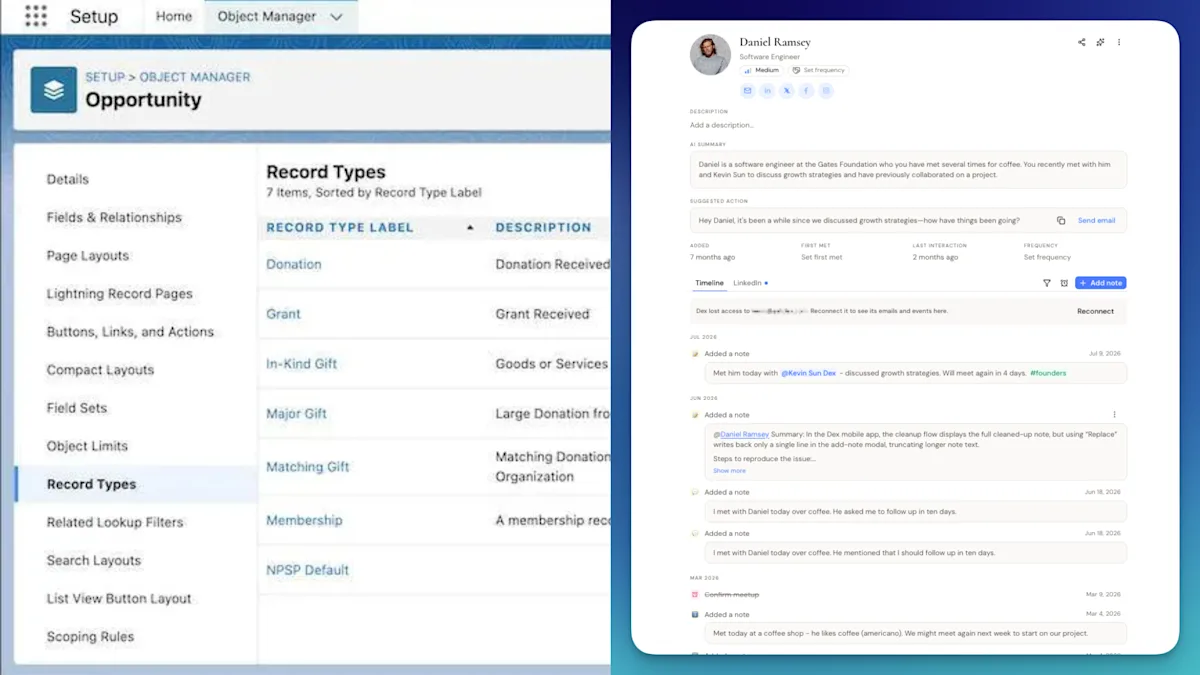
A Salesforce opportunity record beside a Dex contact page showing notes and reminders
The object each one is built on
Salesforce's central object is the Opportunity. An Opportunity has an amount, a stage, and a close date, and those fields are not decoration. They feed forecasting, which is what the whole system exists to produce. A sales leader opens Salesforce to answer one question: how much will we close this quarter.
That design is excellent for its purpose and hostile to everything else. A person you met at a conference has no amount. A former manager worth staying close to has no close date. You can force them in as a Contact with no Opportunity attached, and many people do, but then they sit outside every report, every dashboard, and every automation the system is built around. They become invisible in the exact tool you filed them in.
Dex is built on the person. A contact has a cadence rather than a stage, a history rather than a pipeline, and no field anywhere asking what it is worth. Nothing in it forecasts revenue, which is precisely why it can hold the relationships that will never produce a forecast.
This is the part most comparisons skip. Salesforce is not missing personal relationship features because nobody thought of it. It excludes them because including un-forecastable people would corrupt the number the product exists to produce.
What Salesforce actually costs
The sticker price understates it, so it is worth laying out properly.
Edition | Per user / month | Billing |
|---|---|---|
Free Suite | $0 | Up to 2 users, no expiry |
Starter Suite | $25 | Monthly or annual |
Pro Suite | $100 | Annual |
Enterprise | $175 | Annual |
Unlimited | $350 | Annual |
Agentforce 1 Sales | $550 | Annual |
Enterprise was repriced upward from $165 in 2025, part of a roughly 6% rise across Enterprise and Unlimited. Beyond the licence there is implementation, which is commonly quoted from around $5,000 for something simple and reaches six figures for a real enterprise rollout, and Premier Success support, commonly put at around 30% of licence cost. Data storage overages and AI add-ons bill separately again.
None of that is a criticism. If Salesforce is managing a revenue pipeline, the licence is a rounding error against the pipeline. It matters here only because people evaluating it for personal use rarely see the second and third invoices coming.
For one person, Salesforce Enterprise is $2,100 a year before anyone configures anything. Dex Premium is $144.
Side by side
| Dex | Salesforce |
|---|---|---|
Built around | A person, with a cadence | An opportunity, with an amount and close date |
Price | $12/mo Premium, $20/mo Professional | $0 for up to 2 users, then $25 to $550 per user/month |
Free trial | 7 days, no credit card | Free Suite for 2 users, or 30 days on Starter Suite |
Who it is sold to | Individuals | Revenue teams, per seat |
Setup | Connect accounts, import contacts | Implementation project, often with a partner |
Contact sources | LinkedIn, Gmail, Outlook, Google Calendar, WhatsApp, iMessage, Facebook, X | Email and calendar sync, data enrichment vendors, manual and imported records |
Syncs up to 2,500 connections on Premium, 9,000 on Professional, job titles update automatically | No native personal LinkedIn sync; Sales Navigator is a separate licence | |
Reminders | Per-contact keep-in-touch cadence | Tasks and activity reminders tied to records and deals |
Reporting | Minimal by design | Extensive: forecasting, dashboards, territory and quota management |
Admin overhead | None | Usually a dedicated admin at any scale |
The decision rule
If the relationship has a dollar amount and a close date, it belongs in Salesforce. If it does not, it belongs somewhere else.
That is genuinely the whole test, and it survives most edge cases. A prospect evaluating your product this quarter is a Salesforce record. The investor who passed but said to stay in touch is not, because there is nothing to forecast and never will be, and the moment you file them as a stale Opportunity you have started lying to your own pipeline report.
Plenty of people need both, which is fine and common. The mistake is not using two tools. The mistake is using the forecasting tool for the half of your contacts that will never be forecast.
It is worth being precise about what gets lost. When people give up on building professional relationships inside Salesforce, they rarely announce it. They just stop opening the tab for anything that is not a deal, and the contacts they filed there quietly stop existing.
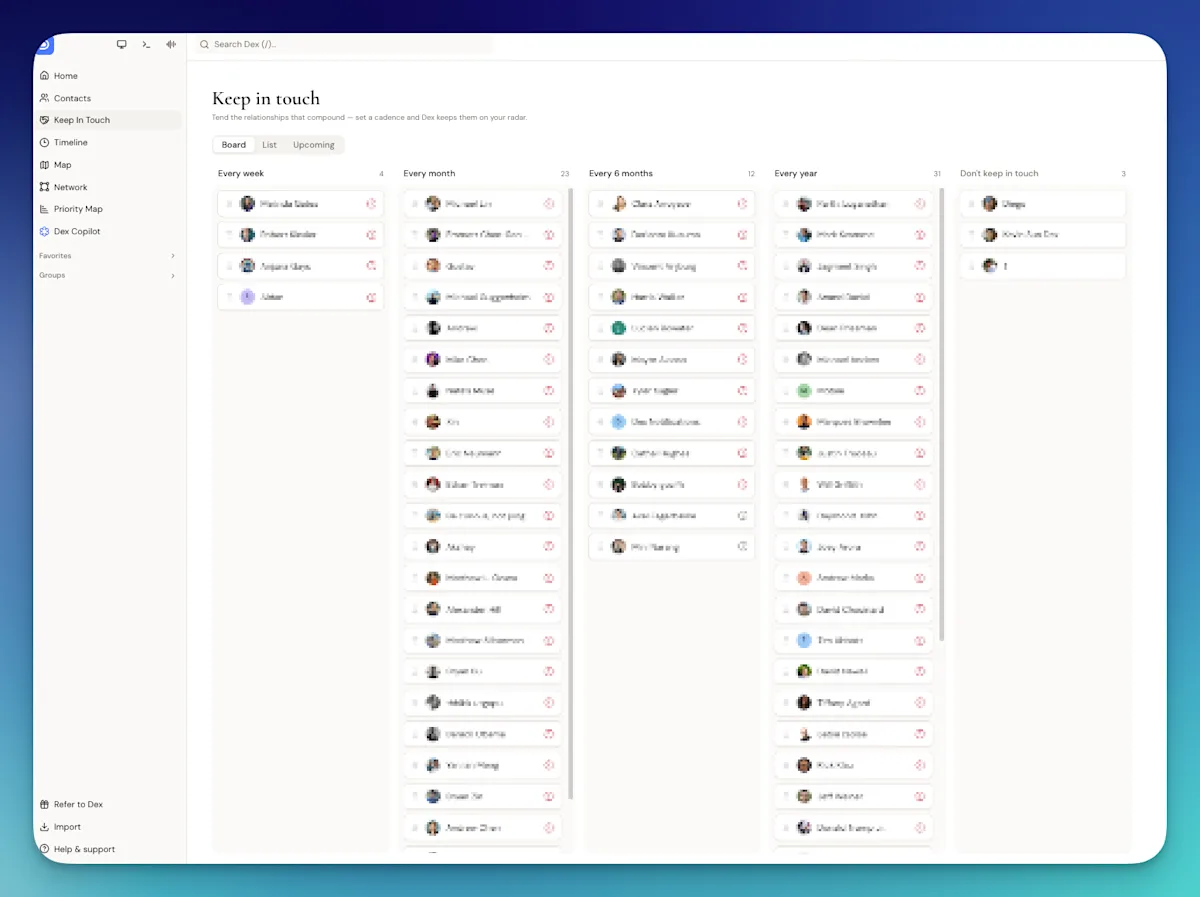
Dex keep-in-touch view listing contacts due for a catch-up.
Building professional relationships when nothing is closing
Here is the practical gap. The relationships that matter most over a career tend to be the ones with no transaction attached, and those are exactly the ones a sales CRM cannot hold.
Building professional relationships is mostly an act of memory. You have to recall that someone moved to Berlin, that their team was reorganised, that they mentioned wanting to leave. Then you have to reach out before the silence gets long enough to make it awkward. Neither half is hard. Both are easy to drop when a quarter gets busy.
Dex handles the memory half with notes and a timeline per contact, and the timing half with a cadence you set per person: quarterly for some, twice a year for others. It pulls contacts from LinkedIn, Gmail, Outlook, Google Calendar, WhatsApp, iMessage, Facebook, and X, and syncs job titles from LinkedIn automatically. That last one does more work than it sounds like, since someone changing companies is the single best moment to reach out and the one you would otherwise never notice.
Salesforce can technically do the memory half. It has notes and tasks. What it will not do is surface a person who has no deal attached, because surfacing them is not what the reports are for. You would be maintaining a list the system has no reason to show you.
Three habits do most of the work, whichever tool holds them:
Set a cadence per person rather than one blanket rule. A close former colleague and a conference acquaintance do not need the same interval.
Write the note the same day. Details you are certain you will remember have a short half-life.
Reach out on the change, not on the calendar. A new job, a funding round, or a move is a real reason to message; "it has been six months" is not.
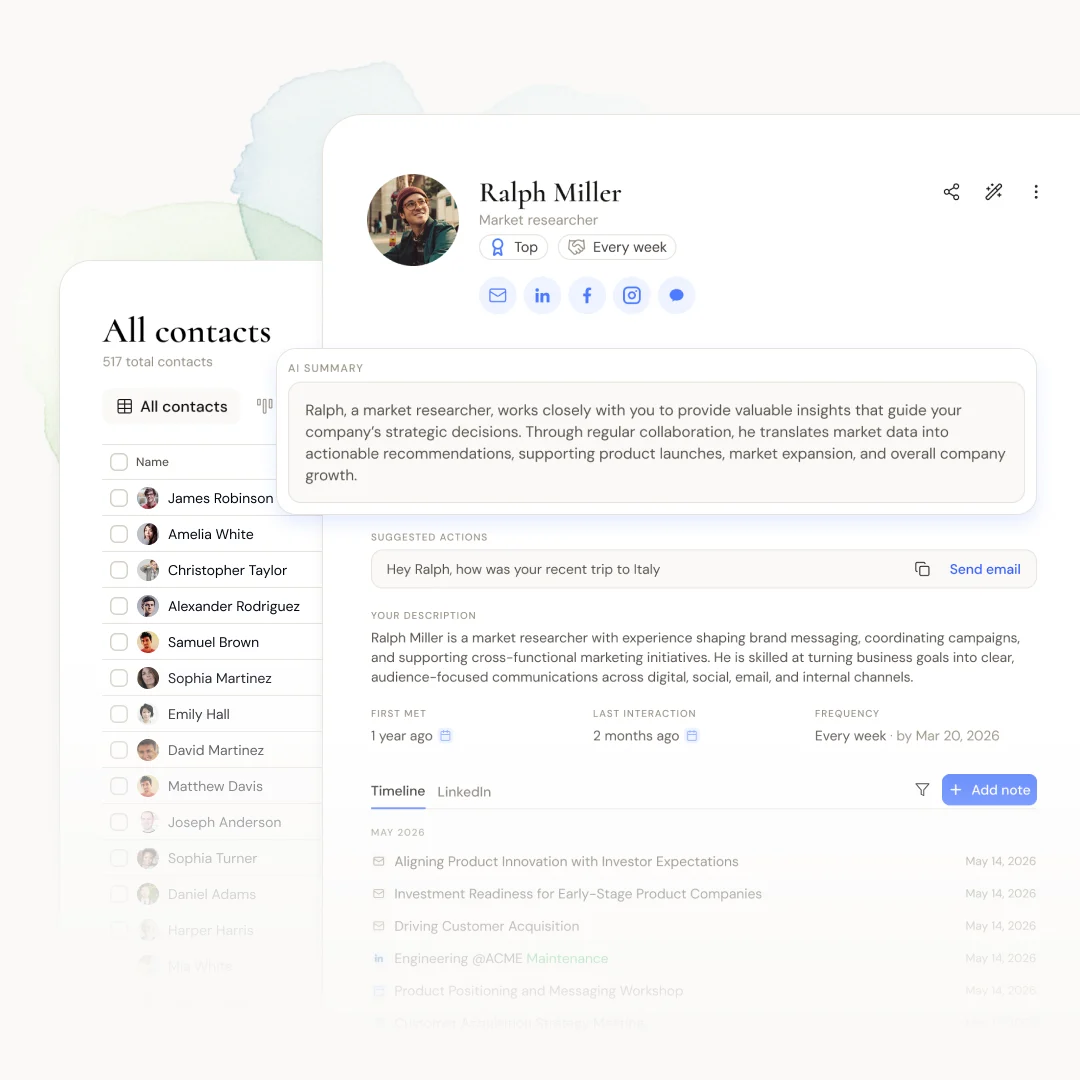
Dex contact page showing interaction history and a recent job change.
Where Salesforce is straightforwardly better
For a large group of people, Salesforce is the right answer and Dex is not a substitute.
Anything with a pipeline. Stages, amounts, weighted forecasts, quota tracking. Dex has none of this and is not trying to.
Teams that need shared records. Salesforce is built for many people working the same account with permissions, audit trails, and territory rules. Dex is built around one person's network.
Reporting that has to satisfy someone else. Board decks, revenue forecasts, and compliance reporting live in Salesforce for good reason.
Deep customisation. Custom objects, Apex, an enormous integration ecosystem. If your process is genuinely unusual, Salesforce will bend to it and a focused tool will not.
Scale. Thousands of accounts across dozens of reps is a Salesforce problem, and no personal CRM solves it.
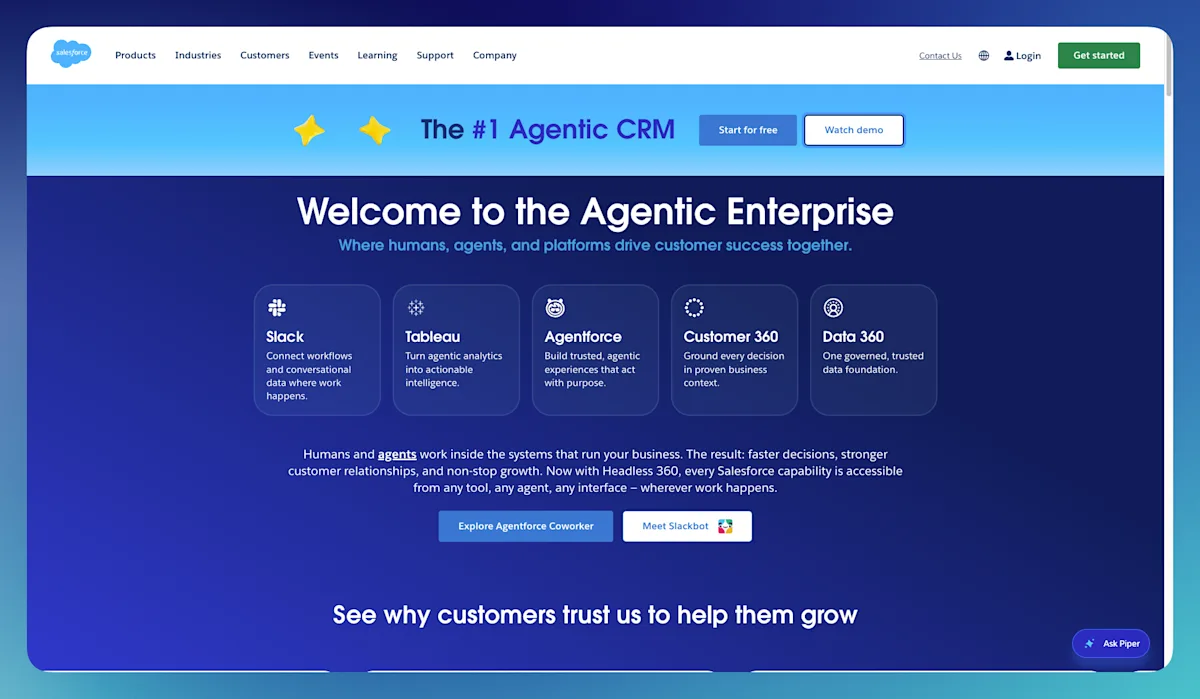
If you are a founder with real revenue and a sales motion, you will likely end up with Salesforce or something like it. The argument here is not that you should not. It is that your personal network should not live inside it, and that building professional relationships is a separate job from closing deals even when the same person is doing both.
Who neither of these is for
If you have under about fifty contacts and remember all of them, both are overhead. Use your calendar.
If you want a shared team CRM but Salesforce is too heavy, the honest answer is neither of these. Look at Attio or HubSpot.
If you need a pipeline and a personal relationship tracker in one system, that product does not really exist. Most people who need both run both.
If your objection is that systematising relationships feels transactional, that is a fair instinct and no feature list resolves it.
The verdict
Salesforce is the correct tool for revenue and a poor one for everything else, which is not a flaw so much as the consequence of doing one job unusually well.
Dex is the better fit for building professional relationships that have no transaction attached: former colleagues, people you met once and liked, the investor who passed, the person who will run a team worth knowing in four years. Those relationships have no close date, which is exactly why the forecasting tool cannot see them and exactly why they decay quietly.
The test at the top holds. Dollar amount and close date, Salesforce. Neither, something built for people.
If you want to try it, Dex is free for 7 days with no credit card. If you are still mapping the category, start with the guide to finding the right personal CRM.

Dex mobile app showing the main contact list.
Frequently Asked Questions About Building Professional Relationships
Can I use Salesforce as a personal CRM?
You can, but it works against the product's design. Salesforce is built around opportunities with amounts and close dates, so contacts with no deal attached fall outside its reports and automations. Its free tier stops at two users, and paid seats run $25 to $550 per user per month, against $12 for a personal CRM like Dex.
What is the best tool for building professional relationships?
For relationships with no transaction attached, a personal CRM fits better than a sales CRM. Tools aimed at building professional relationships track a per-contact cadence, notes, and interaction history rather than pipeline stages, so people who will never appear in a revenue forecast still surface for follow-up.
How much does Salesforce cost per user?
A Free Suite tier costs nothing but caps at two users. Paid Sales Cloud runs $25/user/month for Starter Suite, $100 for Pro Suite, $175 for Enterprise, $350 for Unlimited, and $550 for Agentforce 1 Sales. Only Starter Suite is sold month to month; the rest are billed annually. Implementation and Premier Success support cost extra.
Is Dex a Salesforce alternative?
For individuals tracking a personal network, yes. For a sales team managing a pipeline, no. Dex has no pipeline stages, forecasting, or shared team records, so it replaces Salesforce only where Salesforce was the wrong tool to begin with.
Do I need both Dex and Salesforce?
Many people do, and the split is clean. Anything with a dollar amount and a close date goes in Salesforce; the rest of your network goes in a tool built for people.
Does Dex sync with LinkedIn?
Yes. Dex syncs up to 2,500 LinkedIn connections on Premium and 9,000 on Professional, and updates job titles automatically as contacts change roles. Salesforce has no equivalent native personal sync; Sales Navigator is a separate licence.
Related reading: Best personal CRMs for networking in 2026 · Finding the right personal CRM · CRMs for solopreneurs · Contact management software
More comparisons: Dex vs Attio · Dex vs Monday CRM · Dex vs Streak · Dex vs Clay · Dex vs folk · Dex vs Queue