How to Build an AI Second Brain in 2026 (Notion + Dex + ChatGPT)
An AI second brain uses AI to capture, organize and resurface what you know, who you know and what you need to do. This guide walks through the three pillars (knowledge in Notion, relationships in Dex, and action with an AI agent) and how to connect them with MCP.



An AI second brain is a system that captures what you learn, who you know and what you need to do, and uses AI to do most of the upkeep for you. Instead of filing every note and updating every contact by hand, you connect a few tools to an AI assistant through MCP, and the assistant saves, finds and resurfaces things on your behalf.
This guide shows you how to build a second brain with AI in 2026 with three tools: Notion for knowledge, Dex for relationships, and ChatGPT (or Claude) as the AI layer that ties them together. Prefer to watch? The full walkthrough is in the video below:
What is an AI second brain?
The idea of a second brain comes from productivity writer Tiago Forte's book Building a Second Brain: a trusted, external place to store ideas so your actual brain can focus on thinking. The classic method works, but it has one big weakness. You have to maintain it yourself. Most people set up a beautiful system, add notes for a couple of weeks, then stop.
An AI second brain fixes that. The AI captures information for you, organizes it, answers questions about it, and brings things back when they become relevant. The lower the effort, the more likely you are to keep using it, and a second brain you actually use is the only kind that helps.
The 3 pillars of an AI second brain
A useful AI second brain covers three areas of your life:
Knowledge and information: what you learn, read and want to remember.
Relationships and communication: who you know, how you know them, and what's going on in their lives.
Action: what you need to do, surfaced at the right moment.
Pillar | Tool | What the AI does |
|---|---|---|
Knowledge | Notion + Notion MCP | Summarizes and files what you read, finds it again on request |
Relationships | Dex + Dex MCP | Builds your network from your apps, remembers context, reminds you to follow up |
Action | ChatGPT Work (or another AI agent) | Checks everything on a schedule and brings you what matters |
Pillar 1: Build a Notion second brain for knowledge
Step 1: Start from a template
You need somewhere for everything you want your second brain AI to remember, and a Notion second brain is the easiest place to start. You could build it from scratch, but a Notion second brain template gets you there in minutes, and there are hundreds to choose from.
A good template splits your life into areas (health, personal growth, relationships, finances, home, travel, creativity) and lets you add three kinds of items inside each:
Notes: a book, article, video or PDF you learned something from.
Projects: things you're actively working on.
Tasks: things you actually need to do.
Rename the areas to match what you care about. That's your Notion second brain.
Step 2: Connect Notion to your AI with MCP
If you have to fill this in by hand every time you learn something, you'll stop within a week. This is where the AI comes in.
Notion has an MCP server. MCP (Model Context Protocol) lets an AI assistant like ChatGPT or Claude read from and write to your Notion workspace directly. Connect your account, give it access to your Notion second brain, and your assistant can now work inside it.
Step 3: Let the AI capture for you
Now, instead of taking notes yourself, you hand the work to the AI:
Give it a research paper and say: "Read this, pull out the ideas worth remembering, and add them to my second brain under Personal Growth."
Have an idea while walking? Say: "Add 'test whether AI can plan an entire vacation' to my content ideas."
Open Notion and it's there, already filed. You didn't organize anything.
Step 4: Ask your second brain questions
Capturing is only half the job. Six months later, you won't remember where anything is, and you don't need to. Ask: "What have I saved about negotiation?" Your AI searches your own notes instead of giving a generic answer. Or try: "I'm writing about building an AI second brain. Find anything I've saved that might help."
Pillar 2: A second brain for relationships with Dex
There's a whole category of information that doesn't fit neatly into Notion: people. Who you know, how you met, what you talked about last time, what's happening in their lives, and what you promised to follow up on. You could track all of that in Notion manually, but almost nobody keeps it up. People need a second brain for relationships.
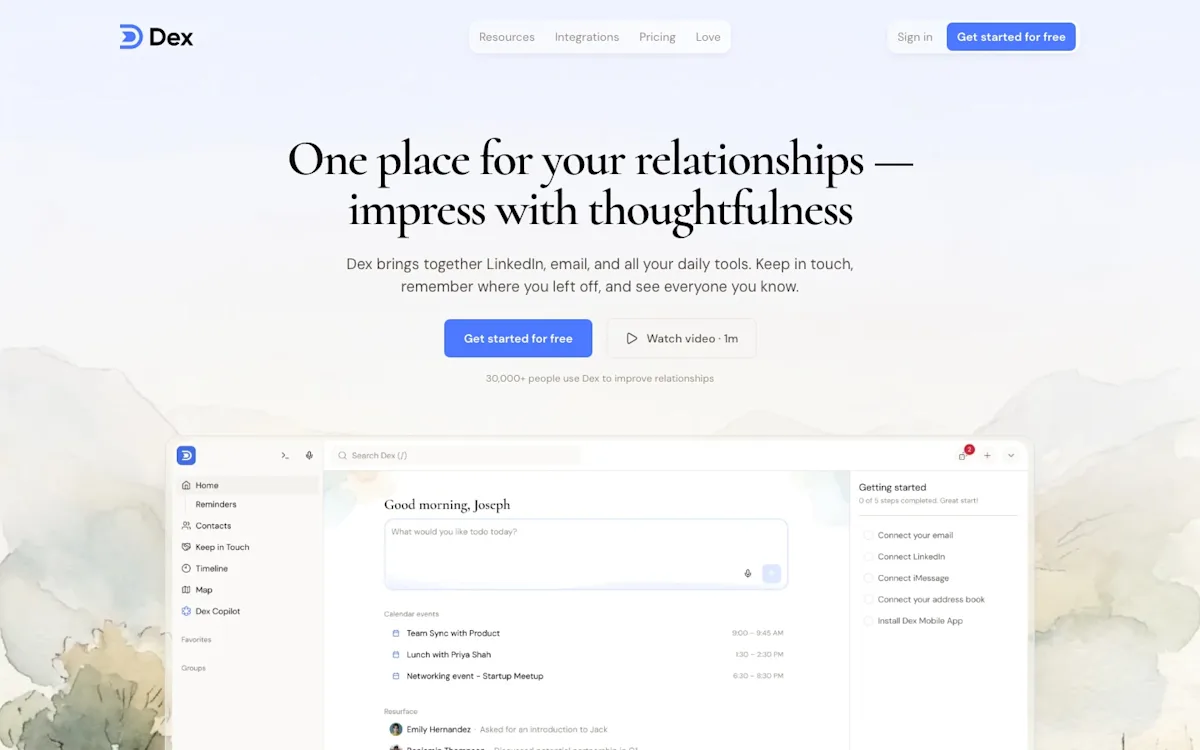
Dex is a personal CRM built to be a second brain for relationships. It handles the people pillar of this setup, and like Notion, it does most of the maintenance for you.
Step 1: Connect where you already talk to people
Connect the places you already communicate: email, calendar, LinkedIn, WhatsApp and iMessage. Dex works out who you know and builds your network automatically, so you start with everyone from all your apps in one place instead of creating contacts one by one.
Step 2: Let Dex remember the context
A list of contacts isn't very useful on its own. What you want is for your second brain to remember what's going on with each person. Say your friend James mentions he's starting a new job, moving to New York, or raising a round for his company. Dex picks up that context from your conversations, so you don't have to update his profile after every message.
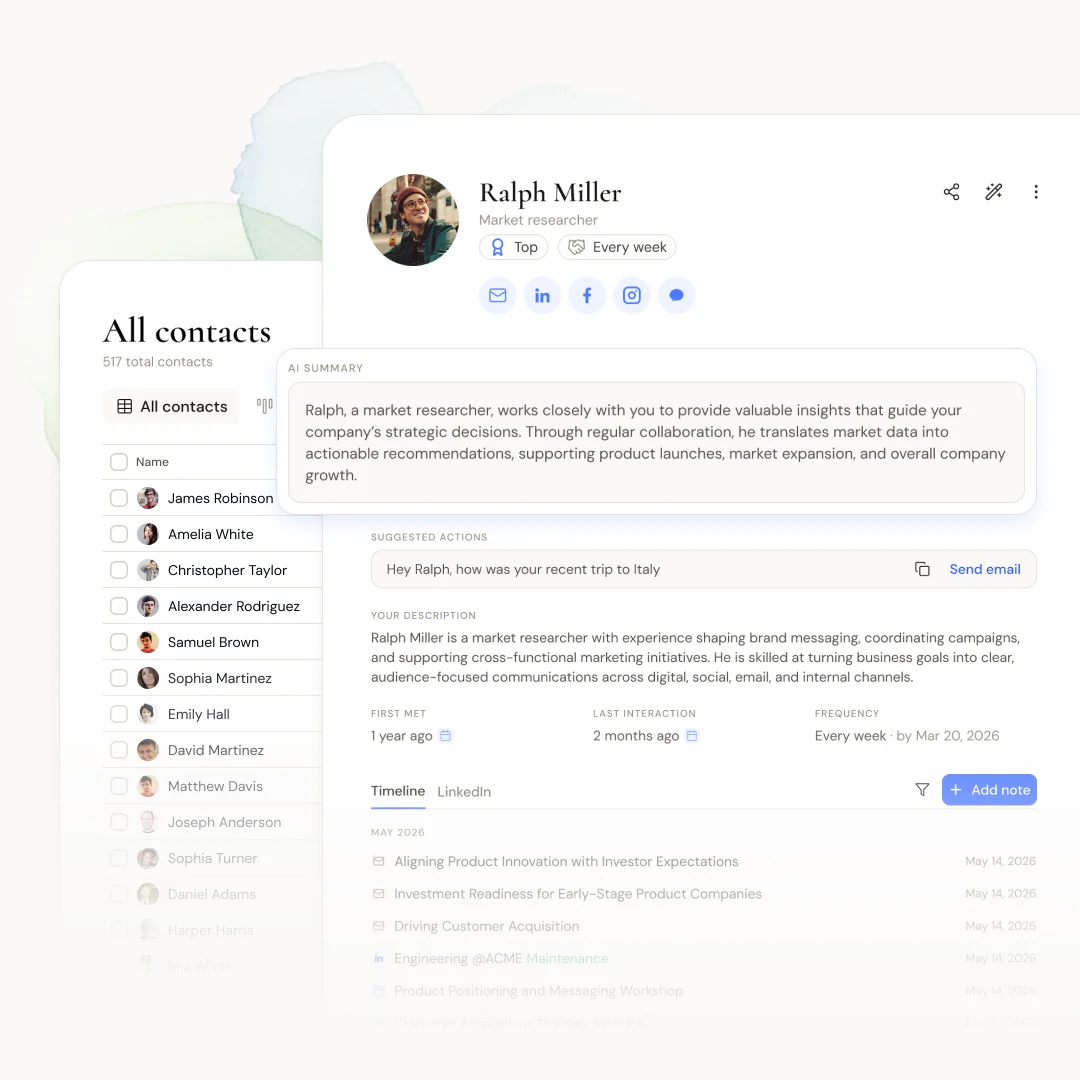
That's the shift: your second brain no longer only stores what you deliberately save. It builds memory from what's actually happening in your life.
Step 3: Get resurfaced at the right time
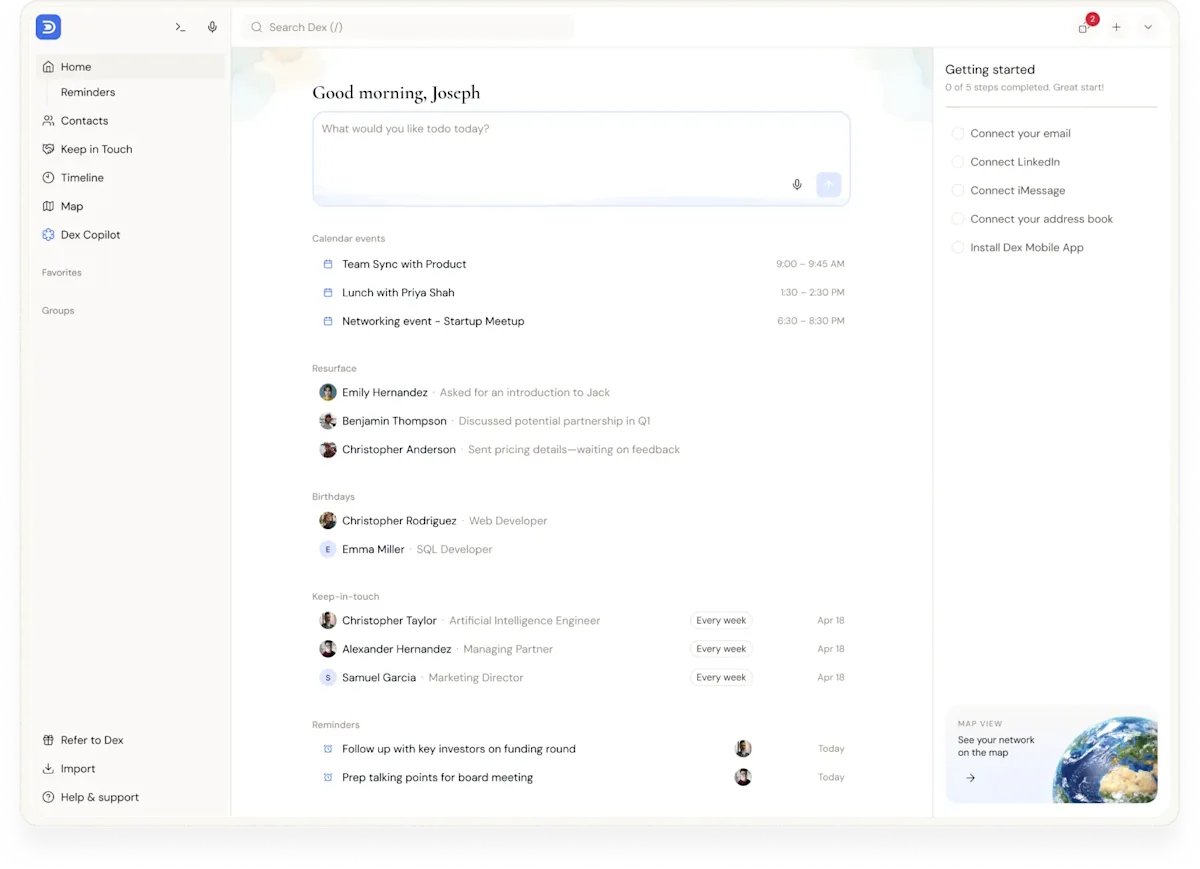
In an AI second brain, remembering something only helps if you see it again. Dex's resurface reminders look through what it knows about your relationships and bring back what's worth acting on. A week after James starts that job, Dex texts you: "James started his new job last week." You send him a quick note asking how it's going. You didn't set a reminder or open an app.
Step 4: Connect Dex to your AI
Dex also has its own MCP server. Connect it to ChatGPT or Claude and your assistant can reason over your real network:
"What was the last thing James and I talked about?"
"Who do I know at OpenAI?"
"I'm going to New York next week. Who do I know there that I haven't spoken to recently?"
"Who could introduce me to investors?"
"Catch me up on everything I should remember before my meeting with Priya."
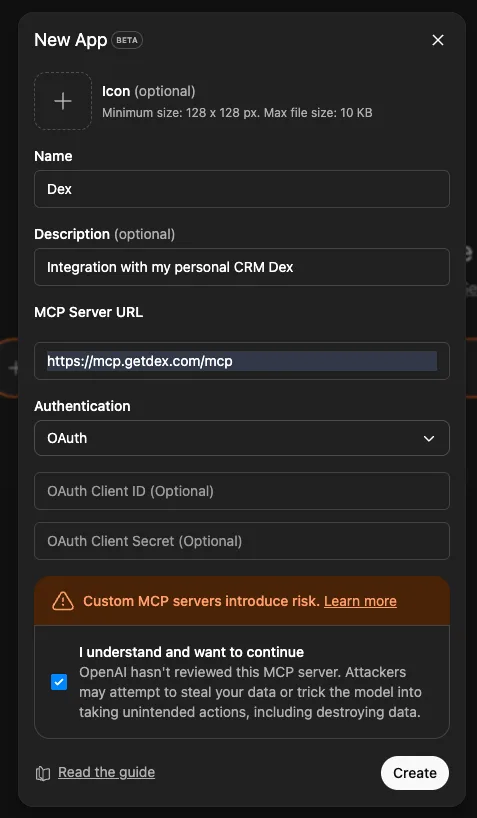
Because the answers come from your actual relationship history, they're personal to you. Notion now handles what you know, and Dex handles who you know.
Pillar 3: Building a second brain with an AI agent
The last pillar is action, and it's where an AI second brain really pulls ahead of the old way. Ideally you don't have to remember to ask your second brain anything. It notices when something becomes relevant and brings it to you.
AI agents can now run tasks in the background on a schedule, monitor for changes and use the apps you've connected. In the video we use ChatGPT Work and give it one recurring task:
Every morning, look through my second brain, my relationships, and anything relevant that's changed. Find things I might want to know or do, and bring them to me.
Here's what that looks like in practice:
A new book from an author you've taken notes on comes out. The agent tells you: "You saved a lot of notes from this author. They just released a new book."
You're going to a conference next week. The agent checks who's attending, cross-references Dex, and reports: "Six people you already know are going. You haven't spoken to three of them in over a year. Here they are."
You didn't search the attendee list or look anyone up. Your AI second brain spotted an opportunity in your network and brought it to you, and it can help with the next step too, like drafting a message.
How the pieces connect: building a second brain with AI assistant integration
If you're wondering how to build a second brain that runs itself, this is the answer. The whole system runs on one idea: every tool connects to your AI assistant through MCP.
Notion MCP gives the assistant your knowledge.
Dex MCP gives it your relationships.
An AI agent (ChatGPT Work, or scheduled tasks in your assistant of choice) runs on a schedule and acts on both.
Each piece of your AI second brain is useful alone. Together, they make an AI second brain that stores what you know, remembers who you know, and tells you when something matters.
Tips for an AI second brain you'll actually use
Cut friction everywhere. Capture by voice or by forwarding things to your AI. If saving takes more than a few seconds, you'll stop.
Let tools sync instead of typing. Connect your inbox, calendar and messaging apps so your relationship data stays current on its own.
Ask questions often. The more you ask your AI second brain, the more value you get back from everything you've saved.
Start small. Set up one pillar this week, then add the next. Most people get the fastest win from the relationships side of their AI second brain, because that data is already in their apps.
Frequently Asked Questions About AI Second Brain
What is a second brain in AI?
An AI second brain is a personal knowledge system where AI does the capturing, organizing and resurfacing for you. It usually combines a notes tool like Notion, a personal CRM like Dex for relationships, and an AI assistant connected to both through MCP.
What is the AI Second Brain Skill?
An AI second brain skill refers to reusable, step-by-step instruction files and workflows (often written in plain Markdown) given to an AI agent so it knows how to read, organize, update, and act upon your personal or enterprise knowledge base.
Which AI is the best for the second brain?
The best AI second brain depends on whether you prefer a local-first plain-text vault, an automated passive capture tool, or an all-in-one workspace
How do you build a second brain with AI?
Pick a home for each pillar (Notion for knowledge, Dex for relationships), connect both to ChatGPT or Claude using their MCP servers, then give an AI agent a recurring task to review everything and surface what matters.
Can ChatGPT be a second brain on its own?
Not really. ChatGPT's memory is limited and not organized for retrieval. It works best as the AI layer on top of tools that store your information properly, which is exactly what MCP connections allow.
Is a Notion second brain enough?
For knowledge, projects and tasks, yes. It's weaker for people, because relationship details change constantly and are hard to keep updated by hand. That's why a second brain for relationships works better in a dedicated tool like Dex.
Start building the relationship layer of your AI second brain
Learning how to build a second brain used to mean weeks of tagging and filing. You don't need to code or spend a weekend on setup.
Start with the pillar that matters most to you. If staying in touch with people is the part you keep dropping, try Dex free and connect it to your AI assistant. Your AI second brain will start remembering who you know from day one.
Related guides