
How to Strengthen Relationships: 9 Habits Backed by Research
To strengthen a relationship, show up often in small ways: reach out first, respond warmly to good news, turn toward small bids, remember details, and spend real time together. Frequency beats big gestures.



Most advice on strengthening relationships is written for couples in trouble. Weekly check-ins, date nights, "I statements" during arguments. Fine advice, as far as it goes.
Most relationships outside of romance don’t end in a fight, though. They fade out. A friend moves to another city, a former coworker changes jobs, or a cousin has a baby and you promise to call, but never do. A year goes by, and by then, reaching out feels strange. It doesn't have to be.
So this guide covers all of them: partners, friends, family, and the people you work with. The research on what makes a bond stronger is surprisingly consistent across all four. Most of it comes down to small things done often.
Fast facts:
A 2010 meta-analysis of 148 studies (about 308,000 people) found strong social relationships raised the odds of survival by 50%.
Becoming close friends with someone takes roughly 200 hours together, according to a 2018 study by Jeffrey Hall.
People consistently underestimate how much others appreciate an unexpected message, so most of us reach out less than we should.
Couples who stayed together responded to each other's small bids for attention 86% of the time. Couples who divorced: 33%.
Why strong relationships are worth the effort
The longest-running study of adult life, the Harvard Study of Adult Development, has followed the same group of men (and later their families) since 1938. Its current director, Robert Waldinger, has summed up the main finding many times: the quality of people's relationships predicted their health and happiness in old age better than cholesterol levels or income did.
The health data backs that up. Julianne Holt-Lunstad's 2010 meta-analysis in PLOS Medicine pooled 148 studies and found that people with stronger social ties had a 50% greater likelihood of survival over the study periods. That's an effect on par with quitting smoking.
You don't need more friends to get that benefit. The ones you already have are worth looking after.
9 ways to strengthen your relationships
1. Reach out first, and do it more than feels natural
In a study in the Journal of Personality and Social Psychology (published online in 2022), Peggy Liu and colleagues ran a series of experiments where people sent a short note or small gift to someone they hadn't talked to in a while. Senders consistently underestimated how much the message would be appreciated, and the gap was biggest when the message came out of the blue.
Most of us wait for a reason, assume the other person is busy, and decide it would be weird. It usually isn't. A two-line text ("saw this and thought of you") does more than you'd expect.
2. Respond well to good news, not just bad
Shelly Gable's research on what she calls "capitalization" found that how people respond when you share good news predicts relationship quality more strongly than how they respond in a crisis. The best response is active and constructive: ask questions, get excited, let them tell the story. A flat "nice" or a quick change of subject does quiet damage.
This is the easiest habit on the list to start today. Next time someone shares a win, ask one follow-up question before you say anything about yourself.
3. Turn toward small bids for attention
John Gottman's lab tracked newlywed couples and coded every small "bid" for connection: a comment about a bird outside, a sigh, a "look at this." Six years later, couples who were still married had turned toward those bids 86% of the time. The divorced couples had turned toward them 33% of the time.
The same pattern shows up in friendships and at work. When a colleague forwards you an article or a friend sends a meme, how you answer matters more than it looks. People notice when those messages go unanswered, even if they never say so.
4. Remember the details people tell you
Few things make someone feel known like being asked, three months later, how their mother's surgery went. People rarely expect you to remember, which is why it means so much when you do.
It's also the habit that fails first. You can hold the details for maybe a dozen people in your head. Past that, write them down: kids' names, a job they're nervous about, the trip they're planning, the restaurant they recommended.
5. Put in the hours
Jeffrey Hall's 2018 study at the University of Kansas estimated how much time turns an acquaintance into a friend. It took roughly 50 hours to move from acquaintance to casual friend, about 90 hours to become a friend, and over 200 hours to become a close friend.
I find that oddly reassuring. First, a relationship that's stuck may just need more hours, not a better conversation. Second, the kind of time matters: Hall found that hanging out, joking around, and catching up built closeness faster than time spent together at work.
6. Ask deeper questions
Arthur Aron's 1997 "36 questions" study paired strangers and had them ask each other a sequence of increasingly personal questions over 45 minutes. Those pairs reported feeling closer than pairs who made small talk for the same time.
You don't need the full list. Swap one "how's work?" per conversation for something like "what's been on your mind lately?" or "what are you looking forward to this year?" and see what comes back.
7. Say thank you, specifically
Amit Kumar and Nicholas Epley had people write gratitude letters to someone who had helped them. Writers expected the recipient to feel a little pleased and a little awkward. Recipients reported being far more surprised and happy than writers predicted, and much less awkward.
A specific thank-you ("the advice you gave me about negotiating got me 10% more") beats a general one. It also gives the other person a reason to reply.
8. Repair quickly after friction
Every relationship has friction. In Gottman's work, lasting couples fought too; what set them apart was how quickly they repaired things afterward: a joke, an apology, a hand on the arm. The same applies to a tense exchange with a coworker or a snippy text to a sibling. A short "I was short with you yesterday, sorry" closes the loop before it hardens into distance.
9. Match the cadence to the relationship
Not everyone needs the same attention. Robin Dunbar's research on social networks describes layers: roughly 5 people in your closest circle, 15 good friends, 50 friends, and 150 meaningful contacts. Each layer out gets less contact and still holds together, as long as contact doesn't stop entirely.
That gives you a practical rule: decide how often each person deserves to hear from you, and then actually do it.
How often to reach out, by relationship
This is a starting point, built from Dunbar's layers. Adjust it to your life.
Layer | Roughly how many | Who's usually in it | Suggested contact |
|---|---|---|---|
Inner circle | 5 | Partner, closest family, best friend | Weekly or more |
Close friends | 15 | Good friends, siblings, a trusted mentor | Every 2 to 4 weeks |
Friends | 50 | Friend group, favorite colleagues, extended family | Every 1 to 3 months |
Meaningful contacts | 150 | Former coworkers, old classmates, clients, people from your field | Every 6 to 12 months |
The outer layer is where most relationships quietly die. These are also the weak ties that research links to job leads and new opportunities, so losing them costs more than it seems.
What the research says, in one table
Study | What they looked at | Key finding | Habit it supports |
|---|---|---|---|
Holt-Lunstad et al., PLOS Medicine (2010) | Meta-analysis of 148 studies, ~308,000 people | Strong social ties raised survival odds by 50% | Why any of this matters |
Liu et al., JPSP (2022) | Experiments on reaching out to old contacts | Senders underestimate how much the message is appreciated | Reach out first |
Gable et al., JPSP (2004) | How partners respond to good news | Active, enthusiastic responses predict better relationships | Respond well to good news |
Gottman and Driver (newlywed study) | Couples' responses to small bids, followed for six years | 86% turn-toward rate in lasting couples vs. 33% in divorced ones | Turn toward bids |
Hall, Journal of Social and Personal Relationships (2018) | Hours spent with new acquaintances | ~50 hours for a casual friend, 200+ for a close friend | Put in the hours |
Kumar and Epley, Psychological Science (2018) | Gratitude letters and how recipients felt | Recipients were happier and less awkward than writers expected | Say thank you |
The hard part is remembering
Read the list again and notice how much of it depends on memory. Remembering to reach out. Remembering what they told you last time. Remembering it's been four months, not four weeks.
For your inner five, life does this for you. For the 50 and the 150, nothing does. Your calendar holds meetings you already booked, and your inbox holds people who already wrote to you. Neither tells you that an old friend has drifted out of range.
That's the gap we built Dex to fill.
Where Dex comes in
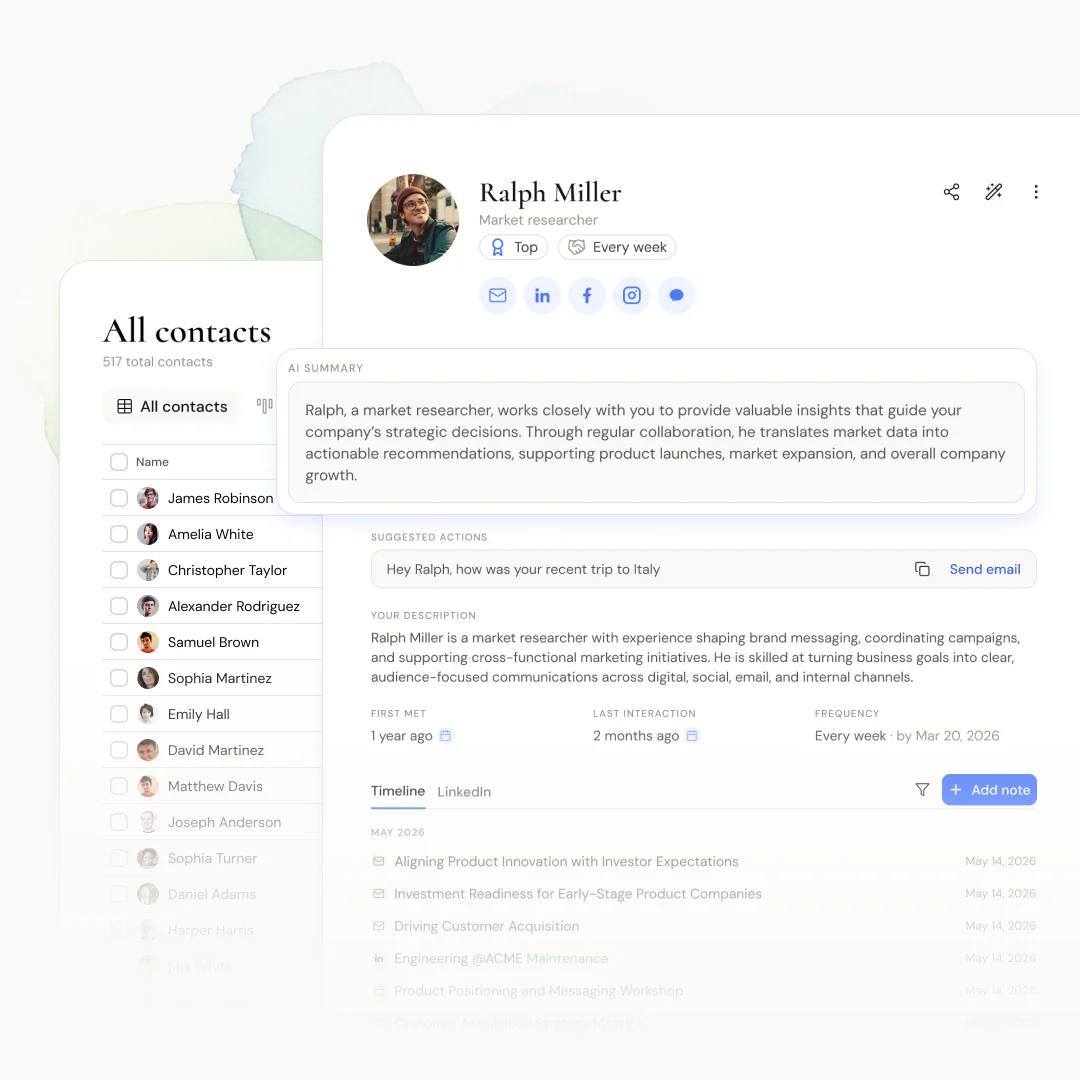
Dex is a personal CRM: one place that keeps track of the people in your life and tells you when to reach out. Here's how it maps to the habits above.
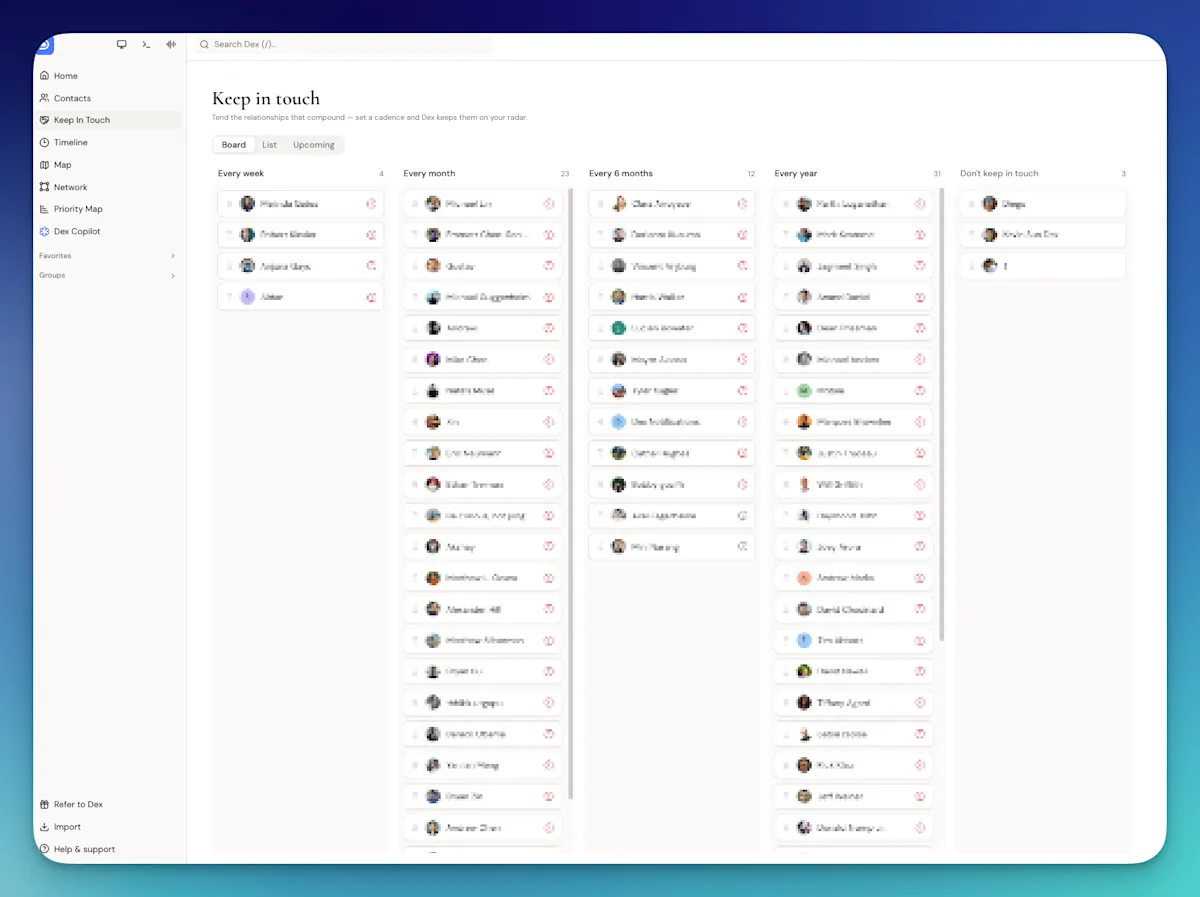
Cadence (habit 9). Set a keep-in-touch frequency on anyone, weekly for a sibling, twice a year for an old manager, and Dex reminds you when it's due. Emails, meetings, and synced messages count as contact, so the timer resets on its own when you've already been in touch.
Reaching out first (habit 1). Dex Shuffle picks someone you've drifted from, explains why they came up, and drafts a short message you can edit. Nothing sends unless you send it.
Remembering details (habit 4). Every contact has notes and a timeline pulling in Gmail, Outlook, Google Calendar, LinkedIn, and WhatsApp. On the Professional plan, voice mode lets you say "add a note to Maya: her dad's surgery is on the 14th" while walking to the car.
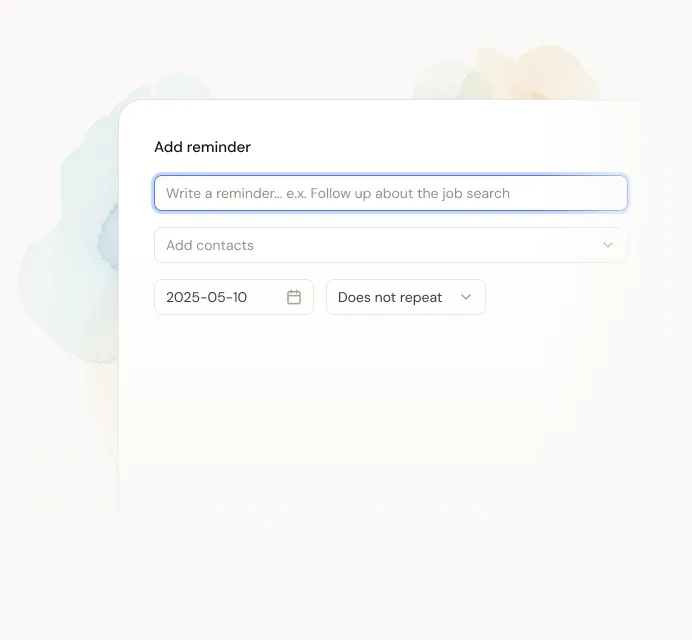
Saying the right thing at the right time (habits 2 and 7). Birthdays and recurring reminders show up in your morning digest. Dex also picks up job changes from LinkedIn, which is about the best excuse there is for a congratulations message.
A 15-minute weekly routine
A tool won't do this for you. A short weekly habit will, and a tool makes the habit easier to keep.
Open your reminders and pick three people who are due.
Send each of them a short message that mentions something real from your notes.
Reply to anything you left hanging, including old bids.
After any call or coffee that week, write down the details you'll want later.
Plan one block of real time, like a call, a walk, or a dinner.
Fifteen minutes a week is about 13 hours a year. That's enough to keep 150 relationships from going cold.
When not to strengthen a relationship
Not every relationship deserves more investment.
If a relationship is consistently draining or one-sided, more contact won't fix it. Strengthening the wrong relationship just costs you time you could give to better ones.
If it's harmful or controlling, none of these habits apply. HelpGuide and the National Domestic Violence Hotline are better places to start than any tips list.
If you're in a serious rough patch with a partner, a couples therapist will do more than general habits. Most of the advice above is maintenance, not repair.
If you have a small circle and already see everyone often, you don't need a system. Just keep doing what works.
The bottom line
Grand gestures get the attention, but strong relationships mostly come from a text sent on a Tuesday, a good reaction to someone's news, a detail remembered, and enough hours together over enough years.
People want to hear from you more than you think. For most of us the obstacle is remembering to do it. If you want help with that part, you can get started with Dex. Premium and Professional plans come with a 6-day free trial; a credit card is required, and you won't be charged until it ends.

FAQ
What are the most important ways to strengthen a relationship?
Regular contact, responding warmly when the other person shares something, remembering what matters to them, and spending real time together. Research by Gottman, Gable, and Hall points to small, frequent actions mattering more than occasional big gestures.
How do you strengthen a relationship with a friend you've drifted from?
Send a short, specific message that references something you shared, without apologizing at length for the gap. A 2022 study found people underestimate how much these unexpected messages are appreciated. Then suggest a low-effort next step like a call or coffee.
How much time does it take to become close friends?
A 2018 study by Jeffrey Hall estimated about 50 hours to become casual friends, about 90 hours to become friends, and over 200 hours to become close friends. Time spent hanging out and catching up counted more than time spent together at work.
How often should you contact friends to keep the relationship strong?
It depends on how close you are. A practical rule based on Dunbar's network layers is weekly for your closest five, every few weeks for about 15 good friends, every one to three months for the next 50, and once or twice a year for your wider network.
Can you strengthen relationships at work the same way?
Yes. The same habits apply: respond to colleagues' small bids, remember details about their projects and lives, thank people specifically, and keep in touch with former coworkers after one of you leaves. Those former coworkers are often the source of future job leads.
What is a personal CRM?
A personal CRM is an app for keeping track of the people in your life, similar to a sales CRM but built for individuals. Tools like Dex store notes and past conversations for each contact and remind you when it's time to reach out.
Related guides