
A Realtor's Daily Schedule That Protects Sphere Time
Protect one 45-minute sphere block every weekday morning, before showings and email take over. In that block, contact four or five people from your sphere, write down what they said, and schedule the next touch. That's enough to reach a 250-person sphere on a tiered plan.

The work that pays a real estate agent the most is the work that's easiest to skip.
NAR's 2026 Member Profile, as reported by HousingWire, says the typical Realtor got a median of 28% of their business from repeat clients and 22% from referrals by past clients. That's about half the business coming from people the agent already knows. For agents with 16 or more years in the business, it's 49% and 32%.
And yet sphere time is the first thing to go when the day fills up. A buyer wants to see a house at 2. An offer needs a counter by 5. The inspection report lands. None of that can wait, and a text to a past client always can. So it waits, every day, until it's been eight months.
The fix isn't a perfect hour-by-hour plan. It's one protected block of time, at the same time every day, that nothing short of a client under contract can interrupt. Here's how to build a schedule around it. For who should be in that block and how often, see our 33 Touch plan, updated with tiers.
Fast facts:
The typical Realtor worked a median of 35 hours a week in 2025, per NAR's 2026 Member Profile.
About half of a typical agent's business comes from repeat clients and referrals from past clients.
A 45-minute morning block is enough to contact four or five people a day.
Four or five a day covers a 250-person sphere on an A/B/C plan, including anniversaries and birthdays.
The block works best before you open email, because email is where the urgent things live.
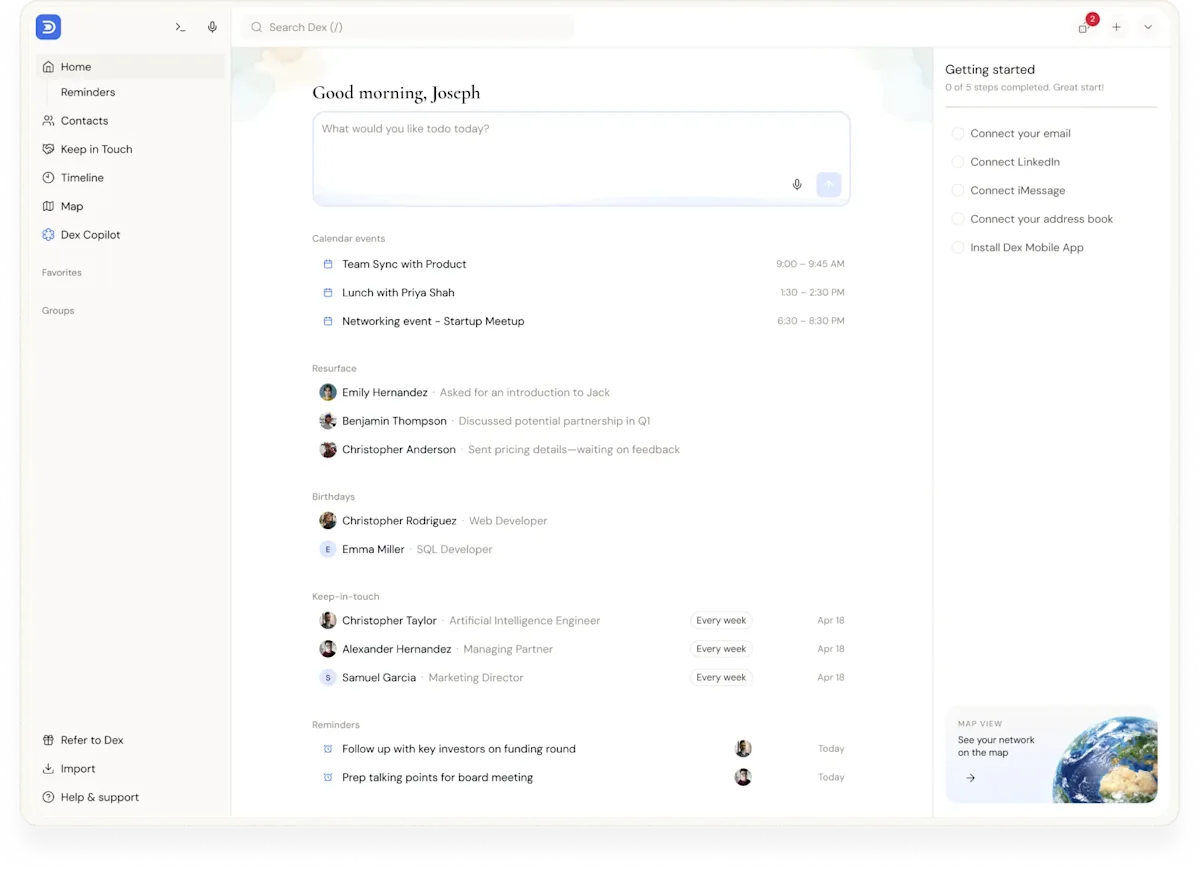
Image: The Dex home screen shows today's reminders, birthdays and who's due for a check-in
Why the sphere block goes first
Every schedule template tells you to "prospect in the morning." The reason is real, but it's usually explained badly.
It isn't about energy levels or morning people. It's that once you open email or answer the first call, your day belongs to other people's deadlines. Deals in progress have hard dates. Your sphere doesn't, so it loses every one of those fights. If the sphere block comes first, it's done before the fighting starts.
The other reason is consistency. A sphere works through repetition over years. Forty-five minutes every weekday beats a frantic Sunday afternoon once a month, because people notice when you show up regularly.
A sample weekday
This assumes a full-time solo agent working roughly NAR's median week. Move the times to fit your market, but keep the order.
Time | Block | What happens |
|---|---|---|
8:00 to 8:30 | Plan | Look at today's appointments and deadlines. Don't open email yet. |
8:30 to 9:15 | Sphere block | Four or five texts or calls to people in your sphere. Notes on each. Next touch scheduled. |
9:15 to 10:00 | Email and active deals | Now open email. Handle anything with a deadline today. |
10:00 to 12:00 | Client work | Showings, listing prep, CMAs, calls with clients under contract. |
12:00 to 1:00 | Lunch | Once a week, have it with someone from your sphere or a referral partner. |
1:00 to 4:30 | Appointments | Showings, inspections, listing appointments. |
4:30 to 5:15 | Admin | Paperwork, follow-ups, tomorrow's prep. |
5:15 to 5:25 | Capture | Ten minutes to write down anything you learned about anyone today. |
Evenings | As needed | Evening showings happen. Try to keep two nights a week fully off. |
The two blocks that matter most are the sphere block and the ten-minute capture at the end of the day. The capture is what makes tomorrow's texts personal. "Hendersons' daughter starts at State in the fall" only helps you if it gets written down the day you hear it.
What goes in the 45 minutes
The block is short, so it needs structure. Here's how to spend it.
Minutes | Task | Notes |
|---|---|---|
0 to 5 | Pull today's list | Who's due, whose anniversary or birthday is today, anyone you promised to follow up with |
5 to 30 | Reach out | Three or four texts and one or two calls. Calls go to your A list. |
30 to 40 | Write it down | One line per person on what they said and anything new in their life |
40 to 45 | Set the next touch | When should you hear from them next, and why? |
If you finish early, send one more. If someone calls back and you end up talking for twenty minutes, that's the block working, not failing. A real conversation with one past client is worth more than five texts.
Stuck on what to say? Our 40 texts for past clients are sorted by situation.
The math: is four or five a day enough?
Here's what a 250-person sphere looks like on a tiered plan, using the A/B/C split from our guide to organizing your real estate contacts.
Tier | People | Personal touches a year each | Touches a year |
|---|---|---|---|
A list | 25 | 12 (monthly) plus birthday and anniversary | 350 |
B list | 75 | 5 (every 2 to 3 months) plus birthday and anniversary | 525 |
C list | 150 | Mostly a quarterly email, plus one personal text a year | 150 |
Total | 250 |
| About 1,025 |
Spread over about 240 working days, that's a little over four personal touches a weekday. Four or five a day covers it, and the C list's quarterly email goes out as one batch, not 150 separate messages.
If your sphere is bigger, don't make the block longer first. Make the C list do more of the work through email and save personal touches for A and B.
A weekly rhythm
Days have a shape, and so do weeks. Here's one way to use them.
Day | Sphere focus | Other |
|---|---|---|
Monday | A list calls. Start the week with your best people. | Plan the week, check deadlines on active deals |
Tuesday | B list texts | Listing appointments |
Wednesday | B list texts, one lunch or coffee | Showings |
Thursday | Pop-bys or a handwritten card or two | Showings, prep for weekend open houses |
Friday | Thank-yous and follow-ups from the week. Ten minutes on database cleanup. | Admin, close out the week |
Saturday | Open house: capture everyone you meet | Showings |
Sunday | Off | Off, as much as the business allows |
What's allowed to interrupt the block
The block only works if you defend it. You need one rule, decided in advance, so you're not deciding at 8:45 with your phone buzzing.
A rule that works for most agents: a client under contract can interrupt. Nothing else can. An offer deadline, an inspection problem, a closing issue: take it. A new buyer who wants to see a house this afternoon can hear back at 9:15. They'll never know the difference.
Some agents go further and put their phone on Do Not Disturb with only active clients allowed through. Others just leave it face down. Either way, protect 45 minutes and the rest of the day can be as chaotic as the business needs.
When the block gets blown up anyway (it will, some days), don't try to make it up later in a pile. Send one text before bed and start fresh tomorrow.
Schedules for different situations
Not everyone works the median week. Here's how the same idea fits other setups.
Situation | Sphere block | Adjustments |
|---|---|---|
Part-time agent with a day job | 20 minutes at lunch or right after work | Two or three contacts a day. Lean on email for the C list. Batch pop-bys on Saturday. |
New agent (first two years) | 60 minutes, because your sphere is still being built | Half the time reaching out to people you know, half adding and organizing new contacts |
Agent with young kids | After school drop-off, or after bedtime for texts | Texts can go out at 8 p.m. Calls need daytime. Do A list calls on your two most predictable days. |
Agent on a team | 30 minutes on your personal sphere | The team's buyer inquiries go in the team system. Your own sphere is still yours to work. |
High-volume agent with an assistant | 30 minutes on calls only | Your assistant prepares the list, handles cards and pop-by logistics. The personal outreach stays with you. |
One thing doesn't change across all of these: the outreach itself comes from you. Assistants can do logistics, but a past client can tell when the text didn't come from their agent.
Running the block in Dex
Full disclosure: Dex is our product. It's a personal CRM, and it's built around the first five minutes of the block: knowing who to contact today.
Set a keep-in-touch frequency on each group (30 days for your A list, 75 or 90 for B), and Dex builds the daily list of who's due. Birthdays and the yearly reminders you set on close dates show up on the same home screen and in a daily digest email, so the anniversary text doesn't get missed.
During the block, open each person's record to see your last conversation and your notes before you write. The ten-minute capture at the end of the day can happen on your phone through the mobile app, right after the showing. And because texts, emails and calls sync back to the contact (iMessage and phone calls through the Mac desktop app), the keep-in-touch clock resets without you logging anything.
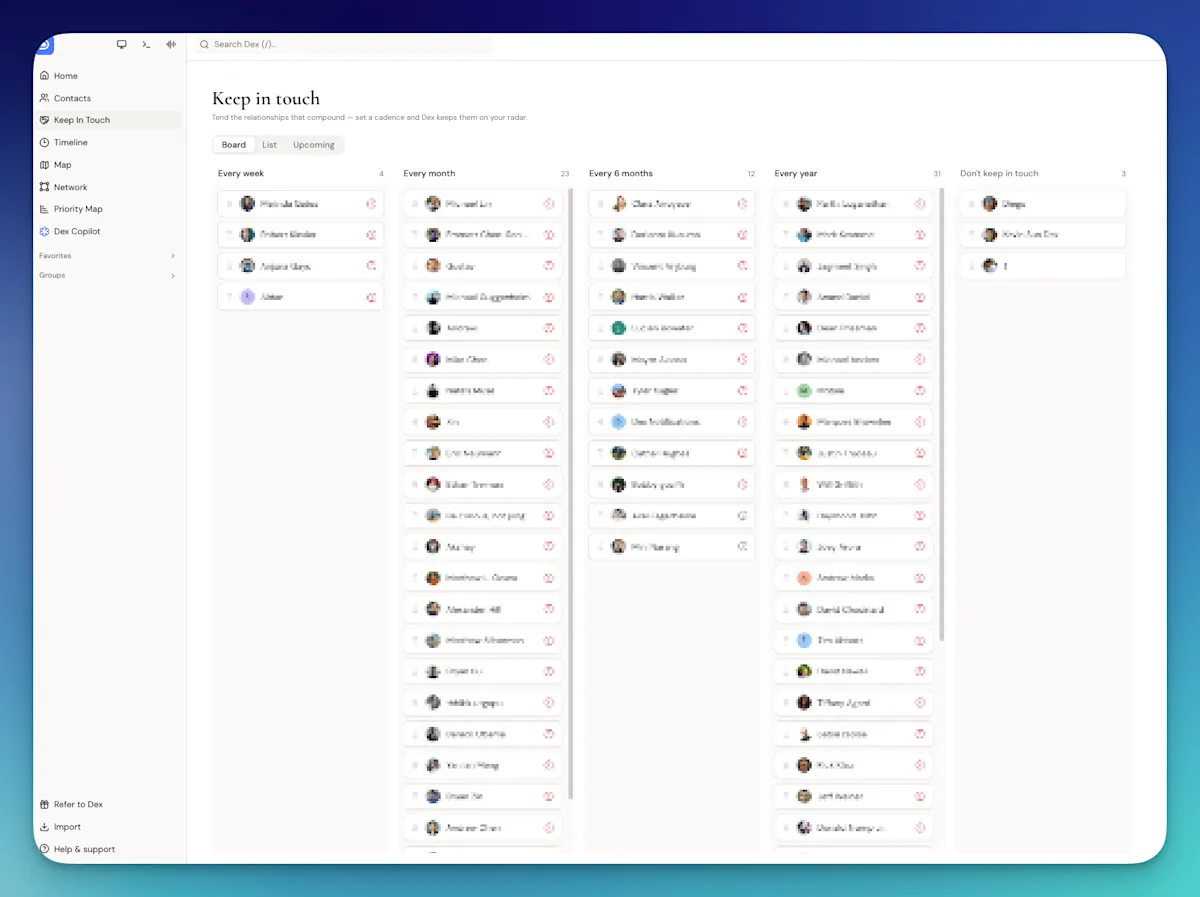
Image: A keep-in-touch board in Dex shows who's coming due across your sphere
What Dex won't do: schedule your showings or manage your calendar for you. It handles the sphere half of the day. More on how Dex fits a referral-based business is on the Dex for real estate agents page.
Who this isn't for
If most of your business comes from paid online inquiries, your morning block probably belongs to fast follow-up on new inquiries, and that's a different schedule. A shorter sphere block later in the day still makes sense, because those buyers become past clients too.
And if you already have a routine that keeps you in touch with your sphere, keep it. The point is protected, regular time. The exact hour doesn't matter.
FAQ
What does a typical day look like for a real estate agent?
A mix of planned work and interruptions: planning and outreach in the morning, client work and showings midday and afternoon, admin late in the day, and evening showings when clients need them. NAR's 2026 Member Profile puts the median work week at 35 hours.
How many hours a week do realtors work?
NAR's 2026 Member Profile, as reported by HousingWire, says Realtors worked a median of 35 hours a week in 2025. Sales agents reported a median of 30, and brokers who also sell reported more.
How should a real estate agent time block their day?
Put a protected 45-minute sphere block first thing, before email. Then handle active deals, then appointments, then admin. End with ten minutes writing down what you learned about people that day.
How many people should a realtor contact each day?
Four or five personal touches a weekday is enough for a 250-person sphere on an A/B/C plan, including birthdays and home anniversaries. Use email for the broader C list.
What is the best time of day to call past clients?
Late morning or early evening on weekdays tends to work. Texts are more flexible. Keep calls for your closest clients and send texts to the rest.
How do part-time agents fit in sphere time?
A 20-minute block at lunch or after work, two or three contacts a day, and email for the wider sphere. Batch pop-bys and cards on weekends.
The bottom line
You don't need a perfect schedule. You need 45 minutes every weekday morning that belongs to your sphere and nothing else, plus ten minutes at the end of the day to write down what you heard. Do that for a year and half your business will have a system behind it.
If you want the daily list built for you, start a 6-day Dex trial.
Related guides