Dex vs Queue: Which Personal CRM Keeps You in Touch?
Queue is an Apple-only stay in touch app at $4.99/mo that auto-logs iMessage, calls, and Mail through a Mac companion. Dex is $12/mo, runs on web, iOS, Android, and browser, and syncs LinkedIn. Platform choice decides it.



Queue is an Apple-only stay in touch app at $4.99/mo that auto-logs iMessage, calls, and Mail through a Mac companion. Dex is $12/mo, runs on web, iOS, Android, and browser, and syncs LinkedIn. Platform choice decides it.
Both of these apps exist for the same embarrassing reason: you liked someone, you meant to follow up, and then eight months went by.
Queue and Dex are the two names that come up most when people go looking for a personal CRM, or a stay in touch app - and they solve the problem the same way in principle. Put your people in one place, attach a cadence to each of them, and let the app tell you who's gone quiet. Where they split is not really about features. It's about what kind of computer you own, and how much of your network lives on LinkedIn.
Fast facts
Queue costs $4.99/month or $49.99/year, with a one-week free trial.
Dex Premium is $12/month and Professional is $20/month, both with a 7-day free trial and no credit card required. Annual billing takes 40% off.
Queue runs on iPhone, Mac, and Apple Vision only. There is no Android app and no web app.
Queue's best feature, automatic logging of texts, calls, and email, requires the Mac companion app running. Without a Mac, you log by hand.
Dex syncs up to 2,500 LinkedIn connections on Premium and 9,000 on Professional.
What Queue is
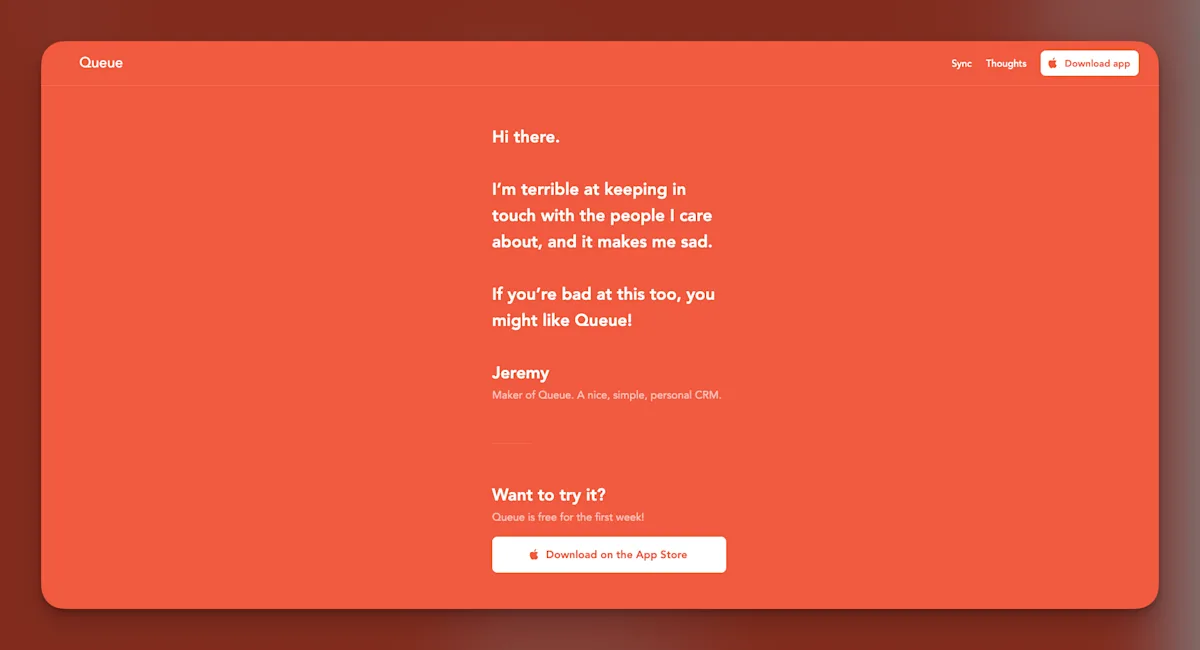
Queue is an indie app by developer Jeremy Lubin, sold on the App Store under the tagline "Be better at keeping in touch." It's small on purpose. The pitch on the site is about as unvarnished as software marketing gets: the maker says he's terrible at keeping in touch with people he cares about, and built the thing he needed.
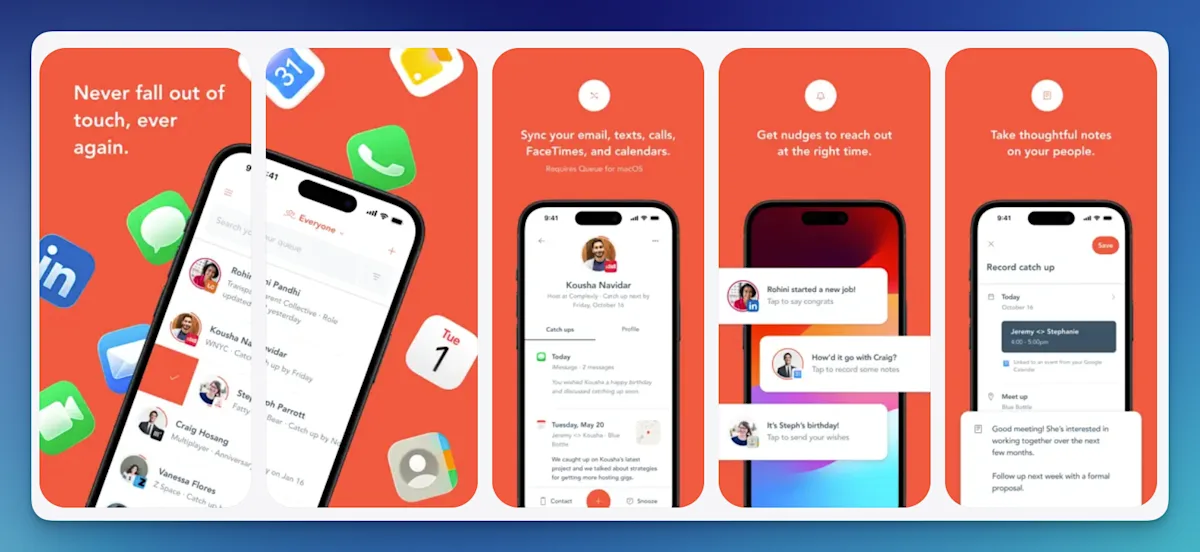
You pull people in from your iPhone contacts, Google Contacts, your calendar, and LinkedIn. You set a catch-up frequency per person, every three weeks or every six months. Queue tracks how long it's been since the last real contact and sorts your list by who's most overdue. A Today view shows the ones that have gone past due. Birthdays, anniversaries, and job changes fire as notifications.
The unusual part is how it decides you've caught up with someone. Calendar meetings get logged automatically. And if you install the Mac companion app, Queue will also read your Mail, iMessage, calls, and FaceTime history to log interactions on its own. That analysis runs locally on the Mac using Apple's on-device models, and the summaries stay in your private iCloud.
It's a real privacy story, and it's the reason Queue can do something most personal CRMs can't. It's also the reason Queue can't leave the Apple ecosystem.
As of version 2.2.0 it sits at 4.4 stars from 42 ratings on the US App Store. That's a small sample, which reads as a small, dedicated user base rather than a mass-market product.
What Dex is
Dex is a personal CRM built around the same core mechanic, keep-in-touch reminders on a per-contact cadence, with a much wider footprint underneath it.

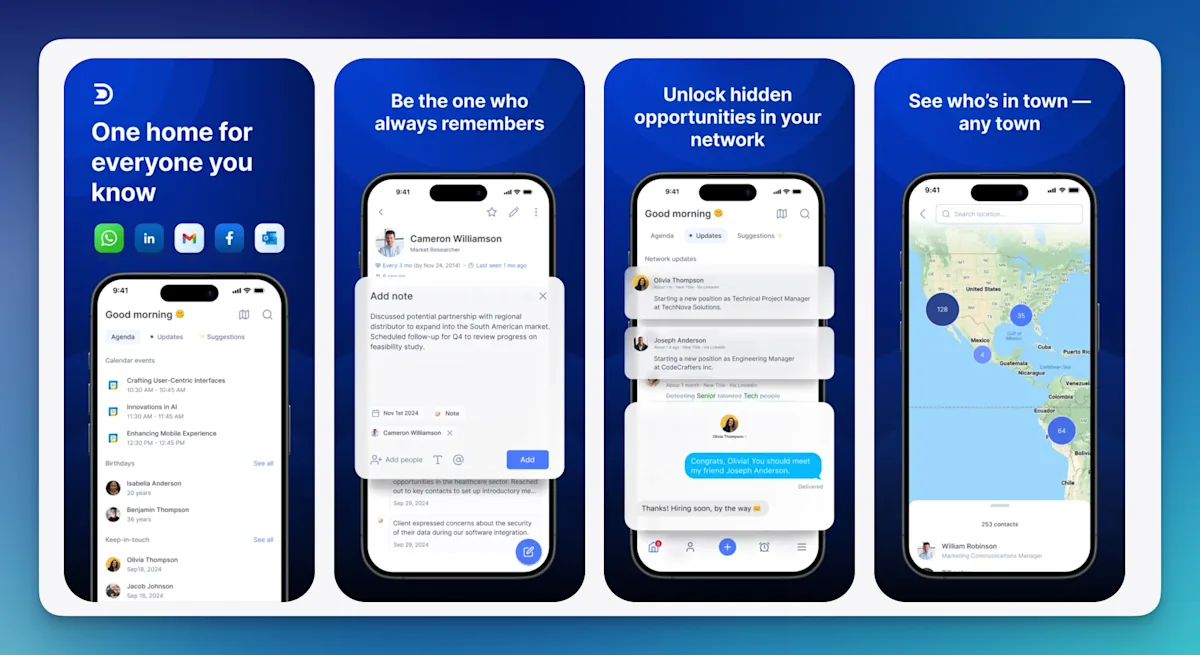
Contacts come in from LinkedIn, Gmail, Outlook, Google Calendar, WhatsApp, iMessage, Facebook, and X, plus a browser extension that puts Dex inside LinkedIn and Gmail while you're already working there. Each contact carries notes, a timeline of past interactions, and structured fields for the things you actually forget: how you met, family, important dates, gift ideas, education, event history.
The LinkedIn sync does the heaviest lifting. Job titles update automatically, which matters more than it sounds, because someone changing companies is the single best moment to reach out and it's a moment you would otherwise never notice. Dex has also shipped AI features (Copilot, AI Assist, research credits, and MCP support so you can query your network from Claude or ChatGPT).
It runs on web, iOS, Android, desktop, and as a browser extension.
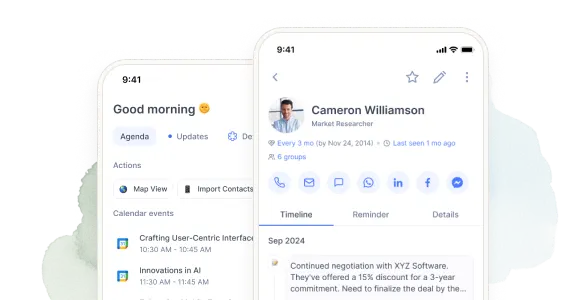
Dex interface on mobile
What a stay in touch app is supposed to do
If you're new to this category, it's worth naming the job before comparing the two products, because a stay in touch app is not a contacts app and not a sales CRM.
A contacts app stores who someone is. A sales CRM tracks a deal through stages toward a close. The thing sitting between them tracks the health of a relationship that has no deadline attached: when you last spoke, how long is too long for this particular person, and who has quietly drifted past that line while you weren't looking.
Three jobs define the category, and both products here do all three:
Remembering the cadence. You decide someone is a twice-a-year person and the app holds that, rather than you holding it.
Detecting the gap. It watches your actual conversations and works out how long it's been, instead of waiting for you to log something by hand.
Surfacing at the right time. Reminders arrive before the relationship is awkward to restart, not after.
Everything else is preference. Where Dex and Queue diverge is in how they detect that gap, and that difference is downstream of one architectural decision each of them made.
Feature comparison at a glance
| Dex | Queue |
|---|---|---|
Price | $12/mo Premium, $20/mo Professional | $4.99/mo or $49.99/yr |
Free trial | 7 days | 1 week |
Platforms | Web, iOS, Android, desktop, browser extension | iPhone, Mac, Apple Vision |
LinkedIn sync | Up to 2,500 connections (Premium), 9,000 (Professional), job titles auto-update | Contact import from LinkedIn; job change alerts |
Auto-logging of texts and calls | WhatsApp and messaging sync | iMessage, calls, FaceTime, Mail, but only with the Mac app running |
Email integration | Gmail, Outlook, multiple accounts on Professional | Apple Mail via Mac app |
AI features | Copilot, AI Assist, research credits, MCP for Claude/ChatGPT, etc. | On-device conversation summaries via Apple models |
API / automation | API and Zapier on Professional | None |
Team / business use | Yes, on Professional and Enterprise tiers | No, single-user by design |
The real dividing line
The table above hides the actual decision.
Queue's automatic catch-up logging is the best version of that feature in the category. Nothing else reads your iMessage thread and quietly marks a friend as caught up without sending your texts to a server. But it works that way because it runs on your Mac, against Apple's local frameworks, on Apple's data stores. That design choice is what makes it private, and it's the same choice that means there will never be an Android app, never a web app, and never a version your Windows-using coworker can open.
Dex made the opposite trade. It's cloud-based and cross-platform, so it reaches LinkedIn, Outlook, WhatsApp, Facebook, and X, and it works on any device you happen to be holding. The cost is that it isn't reading your iMessage database locally on a Mac, so the depth of "we noticed you texted them" is different.
Neither is a flaw. They're two coherent answers to the same question.
Which one fits which person
Queue fits you if every device you own has an Apple logo on it, your network lives mostly in your phone contacts and iMessage, you want to spend $50 a year rather than $144, and you'd rather have one small app that does one thing than a platform.
Dex fits you if a meaningful share of your network is on LinkedIn, you switch between a laptop and a phone all day, you follow up over email as much as over text, or you need this for work. Clients, candidates, investors, a founder's network: cases where losing a relationship has a price attached.

Dex allows you to see your network and how they connect with each other via Network Map
The short version of the rule: if your relationships are mostly people whose phone numbers you have, Queue is the better stay in touch app for you. If they're mostly people whose LinkedIn you have, Dex is.
How each one handles the moments that matter
Right after you meet someone, Queue has you add them from your phone contacts and pick a cadence. Dex lets you clip them straight off their LinkedIn profile with the browser extension, which is faster when you met professionally and slower when you met at a barbecue.
Six months later, when they change jobs, both will tell you. Dex updates the title on the contact record automatically from LinkedIn sync, so your list stays accurate without you touching it. Queue sends the alert.
When you're about to see them again, Dex offers pre-meeting context: notes, history, and AI-assisted briefs, aimed at the person walking into eight meetings a day. Queue prompts you for a note after a meeting ends, aimed at the person who just wants to remember what their friend said about their move.
When you want to reach out to twelve people at once, Dex Professional has mail merge and Zapier. Queue has multi-select bulk actions inside the app, but no outbound automation. If "work through a list of 200 people over six weeks" describes your situation, that's a Dex job.
Where Queue is straightforwardly better
For a specific and fairly large group of people, Queue is the right pick and Dex is overkill.
It's less than half the price. $49.99/year against $144/year at Dex's Premium rate before annual discounts. For personal use, that gap is real.
The privacy model is stronger. Local analysis on your Mac, summaries in your own iCloud, an indie developer who has publicly committed to never selling data or running ads. If that's your priority, it's not close.
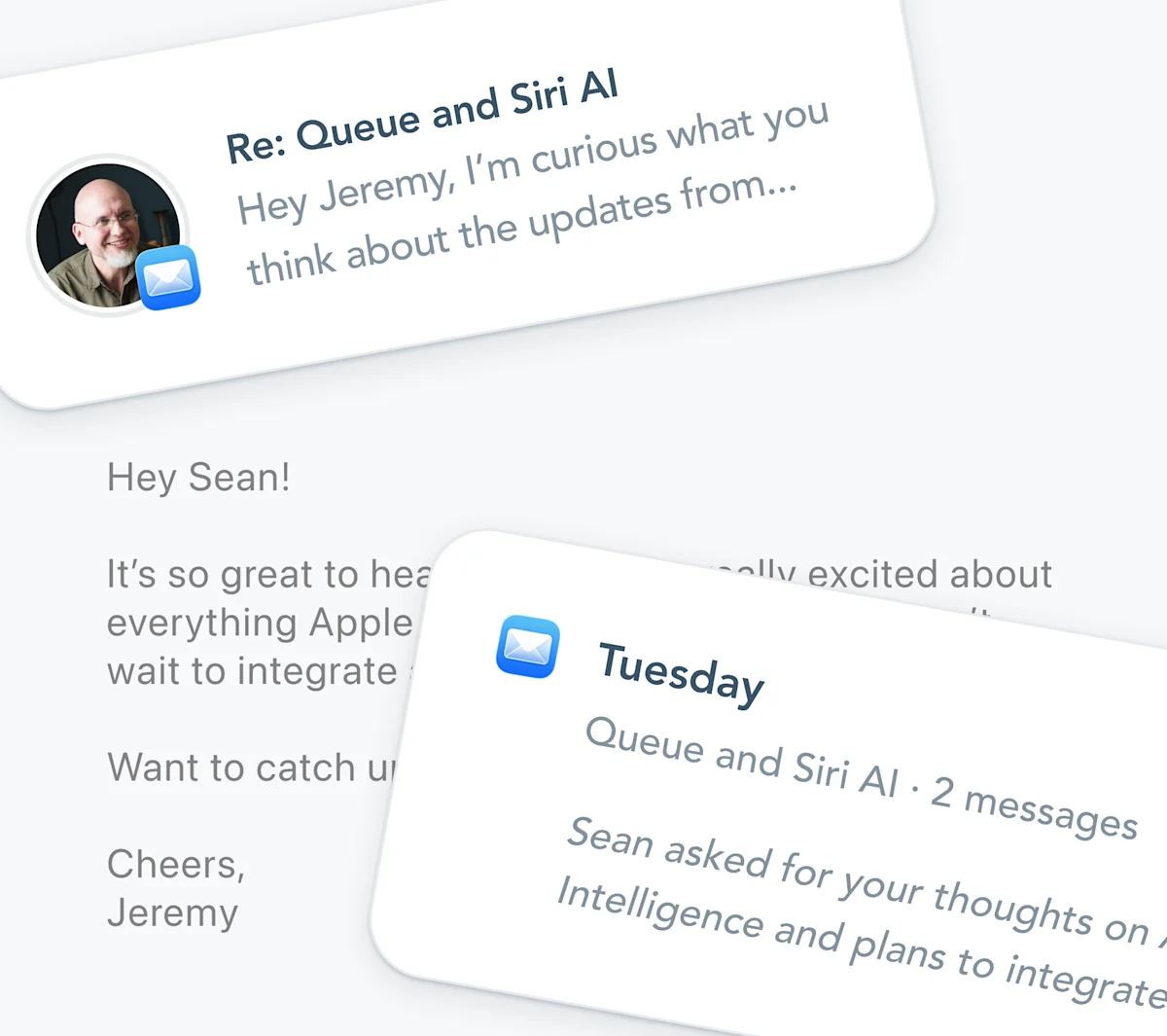
Queue, as of August 17, 2026, now syncs with Apple Mail and Calendar. Image taken from queue.community.
The auto-logging is better at what it covers. Texts and calls, handled without you doing anything, is the version of this feature most CRMs can't touch.
It's simpler. Queue is small enough that you'll never fight it, and an app you actually open beats one you spend an afternoon configuring.
Who neither of these is for
If your network is under about fifty people and you already remember all of them, both apps are overhead. Use your calendar.
If you're managing a sales pipeline with stages, deal values, and a team, neither is right. That's a sales CRM, and you should be looking at HubSpot or Attio.
If you're on Android and want automatic message logging, that combination doesn't exist yet. Dex will get you cross-platform reminders and LinkedIn sync, but the passive text-reading part is an Apple-only trick right now.
If you're on an older iPhone or Mac, check the version floors before you buy Queue. iOS 18.2 and macOS 26.1 rule out a lot of hardware people are still happily using.
If the idea of software tracking your friendships makes you uncomfortable, that discomfort is legitimate and no feature list fixes it.
The verdict
Queue is a very good small stay in touch app with one exceptional feature and a hard ceiling, which is the Apple ecosystem. If you live entirely inside it and your relationships are personal ones, buy Queue and be happy.
Dex is the better answer for most people asking this question, because most people's networks aren't confined to their phone contacts. Once a meaningful part of your network is professional, meaning people you met at work, on LinkedIn, over email, or on a different operating system than yours, the cross-platform reach and the LinkedIn depth become the whole reason to pay for a tool like this. That's also the case where the price difference matters least, since one recovered relationship covers a year of subscription several times over.
Neither app does the actual work. What a personal CRM doubling as a stay in touch app buys you is narrow: it makes sure the person doesn't disappear before you get around to it.
Frequently Asked Questions
What is the best stay in touch app?
It depends on which devices you use. Queue is the better stay in touch app if you're entirely on Apple hardware and want automatic logging of iMessage, calls, and Mail for $4.99/month. Dex is the better choice if your network includes LinkedIn contacts and you move between a laptop, a phone, and the web, at $12/month.
Is Dex better than Queue?
For most people, yes, but not universally. Dex runs on web, iOS, Android, and desktop, syncs LinkedIn connections with automatic job-title updates, and integrates Gmail, Outlook, and WhatsApp. Queue is better if you use only Apple devices, want automatic logging of iMessage and calls, and prefer the lower price.
How much does Queue cost?
Queue is $4.99 per month or $49.99 per year on the App Store, after a one-week free trial. Dex is $12 per month for Premium and $20 per month for Professional, with a 7-day free trial that doesn't require a credit card and a 40% discount for annual billing.
Does Queue work on Android or the web?
No. Queue is available on iPhone, Mac, and Apple Vision only, and requires iOS 18.2, macOS 26.1, or visionOS 2.2 or later. Dex is the alternative if you need Android or browser access.
Does Queue really read my text messages?
It analyzes them to log catch-ups automatically, but only if you install the Mac companion app, and the analysis runs locally on your Mac using Apple's on-device models rather than on a server. Conversation summaries are stored in your private iCloud.
Does Dex sync with LinkedIn?
Yes. Dex syncs up to 2,500 LinkedIn connections on the Premium plan and 9,000 on Professional, and updates contacts' job titles automatically as they change roles.
Can I use either one for work?
Dex, yes. It has Professional and Enterprise tiers with API access, Zapier, mail merge, SAML SSO, and a SOC 2 report. Queue is built as a single-user personal app and has no team features.
Related reading: Best personal CRM for networking · Dex vs Clay · Dex vs folk