Dex vs Monica: Best Personal CRM in 2026?
Dex vs Monica: a 2026 comparison of features, pricing, and integrations to help you pick the right personal CRM.


Dex and Monica are both personal CRM tools, but they solve different problems. Dex is built around reminders, follow-ups, and keeping track of past interactions automatically. Monica is a privacy-first tool for manually logging personal-life details like family relationships, gifts, and journals.
This comparison is for people managing their personal relationships, not sales teams running pipelines. If you're deciding between Dex and Monica, the right choice comes down to how you want to interact with your network day to day.
Dex and Monica as a personal CRM
Dex - $12 per month, paid annually
Dex is for people who want to stay in touch consistently. It remembers when and how to follow up, with interaction history pulled from connected tools like email, calendars, and social media accounts.
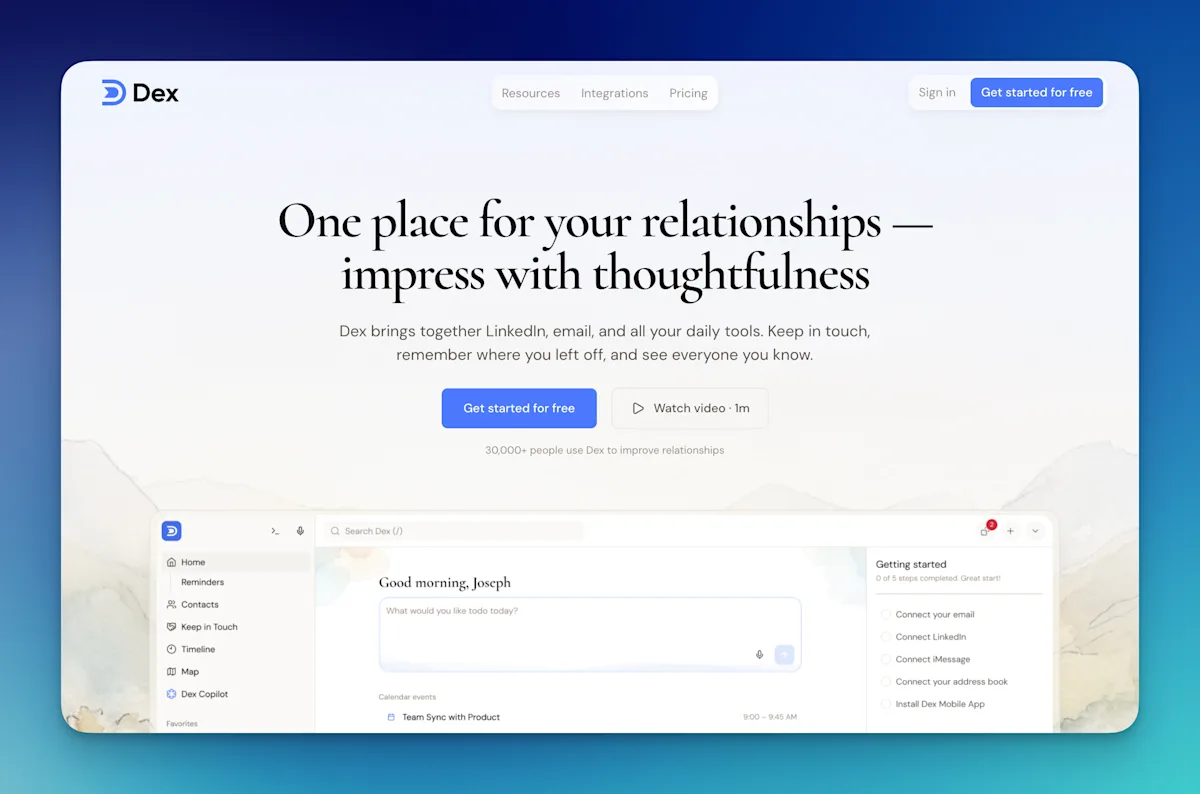
In 2026, Dex's AI got better at understanding your relationships. It surfaces context from emails, calendars, and notes automatically, summarizes past interactions, and suggests ways to reach out.
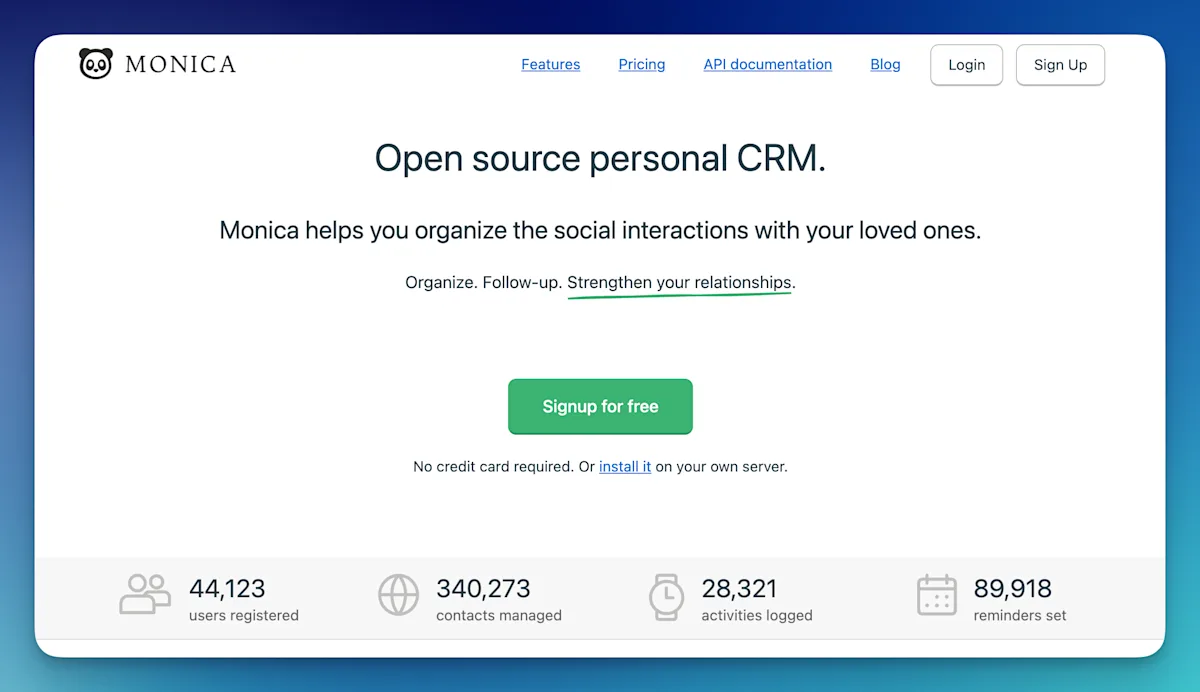
Monica - free self-hosted, or Monica Cloud from $9 per month
Monica is for people who value privacy and data ownership above automation. It's open source and self-hostable, so your contact data can live on your own server for free. Where it shines is personal-life detail: family relationships, gift logs, journaling tied to contacts, and birthday reminders, all entered manually.
Dex vs Monica: key differences and best use cases
Dex is a better fit if you:
Want automatic data capture from LinkedIn, email, calendar, and messaging apps
Want reminders, pre-meeting briefs, and job change alerts that run on real data
Need native iOS and Android apps and a business card scanner
Are a founder, MBA student, freelancer, or professional networker
Monica is a better fit if you:
Want an open-source, self-hostable tool where you own the data outright
Use it for your personal life (friends, family, gifts, journals) rather than professional networking
Are comfortable with fully manual data entry and no email or LinkedIn sync
Feature comparison
Feature | Dex | Monica |
|---|---|---|
Built for | Professional and personal relationship management | Personal-life relationship logging |
Data entry | Automatic (integrations) | Manual only |
LinkedIn sync | Yes (2,500 / 9,000) | No |
Gmail / Outlook sync | Yes (full history) | No |
WhatsApp / iMessage sync | Yes | No |
Calendar sync | Yes (Google + Apple) | No (CalDAV reminder export only) |
Keep-in-touch reminders | Yes (kanban board) | Yes (per-contact intervals) |
Pre-meeting briefs | Yes | No |
Job change alerts | Yes | No |
Family relationships / gift log / journaling | Basic notes | Yes (core strength) |
AI features | Copilot, AI Assist, Messaging Dex | No |
Mobile app | Yes (iOS + Android) | No |
Open source / self-hostable | No | Yes |
Free option | No (7-day trial) | Yes (self-hosted) |
Monica wins on privacy, data ownership, and personal-life depth. Dex wins on everything that requires automation or integration with the tools where your relationships actually happen.
Which offers more value?
Pricing can be a deciding factor, especially if you're choosing a tool for personal use.
Dex is $12 per month billed annually (Premium), with a Professional plan at $20 per month that adds LinkedIn sync for up to 9,000 contacts, Outlook, mail merge, and API/Zapier access. Both come with a 7-day free trial.
Monica is free if you self-host it on your own server (it's open source), and Monica Cloud, the hosted version, starts around $9 per month.
On sticker price the two are close ($9 vs $12), and self-hosted Monica is free if you run your own server. The difference is what the money buys. Monica Cloud is hosting for a manual system. Dex Premium includes LinkedIn sync, email history, messaging sync, reminders, and briefs that keep themselves current.
Choosing between Dex and Monica
Choose Dex if your main problem is forgetting to follow up or losing track of past conversations across a professional network. Choose Monica if your main problem is wanting a private, self-hosted place to log personal-life details like gifts, family relationships, and journals.
Both tools work, but they support different habits. The better choice is the one that matches how you already work, not the one with more features.
How Dex and Monica handle personal CRM workflows
After setting up
Dex
Setup is quick
Contacts, email history, and meetings sync in automatically
Requires minimal cleanup once running
Monica
Setup means installing (if self-hosting) and entering contacts by hand
Every piece of data gets there because you typed it in
Stays accurate only as long as you keep typing
After meeting someone new
Dex
Add the contact (or scan their business card)
Write a short note about the meeting
Set a follow-up reminder
Review the reminder when it surfaces
Monica
Add the contact manually
Log the interaction, relationships, and personal details by hand
Set a per-contact stay-in-touch interval
Decide manually when to reach out
Checking in after past conversations
Dex
Shows past notes, meetings, and messages in one timeline
Calls, emails, calendar events, hand-written notes, and LinkedIn updates all live on one quiet vertical line
Reminders surface based on your schedule
Monica
Shows whatever you've manually logged for that person
No email, calendar, or messaging history to draw on
Tracking long-term relationships
Dex
Prompts periodic check-ins
Works well for staying in touch with many relationships over months or years
Monica
Strong for personal-life depth: family maps, gift logs, journals, birthdays
Less suited to maintaining a large professional network over time
What's new in Dex (2026)
A few recent updates (as of July 2026) worth knowing about if you're evaluating Dex as a Monica alternative right now:
Connect Dex to Claude and ChatGPT. Dex now supports MCP (Model Context Protocol), so AI assistants like Claude and ChatGPT can plug straight into your contacts and relationship data. Search contacts, log notes, set reminders, and organize your network through natural conversation. The Dex Skill adds meeting prep, follow-up suggestions, and duplicate cleanup on top.
Mail Merge. Send personalized bulk emails to up to 200 contacts in one workflow, each with dynamic fields you can customize, plus optional AI-drafted copy. Works with Gmail and Outlook (web only, Dex Professional).
Video
Custom fields on the contacts view. Surface fields like hometown, company, spouse, or important dates right from the main contacts view. Click Properties on any contact or group and pick the fields that matter most.
Quick add from one place. Add new contacts, notes, reminders, and interactions from a single interface instead of hopping between screens.
Check our latest updates on the changelog page.
Where Monica stands out
Monica was built to help you be a better friend and family member. It maps family relationships, tracks gifts given over the years, links journal entries to specific people, and reminds you of birthdays. Its answer to privacy is self-hosting: the code is open source and the data lives on your server.
Dex's answer to privacy is certification and business model. It's subscription-funded with no ads, never sells data, is SOC 2 Type II and ISO 27001 certified, and lets you export or delete your data at any time. Both are legitimate approaches; they just suit different people.
Why Dex is the better personal CRM for most people
Both Dex and Monica help you manage relationships, but Dex is built for follow-through. If you need a system that reminds you to stay on track with the people who matter, the automatic integrations and reminders do the remembering for you.
That's the practical test to apply: will you actually keep the tool up to date? Monica stays accurate only as long as you keep typing. Dex stays accurate because your email, calendar, and LinkedIn keep it that way. Try Dex and see how it fits into your routine.
Frequently asked questions
Is Dex better than Monica?
For professional networking, yes. Dex automates data capture and adds LinkedIn, email, and messaging sync that Monica doesn't have. For privacy-first personal-life logging on your own server, Monica is the better fit. They're built around different priorities.
Can I import contacts from Monica to Dex?
Yes. Monica supports exporting your contacts, and you can import a CSV into Dex. Dex deduplicates against contacts already synced from LinkedIn, Gmail, and other sources.
How should I compare Dex and Monica pricing?
Self-hosted Monica is free but costs server time and manual upkeep; Monica Cloud starts around $9/mo. Dex Premium is $12/mo and includes automatic integrations Monica has no equivalent for. Compare on total effort, not just dollars.
Does Monica sync with LinkedIn or email?
No. Monica has no LinkedIn integration, no email sync, and no calendar sync, and it has no mobile app. All interaction logging is manual. That's a deliberate design choice in favor of privacy and simplicity.
Does Dex have a free plan?
No. Dex offers a seven-day free trial; after that, Premium is $12/month and Professional is $20/month, both billed annually.
Try Dex As Your Personal CRM
30,000+ people use Dex to stay close to the people who matter. Get started for free.