
AI for Real Estate Agents: Use It for the Blank Page, Not the Message
AI is useful for real estate agents on work clients never see: first drafts of listing descriptions, research before an appointment, summarizing notes, cleaning up a database. Keep it out of the messages you send to clients. Let it get you past the blank page, then write the text yourself, so it still sounds like you.



Every real estate tool now has AI in it. The CRM drafts your follow-ups, the website writes your blog, and there's a button that will text your whole sphere "Happy Fall!" in your voice.
Some of that is worth having. Some of it chips away at the reason people refer you.
A Chicago brokerage leader drew the line clearly while evaluating CRMs for their agents. "We love AI. AI is great. There's a place for it," they told us. "But we don't need it crafting messages for people." If it helps with the blank page, fine. But they want the parts a machine smooths out: "I want the weird exclamation marks. I want the human side of the communication."
That's a good rule for any agent whose business comes from people who know them. Here's how to apply it, task by task.
Fast facts:
AI is strongest on work clients never see: research, summaries, first drafts, data cleanup.
It's weakest on messages to people who know you. They can tell, and it reads as a form letter.
You're responsible for anything AI writes in your marketing, including fair housing language and listing facts.
Never paste a client's private details into a public AI tool without checking your brokerage's policy.
A good test: if the client would feel differently knowing a bot wrote it, write it yourself.
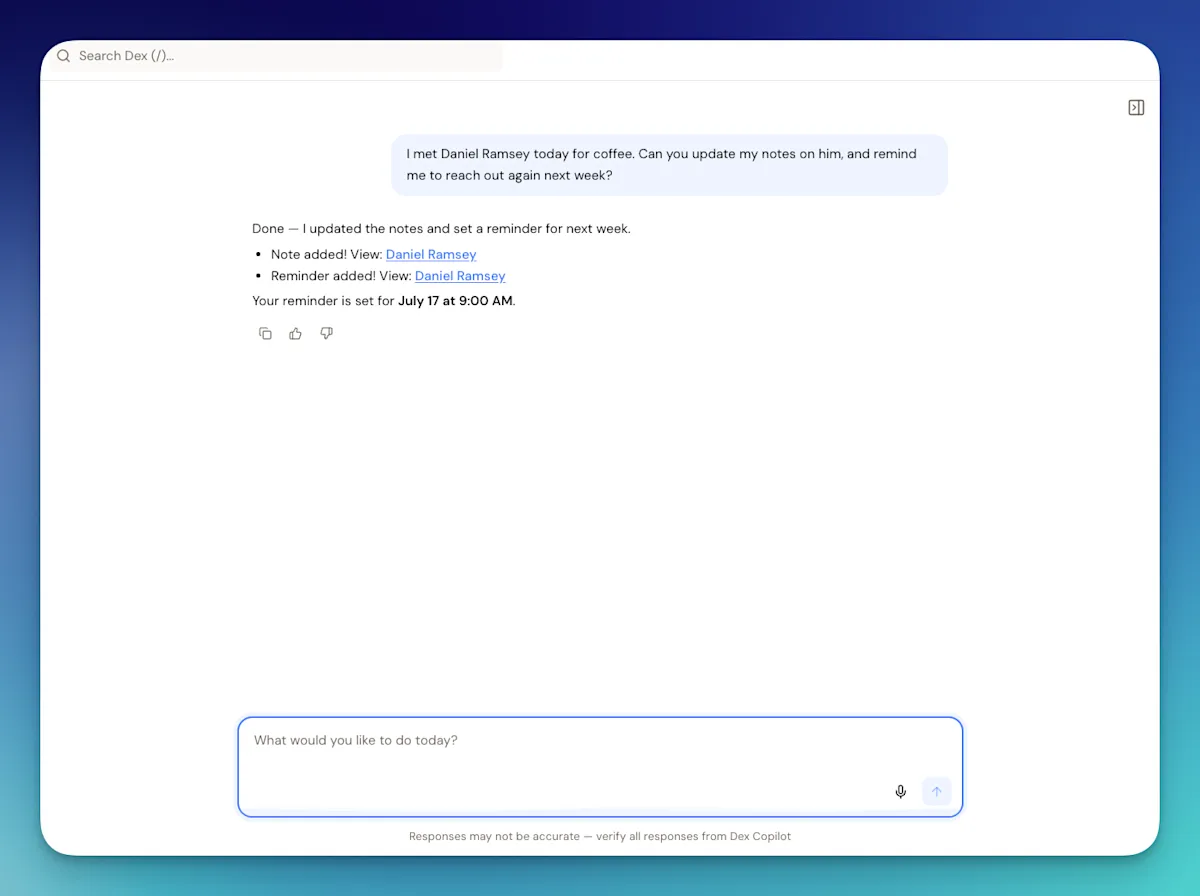
Image: An AI assistant answering a question about your own contacts and notes
Use it, draft with it, or do it yourself
Here's how we'd sort the common jobs.
Task | Verdict | Why |
|---|---|---|
Research a neighborhood or a seller before a listing appointment | Use AI | Fast background, and you check it before you use it |
Summarize your notes from a showing or a long call | Use AI | Saves time, nobody else sees it |
Sort and tag a messy contact list | Use AI | Tedious work with low risk, as long as you review it |
First draft of a listing description | Draft with AI | Gets you past the blank page; you fix facts and tone |
Outline for a market update or blog post | Draft with AI | Structure is easy to automate; local insight isn't |
Ideas for what to say to someone you haven't talked to in a while | Draft with AI | Prompts based on your notes can jog your memory |
Texts to past clients and friends | Do it yourself | These people know your voice |
Replies during a negotiation | Do it yourself | Tone and timing matter, and the stakes are high |
Condolence, congratulations, thank-you notes | Do it yourself | A generic note here does more harm than no note |
The pattern: the closer the words get to a person who trusts you, the less AI should touch them.
Why AI messages backfire with your sphere
A new lead from a portal doesn't know how you write. An auto-reply that's quick and polite is fine.
Your past clients do know. They've read your texts at 10 p.m. during inspection week. When "Hope you're settling in well! Let me know if there's anything I can do!" arrives in a voice that sounds like every other agent's, they notice, even if they couldn't say why. It reads as a mass mailing, because it is one.
Referral businesses run on the opposite feeling: that you were thinking about them specifically. One short, slightly messy text about something you actually remember ("Did the twins make the travel team?") beats a perfect paragraph from a template.
Where AI does help an agent
Before an appointment, ask an AI assistant to summarize recent sales on a street, the history of a subdivision or what a seller's company does. Check anything you'll repeat to a client against the MLS or public records.
After a conversation, dictate notes in the car, then have AI clean them into a few lines on the contact: what they want, the timeline, the kids' names. That's the kind of detail that makes your next real text better.
Your database is another good fit. Grouping 1,500 contacts into past clients, lenders, neighbors and investors by hand takes days. AI connected to your contacts can propose groups in minutes for you to review.
Listing descriptions, open house posts and market update outlines are fine places to start with AI too, as long as you rewrite them.
Prompts that work
Specific prompts get better first drafts. A few to try:
"Draft a 120-word listing description for a 1962 brick ranch with a new roof and original hardwood floors. Describe the home, not the buyer. No exclamation points."
"Here are my notes from a call with a past client. Pull out anything I should follow up on and when."
"Give me three questions to ask a seller who inherited a house and lives out of state."
"Group these contacts by how I know them, based on the notes. Flag anyone you're unsure about."
Notice what's not on the list: "Write a text to my past client checking in." That one's yours.
Fair housing and accuracy: you're still the author
AI tools learn from a lot of real estate copy, and some of it describes the buyer instead of the home. Phrases like "perfect for a young family" or "ideal for empty nesters" can raise fair housing problems under the Fair Housing Act, which bars ads that show a preference based on familial status and other protected classes. Ask for descriptions of the property, and read every draft for words about people.
Facts are the other risk. AI will confidently invent a school district, a square footage or a lot size. The listing goes out under your license, so check every number against the MLS and the documents.
And watch what you paste in. Contracts, financial details and client phone numbers don't belong in a public chatbot. Check your brokerage's policy on AI tools before you share anything confidential.
AI in Dex
Full disclosure: Dex is our product. It's a personal CRM, and its AI follows the same line this guide draws.
AI Assist suggests conversation starters based on your own notes, calendar and email history when you open a contact. It's there to jog your memory, not to send anything. Copilot answers questions about your network, like "who did I meet at the Lakeview open house?" And you can connect Dex to Claude or ChatGPT through MCP to sort and group contacts or pull notes before a meeting.
Dex doesn't send drip texts or auto-replies in your name. The message is still yours. More on how agents use Dex is on our real estate page.
Who this isn't for
If you run a team handling hundreds of online leads a month, automated first replies may be worth it. Speed matters with strangers who filled out a form five minutes ago. Use AI there, and keep it away from your sphere.
And if you love writing every listing description from scratch, keep doing it. Nothing here says you have to use AI at all.
FAQ
How can real estate agents use AI?
For research before appointments, summarizing notes, organizing contacts, and first drafts of listing descriptions and marketing. Keep it out of personal messages to clients and people who know you.
Should realtors use ChatGPT to write texts to clients?
For new leads, a quick AI-assisted reply can be fine. For past clients and your sphere, write texts yourself. They know your voice, and a generic message reads like a mass mailing.
Is it legal to use AI for listing descriptions?
Yes, but you're responsible for what's published. Check every fact against the MLS, and remove language that describes the ideal buyer rather than the property, since that can raise fair housing issues.
What AI tools do real estate agents use?
General assistants like ChatGPT and Claude, AI features inside CRMs and listing platforms, and transcription tools for notes. The tool matters less than which tasks you give it.
Can AI help me keep in touch with past clients?
It can remind you who's due and suggest what to talk about based on your notes. The message itself should still come from you.
Is it safe to put client information into AI tools?
Be careful. Don't paste contracts, financial details or private contact information into public AI tools, and check your brokerage's policy first.
The bottom line
AI is a good assistant and a bad ghostwriter for a relationship business. Let it do the research, the summaries, the sorting and the first drafts. Then put it down and write the message yourself, exclamation marks and all.
If you want an AI that helps you remember people without talking for you, get started with Dex.
Related guides