
Mesh review 2026: Is this Personal CRM worth it?

If you've been Googling "Clay personal CRM" and wondering why you keep landing on something called Mesh, you're not lost. Clay rebranded. The product is the same app, same team, now a different name. This Mesh review is here to sort through what actually changed and what didn't.
Mesh (me.sh) is the personal CRM formerly known as Clay (clay.earth). It was founded in 2019, launched in 2021, acquired by Automattic (the company behind WordPress.com and Beeper) in June 2025, and rebranded from Clay to Mesh. If you're looking at it in 2026, that's a lot of change in a short window.

So: does Mesh actually help you stay on top of your network, or is it coasting on a good idea? I spent real time with the app and dug into what users are saying. Here's what I found.
Who actually needs Mesh?
Mesh is built for individual professionals managing big, scattered networks: founders tracking investors across email and LinkedIn, recruiters keeping tabs on candidates between roles, consultants juggling dozens of client relationships and too much context to keep in their head.
The pitch is simple. Connect your email, calendar, LinkedIn, and Twitter, and Mesh builds a living contact database that updates itself. No manual data entry. The app manages over 150 million relationships across its user base, according to the company.
Mesh has also expanded into team use. Mesh for Teams positions itself as a shared rolodex: a unified view of your team's contacts and connections, with visibility controls so you can customize what gets shared internally. It's aimed at small firms, agencies, VC firms, real estate teams, executive assistants, and anyone whose business runs on knowing who knows who.
That said, Mesh for Teams is not a sales pipeline tool. There are no deal stages, no forecasting, no territory management. If your team needs that kind of structure, you're looking at HubSpot or Salesforce territory. Mesh is for relationship management, not deal management. Our list of the best personal CRMs also covers tools across the spectrum.
6 things Mesh gets right
Enrichment that actually keeps you coming back
Most personal CRMs die the same death: you stop entering data after two weeks. Mesh avoids that by doing most of the data entry for you. Connect your accounts and it populates roughly 80% of what you'd normally type by hand: job titles, companies, locations, social profiles, photos. When a contact changes jobs, Mesh surfaces that update automatically.
Most people have tried personal CRMs that required manual updates for every field, and found them to be a hassle. Mesh's enrichment removes that friction. It pulls from email signatures, LinkedIn data, and public social profiles to keep records current without you doing anything.
That said, enrichment quality depends on how much public information exists about a contact. Well-connected tech founders and investors tend to have rich profiles. Someone who stays off social media? Mesh won't have much to work with there.
It tells you when a relationship is fading
Mesh tracks how often you interact with each contact and flags people who are going cold. This is the feature I kept coming back to. Most of us don't realize a relationship is fading until we need something from that person and realize we haven't spoken in eight months. Mesh turns that passive decay into an actual signal you can act on.
Very few personal CRMs even attempt this. Dex does it with keep-in-touch boards and reminders, but most tools in the category treat relationship management as static: here are your contacts, organize them however you want. Mesh's approach is dynamic. It watches your patterns and tells you when something changes.
Clay for Apple Vision Pro is actually cool
Clay is one of the few personal CRM tools to bet on spatial computing. The Clay for Apple Vision Pro app reimagines the entire experience for visionOS, letting you browse, explore, and interact with your network in three dimensions. Every part of Clay has been redesigned for the Vision Pro environment, from navigation to contact cards to relationship visualization.
That said, it's hard to call this a must-have for most people evaluating a personal CRM in 2026. Apple Vision Pro remains a niche, expensive device, and the core use case doesn't need spatial computing to work well. But it is, undeniably, a cool addition to the Clay/Mesh stack.

Nexus AI search
Nexus lets you query your network in plain English. "Who do I know at Stripe?" or "Investors I haven't spoken to since January." When it works, it's faster than digging through tags and filters. You can ask relationship-level questions that would take ten minutes to answer manually.
The caveat: Nexus is inconsistent. Some queries return exactly what you want. Others miss obvious results or return irrelevant contacts. Multiple App Store reviewers have flagged Nexus bugs, including the feature not loading at all on individual contact pages. Good idea, but needs more polish - as all great things do.
Follow-up nudges that change your habits
Mesh prompts you to reach out to contacts who've gone quiet. This sounds like a small thing, but it's often the difference between a personal CRM that changes your behavior and one that just sits open in a tab. You can set soft reminders like "check in quarterly" without cluttering your task manager. Mesh understands the difference between a to-do and a relationship rhythm, which is a nice touch.
The design is hands-down, pleasing to the eye
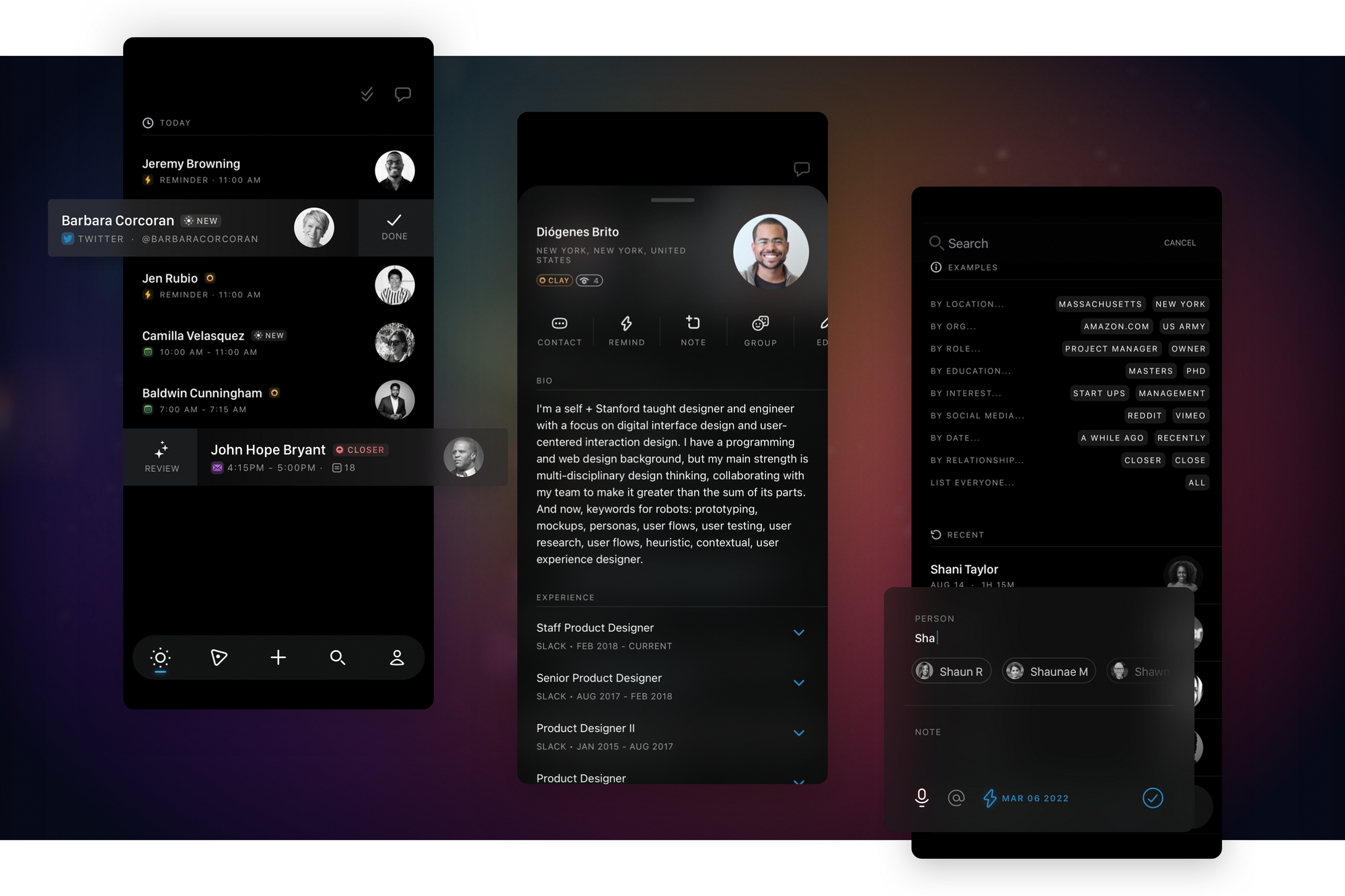
Mesh has native apps for Mac, iOS, iPadOS, Windows, web, and even visionOS. The co-founders come from a design-heavy background, and it shows. The interface is clean and modern, and browsing your contacts feels less like a chore and more like scrolling through something you actually want to use.
5 things that hold Mesh back
Still no Android app in 2026
Mesh works on Mac, Windows, web, iOS, iPadOS, and visionOS. No Android. In 2026, that's a real limitation for a product positioning itself as your relationship hub. The company has clearly prioritized the Apple ecosystem (they even built a visionOS app), but it narrows the audience considerably. If even one person on your team uses Android, the team product breaks down. Our roundup of personal CRMs with mobile apps has cross-platform alternatives.
Organization tools feel half-finished
Mesh has always leaned toward simplicity, which is fine philosophically, but in practice it means lists, tags, and grouping are thin compared to alternatives. If you want a keep-in-touch board where you can visually organize contacts by follow-up cadence, custom fields for tracking specific relationship categories, or structured views beyond basic lists, you'll hit the ceiling quickly.
Mesh lets you add contacts to groups, but the organizational depth stops there. For someone managing a complex network with different categories (investors vs. advisors vs. potential hires vs. existing clients), the lack of structure means you end up doing in your head what the tool should be doing for you.
Mobile app reliability is a problem
The iOS app works, but workflows that feel smooth on desktop get clunky on a small screen. Navigation is cramped, some features don't load reliably, and the overall experience feels like a shrunken desktop app rather than something designed for mobile use.
App Store reviews back this up. One user reported paying $120 for an annual subscription and regretting it because notes weren't syncing to the mobile app and Nexus wasn't working on individual contacts. Another flagged iMessage import failures that couldn't be redone and zero features for automated duplicate resolution, writing that the product was "super buggy and unfocused on its core promise."
Team features are relatively new
Mesh for Teams exists, and on paper the pitch is solid: a shared rolodex with visibility controls, automatic contact syncing across team members, the ability to see who on your team knows a given contact, and HIPAA compliance.
But the team product is newer than the personal CRM, and there's less real-world feedback on how well it works at scale. At $49/seat/month, it's a significant commitment for a small team. If you need proven, mature team CRM features with shared pipelines, deal tracking, and integrations, you're probably better served by a tool built for that from day one. Mesh for Teams is relationship management for groups, not a team sales CRM.
What does Mesh cost in 2026?
Mesh uses a freemium model with three tiers. The free Personal plan lets you search your 1,000 most recent contacts with basic features. The Pro plan costs $10/month when billed annually and unlocks unlimited contacts, full enrichment, reminders, and expanded integrations. Mesh for Teams starts at $49/seat/month.
The Pro plan comes with a 14-day free trial that requires a credit card. If you're a student, educator, or part of a 501(c)(3) nonprofit, Mesh offers three months of Pro for free. Payments are processed through Stripe.
One thing to note: App Store pricing may differ from web pricing. One reviewer reported a $120 annual subscription through the App Store and was unable to get a refund when the app didn't meet expectations. If you're on the fence, start with the free tier on the web and make sure the core features work for your workflow before committing to a paid plan.
What the Automattic acquisition means for Mesh users
In June 2025, Automattic acquired Clay/Mesh. The co-founders and their team of about 30 people joined Automattic's "Other Bets" division, alongside Beeper, Gravatar, Tumblr, and Day One. The acquisition price wasn't disclosed, but Clay had raised $8 million total from a single seed round.
The stated plan is to integrate Mesh with Beeper and build it into an identity layer across Automattic's communication tools. Co-founder Zachary Hamed told TechCrunch they chose Automattic partly because smart address book startups often get acquired and then shut down, and they wanted Mesh to outlast any single company.
The product is actively developed, but if you're picking a personal CRM you'll use for years, that uncertainty is worth weighing. Integration promises are easy to make and hard to keep.
How Mesh compares to other personal CRMs
Mesh does automatic enrichment better than almost any personal CRM on the market right now. If your primary need is contact data that stays current without manual work, and you're on iOS or desktop, it's a strong option. The relationship strength scoring and pre-meeting briefs add real value.
But the gaps are specific and meaningful. No Android. Shallow organization tools. A LinkedIn import that floods rather than filters. Mobile reliability issues. An acquisition that's still fresh. If any of those are dealbreakers, alternatives exist with keep-in-touch boards, cross-platform mobile apps, native email integrations, and AI-powered meeting prep.
For a direct comparison, see our Dex vs. Clay (Mesh) breakdown.
Mesh review: the bottom line
Here's where this Mesh review lands after spending real time with the product.
Mesh gets the hardest part of personal CRM right. Automatic enrichment that keeps your contacts current is the single feature that separates tools people actually use from ones they abandon after a week. Mesh does it better than most. The relationship strength scoring catches fading connections before they go cold. And Nexus, when it cooperates, gives you a faster way to search your network than any filter or tag system.
The team product adds a dimension most personal CRMs don't offer: a shared view of your team's contacts with visibility controls and automatic syncing. For small firms running on relationships rather than pipelines, that's a real differentiator.
The trade-offs are real, though. No Android app rules out a large chunk of potential users. Organization and tagging tools are too thin for anyone managing a complex, multi-category network. The LinkedIn import needs a filter, not a firehose. Mobile reliability issues undermine the promise of an anywhere-access tool. And the Automattic acquisition, while potentially great for long term stability, is fresh enough that the product's direction is still an open question.
If your workflow is desktop-heavy, you're in the Apple ecosystem, and your main goal is keeping contact data current without doing it yourself, Mesh holds up. If you need Android support, structured keep-in-touch workflows, deeper LinkedIn sync controls for large networks, or a more mature team product, the fit breaks down.
To explore your options, check out our roundup for the best personal CRMs in 2026:
Want a personal CRM that works on every device? Try Dex. It syncs up to 9,000 LinkedIn connections, runs on web, desktop, iOS, and Android, and includes AI-powered pre-meeting briefs, keep-in-touch boards, and network mapping.
Frequently asked questions
Is Mesh the same as Clay?
Yes. Mesh (me.sh) was previously Clay (clay.earth) and rebranded in 2026. It's a personal and team CRM for relationship management. Not the same company as Clay.com, which is a B2B sales enrichment platform for GTM teams.
Is Mesh free?
There's a free Personal plan with a 1,000-contact search limit. Pro costs $10/month (billed annually) with a 14-day free trial (credit card required). Teams starts at $49/seat/month. Students, educators, and nonprofits can get three months of Pro free. Check me.sh/pricing for current rates.
Does Mesh have an Android app?
No. Mesh supports Mac, Windows, web, iOS, iPadOS, and visionOS. No Android app as of March 2026.
Who acquired Mesh?
Automattic (the company behind WordPress.com, Beeper, Tumblr, and Day One) acquired Mesh in June 2025. The co-founders and team of about 30 joined Automattic's Other Bets division.
Does Mesh work for teams?
Yes. Mesh for Teams ($49/seat/month) offers a shared rolodex with visibility controls, automatic contact syncing, and the ability to see who on your team knows a given contact. It's SOC 2 and HIPAA compliant. It's built for relationship management, not sales pipelines.
What is Nexus?
Mesh's AI search feature. It lets you query your network using natural language, like "who do I know at Stripe?" or "people I met at CES." Useful but inconsistent, and some users have reported bugs on mobile.
How much does Mesh cost?
Free Personal plan (1,000-contact search limit), Pro at $10/month billed annually (unlimited contacts, full enrichment), and Teams at $49/seat/month (shared contacts, visibility controls). Check me.sh/pricing for the latest.
What integrations does Mesh support?
Mesh connects with Gmail, Outlook, Google Calendar, LinkedIn, Twitter, iMessage, WhatsApp, and Notion. It also supports Zapier and Make for custom integrations with other tools.